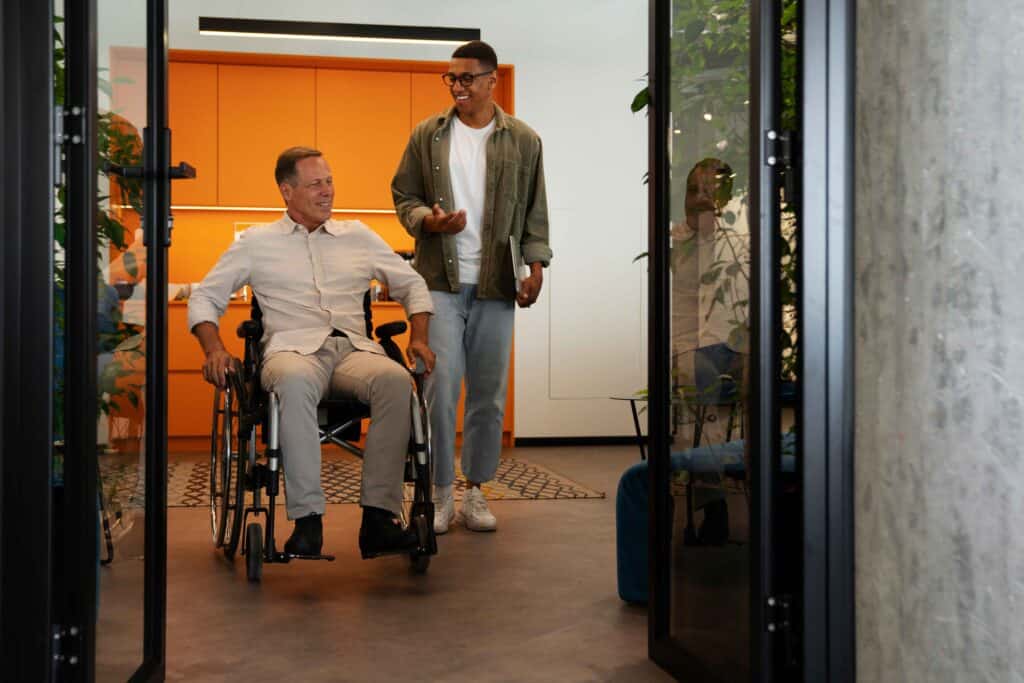
What Is a CASp Inspection?

A CASp inspection is a site evaluation of a commercial property or public accommodation conducted by a Certified Access Specialist, a professional certified by the California Division of the State Architect under Government Code §4459.5. The inspection measures every publicly accessible element of a facility against two overlapping sets of requirements: the Americans with Disabilities Act and the California Building Code Title 24, Chapter 11B. Where the two codes conflict, the CASp applies the stricter standard. California exceeds federal ADA requirements in several categories, including parking slope tolerances, door operating pressure, and restroom fixture specifications.
The inspection produces a written report documenting compliant and non-compliant conditions across the property. When that report is prepared according to the Construction-Related Accessibility Standards Compliance Act (Cal. Civil Code §55.51–55.545), it activates specific litigation protections for the property owner, including Qualified Defendant status.
What Does CASp Stand For?
CASp stands for Certified Access Specialist, a professional certified by the California Division of the State Architect under §4459.5 to evaluate constructed facilities for compliance with state and federal accessibility standards. The certification requires passing a state-administered examination covering both the Americans with Disabilities Act and the California Building Code Title 24, Chapter 11B. No other credential in California carries this dual-code testing requirement. A licensed architect or engineer can evaluate a building for accessibility, but their reports do not activate the litigation protections created under CRASCA. Only a CASp-certified inspector can issue reports that confer Qualified Defendant status on a property owner.
The California Legislature created the CASp program through SB 262 in 2003. SB 1608 expanded it five years later by establishing CRASCA, the statutory framework linking a CASp inspection report to specific litigation protections, including Qualified Defendant status and statutory damage reduction. Before that framework existed, property owners who hired accessibility consultants received recommendations. Nothing more. No statutory standing in court, no damage reduction mechanism, no procedural protections in litigation. A property owner facing a construction-related accessibility claim carried the full $4,000 per-occasion exposure under §55.56 with no mechanism to reduce it. CRASCA is the functional line between a CASp operating inside California’s regulatory system and a general ADA consultant operating outside it.
A CASp evaluates each building element against both the 2010 ADA Standards for Accessible Design and CBC Title 24, Chapter 11B. The two code sets overlap on most requirements but diverge on specific tolerances: California’s code is stricter on parking stall slope gradients, maximum door operating pressure, and restroom fixture dimensions like grab bar placement heights and lavatory knee clearance depths. That is the practical reason dual-code certification exists. When the codes conflict, the CASp documents the stricter requirement as the applicable standard, and that element-by-element analysis is what produces a report detailed enough to hold up under litigation scrutiny.
What Does a CASp Inspection Evaluate?
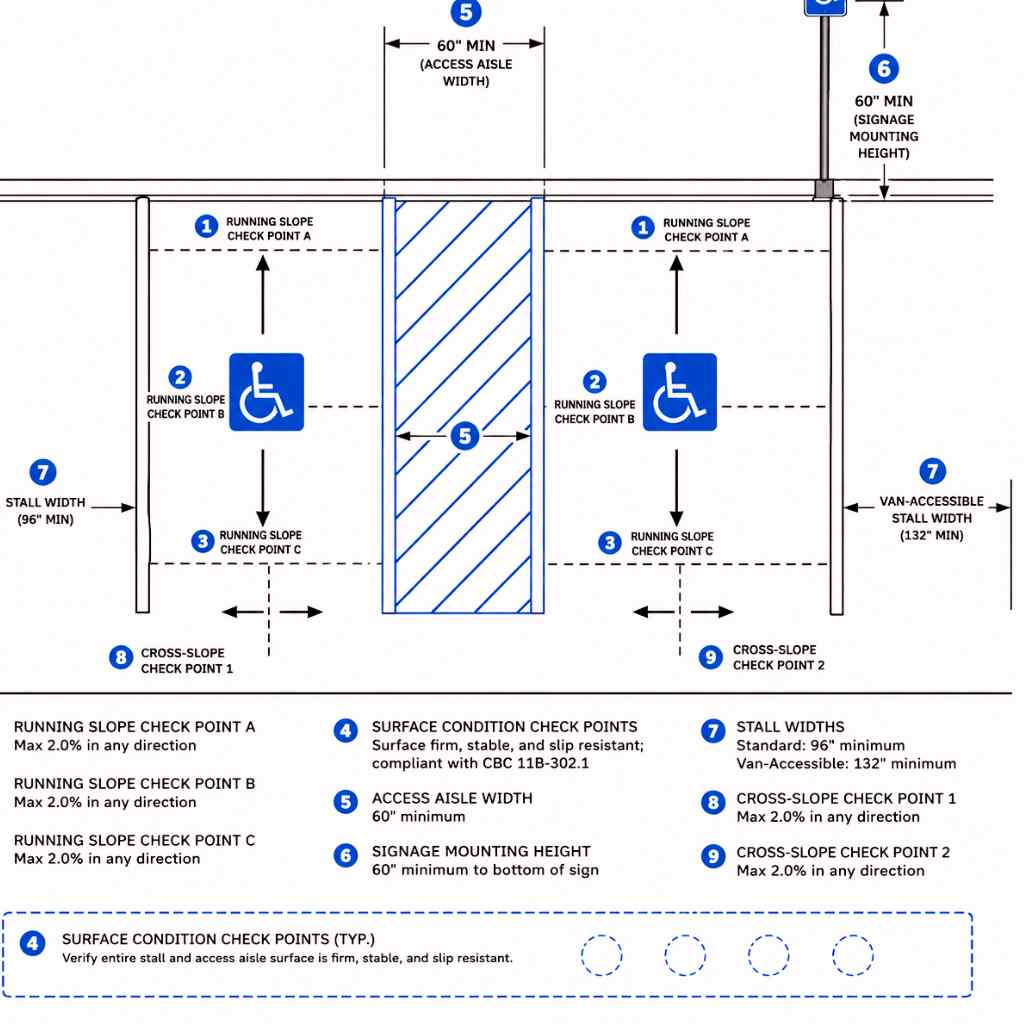
A CASp inspection evaluates every publicly accessible physical element of a facility, with each element individually measured and documented against the applicable code section. The scope follows the path of travel a person with a disability would encounter, from the parking lot through the building interior. Every element along that path is assessed independently.
The inspection scope includes:
- Accessible parking stalls, van-accessible stalls, and loading zones
- Curb ramps and exterior accessible routes including slope and cross-slope
- Building entrances and exits including door hardware, threshold height, and opening pressure
- Interior corridors, hallways, and floor surfaces along the accessible route
- Restrooms including grab bars, toilet centerline, fixture heights, lavatory clearance, and maneuvering space
- Signage and wayfinding including tactile characters, mounting height, and contrast
- Drinking fountains including reach range and knee clearance
- Service counters and dining surfaces including counter height and clear floor space
A single parking stall generates 20 to 40 individual measurements covering running slope, cross-slope, access aisle width, signage height, surface condition, and stall dimensions. A 50-stall commercial lot with four accessible stalls and two van-accessible stalls can produce over 200 data points before the inspector reaches the building entrance. The parking area alone often accounts for a quarter of the total inspection report.
Each restroom generates a comparable measurement load: grab bar placement, toilet centerline distance, flush valve height, lavatory knee and toe clearance, mirror mounting height, door maneuvering clearance, and turning radius. A visual walk-through or checklist-based assessment does not capture this measurement depth, which is why those approaches cannot produce reports that meet CRASCA documentation requirements.
Which ADA Standards Version Applies to My Facility?
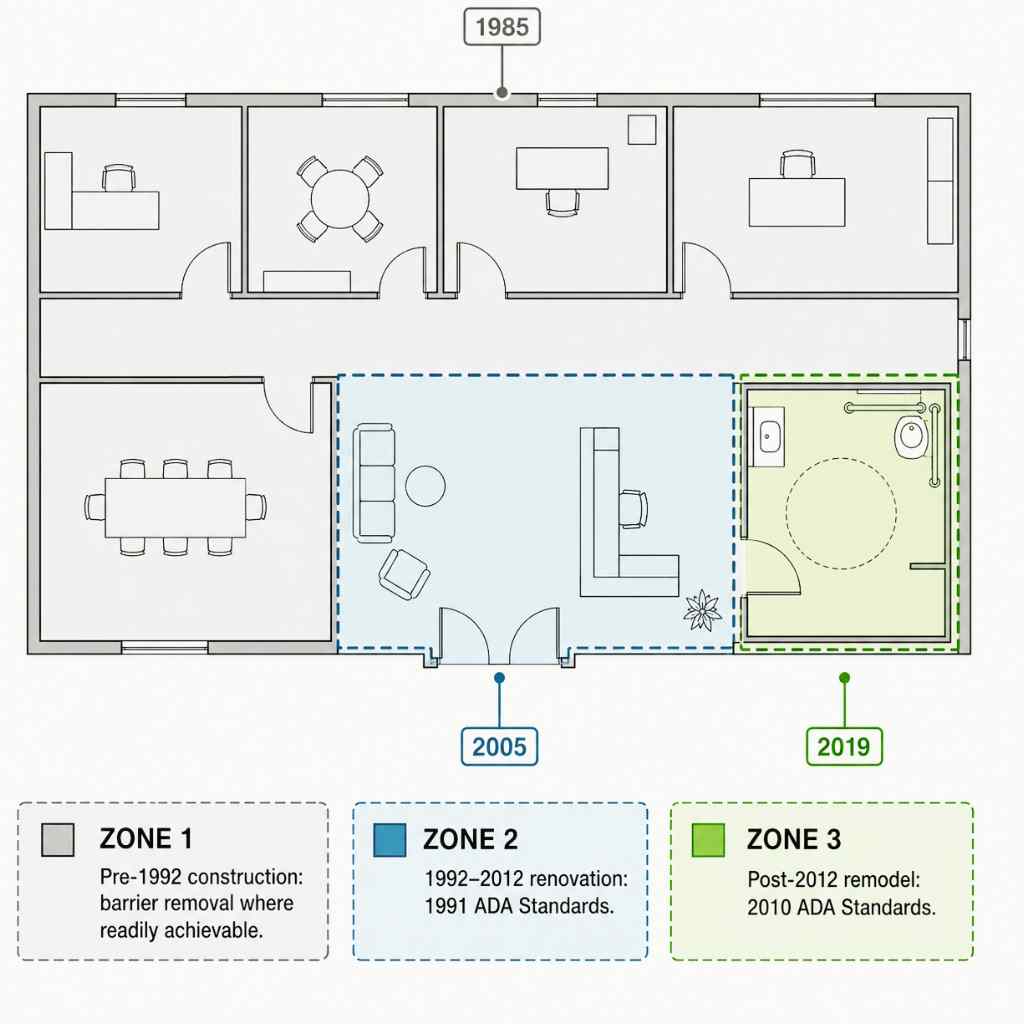
The applicable ADA Standards version depends on the facility’s construction date and renovation history, not the current building code edition. Different areas of the same property can fall under different standards if they were built or renovated during different periods. The oldest category, facilities that predate January 26, 1992, must remove architectural barriers where “readily achievable,” meaning the removal is accomplishable without significant difficulty or expense relative to the business’s size and resources.
The three code-applicability tiers are:
- Facilities built or renovated before January 26, 1992: barrier removal where readily achievable, with no specific ADA Standards edition applied
- Facilities built or renovated between January 26, 1992, and March 14, 2012: compliance with the 1991 ADA Standards
- Facilities built or renovated on or after March 15, 2012: compliance with the 2010 ADA Standards
A property with a 1985 shell, a 2005 lobby renovation, and a 2019 restroom remodel falls under all three tiers at once. General contractors and unlicensed ADA consultants routinely miss this because they apply one code version to the entire property rather than mapping each area to its construction date. A CASp reviews building permits and renovation records to assign the correct standard to each area independently, then flags every element where the applicable ADA version and CBC Chapter 11B conflict. The stricter requirement governs.
What Happens During a CASp Inspection?
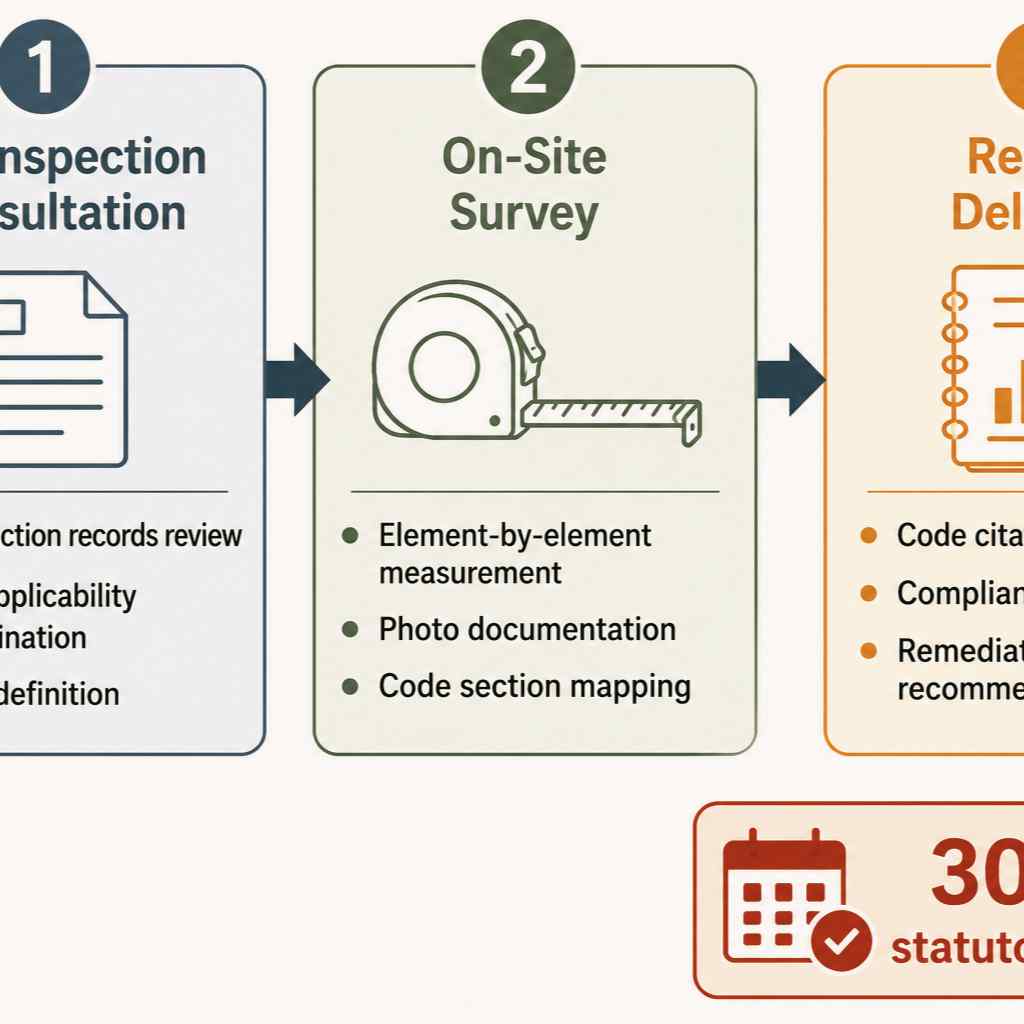
A CASp inspection follows three phases: a pre-inspection consultation, an on-site measurement survey, and report preparation with a statutory delivery deadline. Each phase requires specific preparation from the property owner.
- Pre-inspection consultation: the property owner provides construction records, renovation history, building plans, and any prior inspection reports so the CASp can determine code applicability.
The CASp uses these records to identify which ADA Standards version applies to each area of the property and whether any previous construction triggered a path-of-travel obligation, which requires spending up to 20% of renovation costs on accessibility upgrades along the primary route through the facility. The consultation also defines the scope of work: whether the inspection covers the full site or only the leased premises.
- On-site survey: the CASp measures every accessible element within the defined scope using calibrated tools while photographing and documenting each finding.
Slopes, clearances, heights, reach ranges, and operating pressures are all measured and recorded against the applicable code section. A property representative should accompany the inspector because locked restrooms, restricted tenant spaces, and inaccessible back entrances get documented as “unable to evaluate,” leaving gaps in the report that reduce its value as a CRASCA compliance document.
- Report delivery: the CASp prepares the completed report with code citations, photographs, a compliance schedule, and remediation recommendations.
The report must be delivered within 30 days of the inspection date under Cal. Civil Code §55.53. That deadline is a statutory obligation, not a courtesy timeline. The CASp must also post access inspection notices at the facility on the day of the inspection, and both requirements are prerequisites for CRASCA compliance. A report delivered after the 30-day window can compromise the property owner’s Qualified Defendant status if opposing counsel challenges the timing.
What Does a CASp Inspection Report Include?
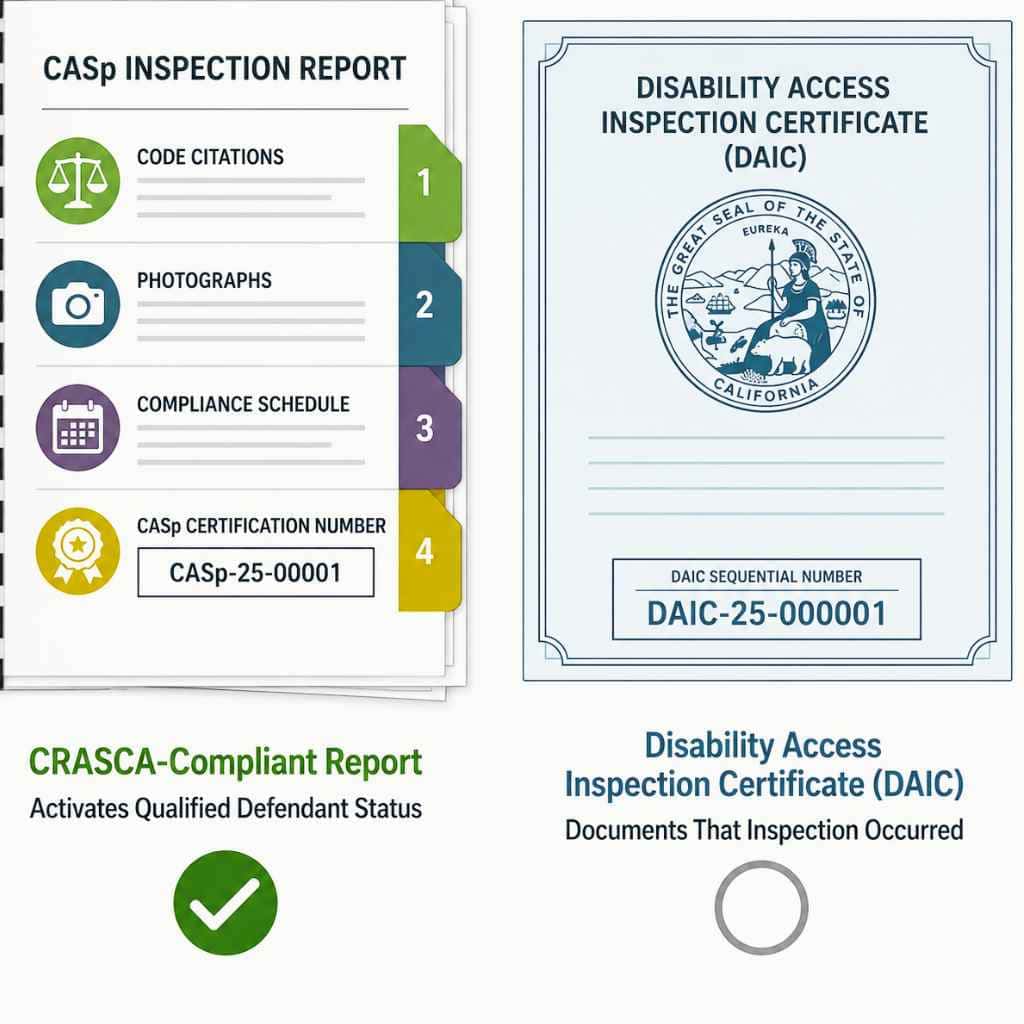
A CRASCA-compliant CASp inspection report must contain specific elements to confer Qualified Defendant status, and the property also receives a separate certificate documenting that the inspection occurred. Missing any required element from the report disqualifies the property from Qualified Defendant protections regardless of whether the certificate is issued.
A CRASCA-compliant report includes:
- Identification of every non-compliant element with the exact ADA or CBC code section violated
- Photographs documenting each finding, tied to the specific code citation
- A compliance schedule specifying the sequence and timeline for barrier removal, prioritized according to 28 C.F.R. §36.304(c)
- Remediation recommendations for each documented violation
- The inspecting CASp’s certification number and certification expiration date
Report quality varies significantly across providers. There is no standardized format for CASp reports, so the completeness of code citations, the specificity of photograph documentation, and the detail of remediation recommendations differ depending on the inspector. A report that omits any required CRASCA element does not confer Qualified Defendant status, even if a DAIC has been issued.
The Disability Access Inspection Certificate is a blue, sequentially numbered certificate bearing the California state seal. The CASp orders it from the state after completing the inspection, and DSA posts the inspection record on its public registry so the property’s inspected status is verifiable. The DAIC documents that an inspection occurred. It does not document what the inspection found. A property owner may receive a report without a DAIC, but the DAIC without a CRASCA-compliant report does not activate Qualified Defendant protections.
What Legal Protections Does a CASp Inspection Provide?
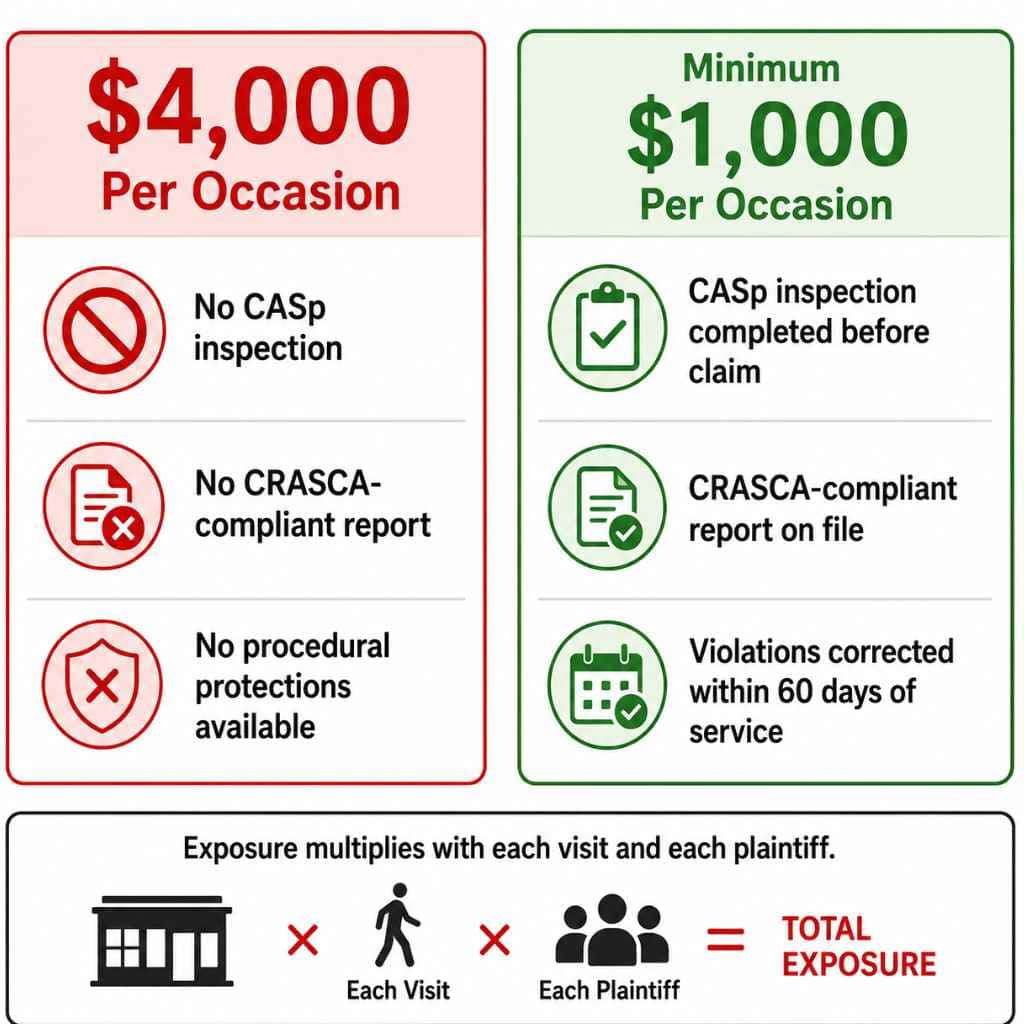
A CASp inspection completed before a lawsuit is filed activates Qualified Defendant status under Cal. Civil Code §55.52, reducing statutory damages from a default of $4,000 to a minimum of $1,000 per occasion. The protection is tied to timing, report compliance, and post-service correction.
The statutory damage framework has two tiers:
- Without Qualified Defendant status, statutory damages under Cal. Civil Code §55.56 are assessed at $4,000 per occasion of denied access
- With Qualified Defendant status, damages may be reduced to a minimum of $1,000 per occasion if all violations forming the basis of the claim are corrected within 60 days of being served
- The Unruh Civil Rights Act under Cal. Civil Code §52(a) provides an independent damages pathway that applies alongside §55.56
- Plaintiff attorney fees are recoverable in construction-related accessibility claims regardless of the property’s Qualified Defendant status
“Per occasion” means per visit where the plaintiff was denied full and equal access. Denial includes encountering the violation, being deterred from entering, or experiencing difficulty or discomfort because of the barrier. Multiple plaintiffs can file separate claims for the same violations on the same property, and the same plaintiff can return and file again for barriers that remain uncorrected. The reduction from $4,000 to $1,000 scales with those visits: a property with three uncorrected barriers visited twice by two separate plaintiffs faces a different exposure calculation than a property with one barrier visited once.
The inspection and CRASCA-compliant report must both be in place before the claim is filed. An inspection obtained after being served carries no retroactive protection for that claim. It does, however, establish protections for any future claims filed against the inspected areas of the property.
What Procedural Protections Does a Qualified Defendant Receive?
Qualified Defendant status provides procedural advantages in court that are separate from the statutory damage reduction framework under §55.52. The stay and conference control the litigation timeline, not the damage amount. Both are established under Cal. Civil Code §55.54.
The procedural protections include:
- A 90-day stay of court proceedings, filed by application, which halts the case while the property owner addresses violations
- A mandatory Early Evaluation Conference held within 35 days of the stay, where a defendant who has corrected all identified violations can present evidence of compliance and request reduction or dismissal of the claim
- A halt on plaintiff fee accumulation during the stay period, preventing the plaintiff’s legal costs from compounding at the defendant’s expense while corrections are underway
- A 120-day grace period from statutory damage liability for qualifying small businesses with 50 or fewer employees, applicable to violations specifically identified in the CASp report
The grace period requires two prerequisites: the CASp report must have been delivered within 30 days of the inspection per §55.53, and the property owner must commit to correcting the identified barriers within the 120-day window. A business that meets the employee threshold but received its report after the 30-day deadline does not qualify. The grace period and the damage reduction under §55.52 are independent mechanisms. A qualifying small business can benefit from both simultaneously, but each has its own activation requirements.
How Does a CASp Inspection Affect Commercial Leases?
Commercial property owners in California must disclose in every lease executed on or after January 1, 2017, whether the premises have been inspected by a CASp. This requirement falls under Cal. Civil Code §1938, as amended by AB 2093. The statute does not require owners to obtain an inspection. It requires disclosure of whether one has occurred. If the property has been inspected and no modifications have altered accessibility compliance since the inspection date, the owner must deliver a copy of the CASp report to the prospective tenant before lease execution. For uninspected properties, the lease must include §1938(e) language notifying the tenant of their right to request an inspection at their expense.
The disclosure carries specific delivery deadlines that are frequently missed. If the CASp report is not provided at least 48 hours before lease execution, the tenant has the right to terminate the lease within 72 hours of signing. Within 7 days of execution, the owner must deliver the current DAIC and any other inspection reports. These deadlines reset with every transaction: each lease renewal, each new tenancy, and each assignment triggers the disclosure and delivery obligations independently, regardless of whether the same report was provided in a prior transaction.
Under ADA Title III, both the landlord and the tenant are legally responsible for accessibility compliance at a commercial property, regardless of how the lease allocates maintenance and repair duties. A lease clause assigning all ADA responsibility to the tenant does not release the landlord from federal liability. Both parties remain defendants in a construction-related accessibility claim, which is why tenants who request a CASp inspection before signing and landlords who have a current report on file both benefit from knowing the property’s documented compliance status before a claim is filed.
How Much Does a CASp Inspection Cost?
A CASp inspection in California typically costs between $750 and $3,500, with the price determined by the property’s physical complexity and the scope of the report. A single-tenant retail storefront with one entrance, one restroom, and a small parking area sits at the lower end of that range. A multi-tenant medical office complex with multiple entrances, accessible routes across several floors, and a large parking structure sits at the higher end. The limited supply of certified CASp inspectors statewide also affects scheduling and pricing in high-demand markets.
Report scope is the other primary cost driver. A CASp 2 report prepared to CRASCA standards requires more detailed code citations, more extensive photograph documentation, and a longer completion timeline than a CASp 1 basic survey. Only the CASp 2 confers Qualified Defendant protections; a CASp 1 documents conditions but does not activate any statutory defense. Several accessibility improvements completed after the inspection qualify for the federal Disabled Access Tax Credit under IRC §44, which can offset a portion of remediation costs.
When Should a California Property Owner Get a CASp Inspection?
The circumstances that make a CASp inspection most relevant share one feature: the property owner’s ability to establish Qualified Defendant status depends on having the inspection and report completed before a claim is filed. That timing constraint is the governing factor. The trigger conditions fall into two categories: situations where a construction-related accessibility claim becomes more likely and situations where a regulatory obligation creates an immediate disclosure or compliance requirement.
The highest-priority trigger conditions are:
- Receiving a demand letter or complaint alleging accessibility violations at the property
- Preparing to execute or renew a commercial lease where §1938 disclosure applies
- Completing a remodel or tenant improvement that triggers a path-of-travel obligation under CBC §11B-202.4, requiring up to 20% of construction cost in accessibility upgrades
- Preparing to sell commercial property where accessibility status affects transaction terms
- Operating any publicly accessible facility that has never been inspected by a CASp
Serial ADA plaintiffs in California target facilities with visible exterior barriers. Non-compliant parking, steep ramps, and missing signage are detectable from the public right-of-way without entering the building, which makes properties with these conditions the most frequently targeted. Retail storefronts, restaurants, medical offices, hotels, gas stations, and strip malls are the most common targets. The targeting is systematic, not random: plaintiffs identify visible violations through drive-by observation and public records, then file against properties whose entrances and parking are publicly accessible from the right-of-way.
Properties that have never been inspected carry the full $4,000 per-occasion exposure under §55.56 with no procedural mechanism to slow or reduce a claim. Qualified Defendant status, the 90-day stay, the Early Evaluation Conference, and the small business grace period are all unavailable without a completed inspection and CRASCA-compliant report.

Written by Emily Johnson
Emily Johnson is a Certified Access Specialist (CASp) Inspector and is passionate about making spaces accessible for all. With over 10 years of experience and degrees in Civil Engineering and Architecture, she inspires others while championing ADA awareness.
RECENT POSTS
CATEGORIES
Get a free quote today!
By clicking “Submit”, you are signing up to receiving emails from us. You can unsubscribe whenever you like. SMS rates may apply.
Want To Know More About ADA Accessibility And How To Get Compliant?
Check out our blog!