What Is the Unruh Civil Rights Act and How Does It Affect ADA Compliance in California?

The Unruh Civil Rights Act is California’s foundational anti-discrimination law for commercial properties, codified at Civil Code §51, guaranteeing full and equal access to every business establishment in the state. The law has applied to every category of business since 1959, with protected classes the California Supreme Court has ruled are illustrative rather than exhaustive. What makes the Unruh Act distinct from the federal Americans with Disabilities Act is a single statutory provision. Civil Code §51(f) treats any ADA violation as an automatic Unruh violation, eliminating the need to prove intentional discrimination for disability access claims. That connection triggers Civil Code §52(a), which imposes a statutory minimum of $4,000 in damages per violation per visit.
No proof of actual injury is required.
California accounts for roughly 42% of all ADA Title III litigation filed nationwide, and the §52(a) damages framework is the primary reason. Property owners who obtain a CASp inspection and meet the correction requirements under Civil Code §55.52 can achieve Qualified Defendant status, reducing statutory damages by 75% and accessing a mandatory litigation stay.
Is Your Property Exposed to $4,000-Per-Violation Liability?
A CASp inspection identifies barriers before a plaintiff does — and can reduce your statutory damages by 75%.
What Is the Unruh Civil Rights Act?
The Unruh Civil Rights Act, codified at California Civil Code §51, is a 1959 anti-discrimination statute that guarantees full and equal access to all business establishments in California, with protected categories the California Supreme Court has ruled are illustrative rather than exhaustive. The law bears the name of Jesse M. Unruh, then Speaker of the California Assembly, who authored the legislation to establish a universal baseline for equal treatment in commercial settings.
Governor Newsom signed a 2024 amendment extending explicit protection to intersectional identity, codifying protections that courts had applied through the illustrative-categories doctrine established in Marina Point (1982). The statute’s reach exceeds every other state public accommodations law because it refuses to limit coverage to enumerated categories, instead applying to all business establishments of every kind.
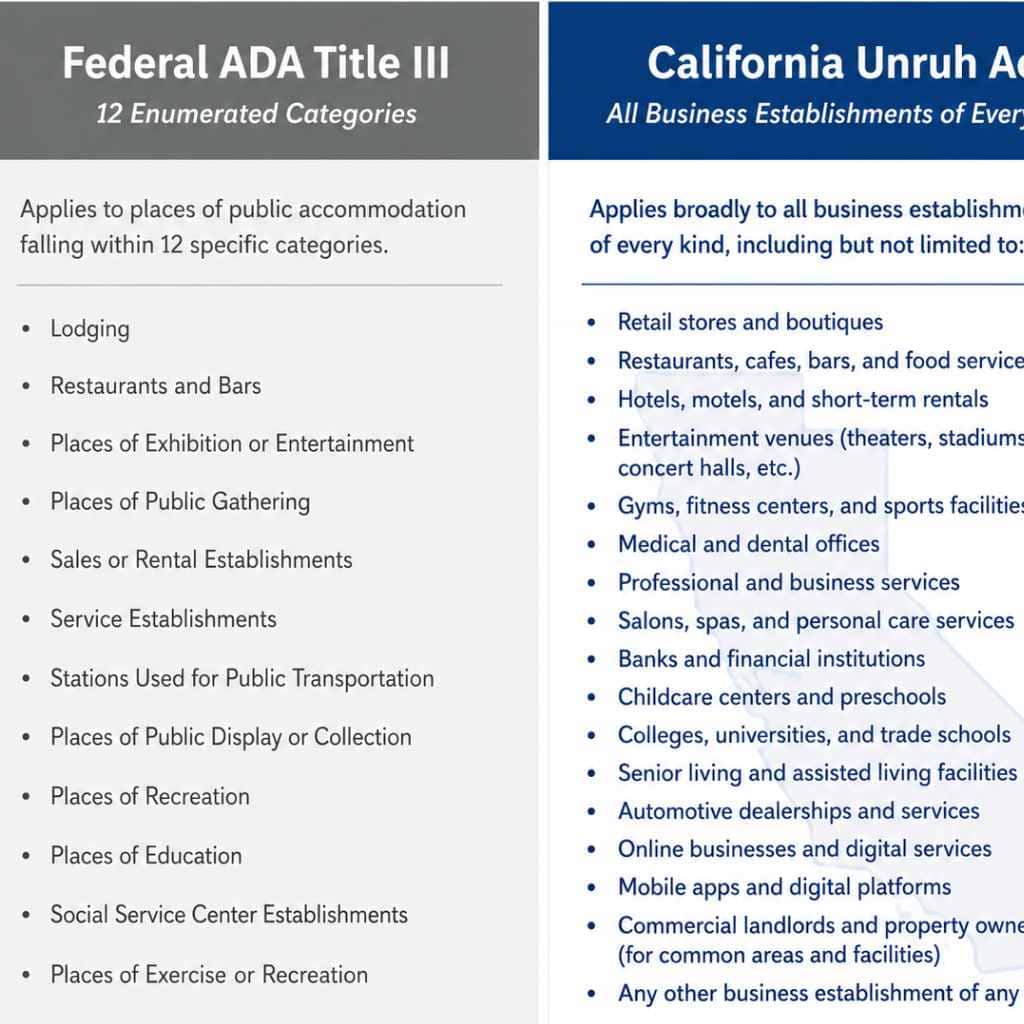
§51(b) guarantees full and equal accommodations in “all business establishments of every kind whatsoever.” The California Supreme Court in Curran v. Mount Diablo Council (1998) interpreted that phrase in the broadest sense reasonably possible, extending coverage well beyond the federal ADA’s 12 enumerated public accommodation categories. A hotel, a medical office, a retail store, and a commercial parking lot all fall within reach. So does any online business selling goods or services to California residents. Where the federal ADA limits its scope to specific listed categories, §51(b) imposes no categorical restriction on which types of businesses qualify.
That list looked finite. It was not. The original 1959 enactment listed six protected categories: sex, race, color, religion, ancestry, and national origin. Marina Point Ltd. v. Wolfson (1982) established that the six categories are illustrative, not exhaustive. The California Supreme Court held that the Unruh Act prohibits all forms of arbitrary discrimination by any California business, including categories the Legislature never named in the original text. Koebke v. Bernardo Heights Country Club (2005) extended that principle to a private country club that denied membership benefits to same-sex couples, confirming that even organizations with selective membership criteria can fall within Unruh coverage when they operate as business establishments.
The Act protects “all persons within the jurisdiction of this state” per §51(b). That language covers California residents, out-of-state visitors, and tourists. No blanket exemption exists for small businesses, older buildings, or any particular property type. A sole proprietorship with three employees faces the same statutory standard as a statewide retail chain. Building age does not create an exemption. Square footage does not create an exemption. The only relevant question is whether the entity operates as a business establishment in California.
How Does §51(f) Connect ADA Violations to Unruh Act Liability?
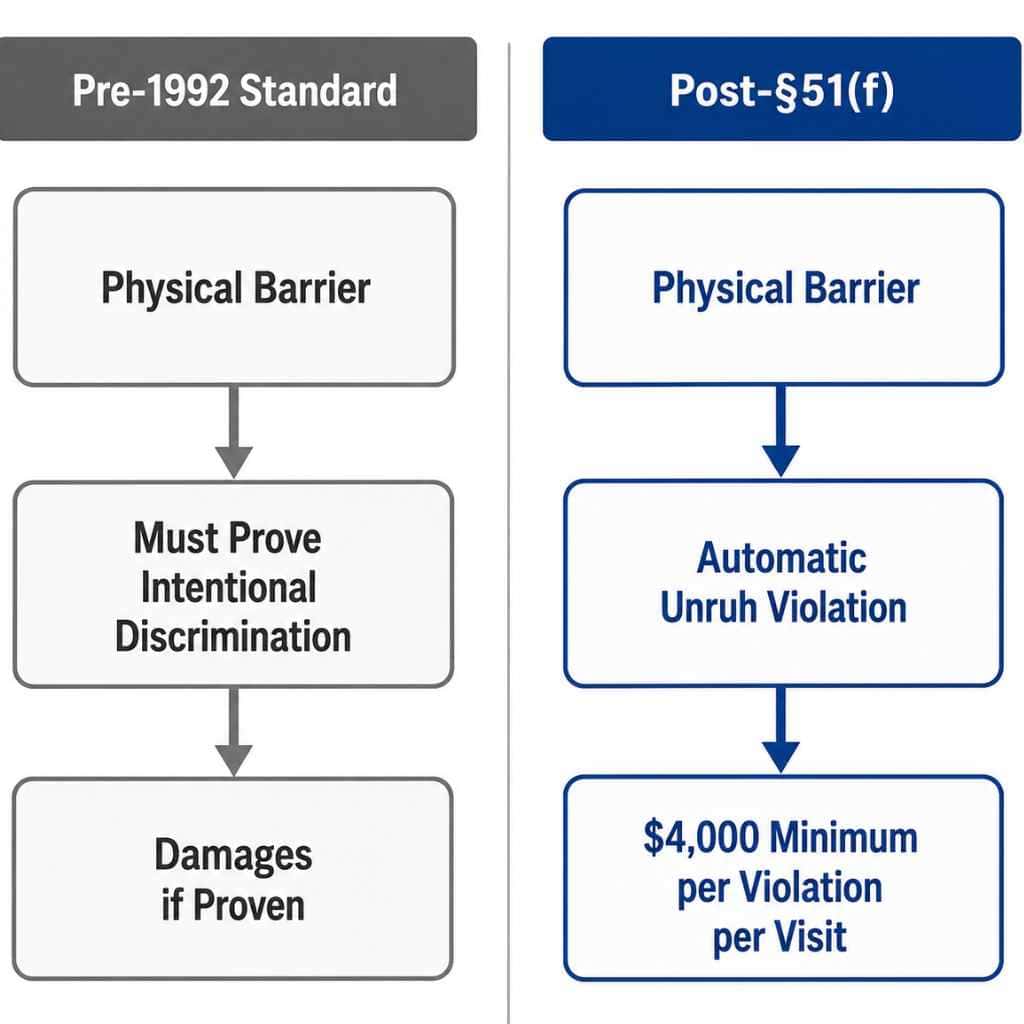
California Civil Code §51(f), added in 1992 by Assembly Bill 1077, makes any violation of the federal Americans with Disabilities Act an automatic violation of the Unruh Civil Rights Act, eliminating the intentional discrimination requirement established in Harris v. Capital Growth Investors XIV (1991) for ADA-based claims. The California Supreme Court confirmed this per se violation standard in Munson v. Del Taco Inc. (2009), holding that a plaintiff bringing an ADA-based Unruh claim does not need to prove the business intended to discriminate. The barrier itself is the violation.
Before 1992, recovering Unruh damages for disability access required clearing a high bar. A plaintiff had to prove the business acted with intentional discrimination under the Harris v. Capital Growth standard, which the California Supreme Court established in a housing discrimination case at 52 Cal.3d 1142. That standard made sense for claims involving refusal of service or discriminatory policies. It made far less sense for a missing grab bar. A barrier that blocks access produces the same result whether the property owner intended discrimination or not.
Assembly Bill 1077 resolved that gap by adding §51(f), which treats any ADA violation as a per se Unruh violation. Slope too steep, counter too high, grab bar missing, doorway too narrow. Intent is irrelevant. The physical condition of the property is the only question.
The distinction matters because §51(f) changes consequences, not technical requirements. A California property owner must meet the same ADA standards under Title III (42 U.S.C. §12182) as a business owner in Texas or Ohio. The 2010 ADA Standards for Accessible Design apply identically in every state.
What differs is what happens when those standards are not met. Under federal ADA Title III alone, a private plaintiff recovers only injunctive relief, a court order requiring the business to fix the barrier. No monetary damages. Under the Unruh Act, that same ADA violation triggers §52(a) statutory damages starting at $4,000 per violation per visit, plus attorney’s fees. The technical standard is federal. The financial consequence is California’s.
Don't Wait For A Lawsuit. Contact Us Today!
What Damages Can a Plaintiff Recover Under Civil Code §52(a)?
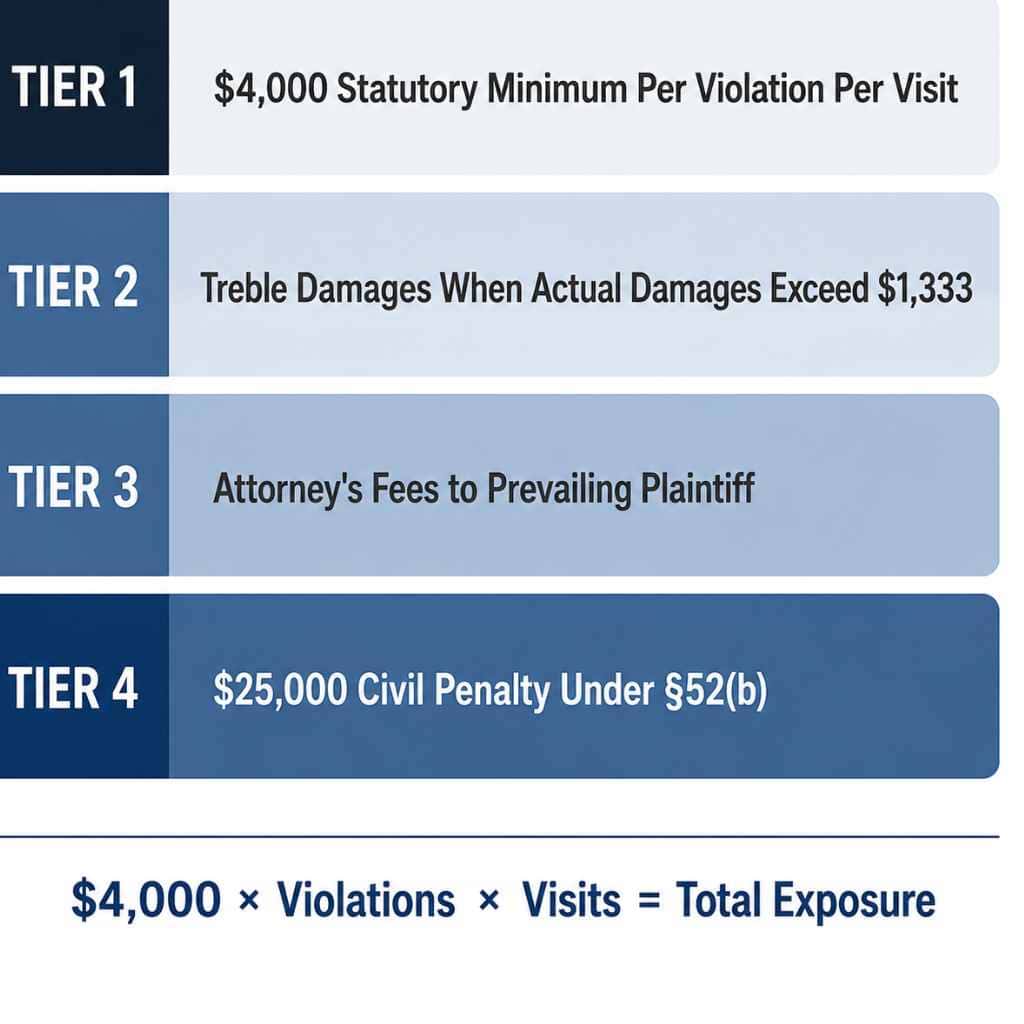
Under California Civil Code §52(a), a plaintiff can recover a statutory minimum of $4,000 per violation per visit regardless of actual injury, up to three times actual damages if actual damages exceed $1,333, plus attorney’s fees, with damages that multiply across barriers and visits.
The §52(a) damages framework operates on a tiered structure:
- $4,000 statutory minimum per violation per visit. No proof of actual injury is required. The California Supreme Court in Koire v. Metro Car Wash (1985) at 40 Cal.3d 24 held that Unruh violations are per se injurious, meaning the violation itself constitutes the harm. A plaintiff does not need to show physical injury, emotional distress, or financial loss to collect the statutory minimum.
- Treble damages when actual damages exceed $1,333. Section 52(a) allows recovery of up to three times actual damages. The $4,000 minimum controls until actual damages cross the $1,333 threshold, at which point treble damages (3 × $1,333 = $3,999) exceed the floor and the higher amount governs. Actual damages under §52(h) include both special damages (quantifiable financial losses) and general damages (non-economic harm such as humiliation or emotional distress).
- Attorney’s fees to prevailing plaintiffs. Fee-shifting runs one direction. A prevailing plaintiff recovers reasonable attorney’s fees from the defendant. A prevailing defendant does not recover fees from the plaintiff unless the court determines the claim was frivolous, unreasonable, or groundless. This asymmetry creates a structural incentive for plaintiff-side filing because the attorney bears no fee risk on meritorious claims.
- $25,000 civil penalty under §52(b). Certain violations carry an additional civil penalty of up to $25,000 per violation, assessed separately from the §52(a) statutory damages. CACI No. 3067 (2026 edition) provides the jury instruction framework courts use to calculate total Unruh damages across all tiers.
Damages compound through a per-violation-per-visit multiplication formula. A property with three ADA barriers visited on two separate occasions generates six individual violation events. At the $4,000 statutory minimum, that produces $24,000 in damages before attorney’s fees.
Feezor v. Del Taco (S.D. Cal. 2005) confirmed that per-visit damages calculations apply even when the barriers remain unchanged between visits. Each visit resets the damages clock. A plaintiff returning to document the same three barriers a third time adds another $12,000. The total does not stay fixed. It increases with every documented visit.
Which Businesses Does the Unruh Act Cover?
The Unruh Act covers all business establishments of every kind in California, including hotels, restaurants, retail stores, medical offices, commercial landlords, and online businesses selling to California residents, with no size threshold, no building-age exemption, and only narrow exceptions for certain non-commercial entities.
Coverage extends to business types that property owners rarely expect. An e-commerce company headquartered in another state but selling to California customers meets the statutory definition. So does a multi-tenant commercial property where the building owner has never operated a public-facing business from the premises. The phrase “business establishments of every kind whatsoever” in §51(b) is not aspirational language. The California Supreme Court in Curran v. Mount Diablo Council (1998) treated it as a functional definition with no categorical exclusions.
Courts have extended coverage to private clubs that function as business establishments. Koebke v. Bernardo Heights Country Club (2005) held that a country club operating dining, recreation, and event services could not claim exemption based on its membership structure alone.
Property ownership and business operation create separate liability tracks. Both building owners and business tenants face joint and several liability under the Unruh Act, meaning a plaintiff can name either or both in the same lawsuit. A commercial landlord who leases space to a restaurant does not transfer Unruh liability to the tenant by signing the lease. The landlord retains liability for building-level access barriers, while the tenant carries liability for conditions within the leased space. One property, two defendants.
The boundaries of Unruh coverage are narrow, and courts have drawn them tightly. In Curran, the Boy Scouts of America argued that its selective membership process placed it outside the Unruh Act’s reach. The California Supreme Court rejected that argument, holding that an organization providing recreational programs, camping facilities, and structured activities to the public operates as a business establishment regardless of its membership screening.
That ruling established the functional test courts still apply. If the organization provides goods, services, or facilities to the public, membership selectivity alone does not create an exemption. Religious institutions that do not provide goods or services to the general public occupy one of the few remaining carve-outs. A business may refuse service based on an individual’s documented conduct, but not based on membership in any protected class or any class the court determines the Act covers under the illustrative-categories doctrine. A blanket policy used as a proxy for excluding a protected class does not meet that standard.
How Does the Unruh Act Differ from the Federal ADA?
The Unruh Act differs from the federal ADA in five critical dimensions: it provides monetary damages where the ADA provides only injunctive relief, applies to a broader definition of business establishments, requires no pre-suit notice, has more lenient standing requirements, and allows a three-year statute of limitations compared to the ADA’s two years. Most California ADA cases are filed in federal court, where California’s state-court procedural protections are generally not recognized. The Unruh Act also differs from the California Disabled Persons Act (Civil Code §§54–55.32), which provides an independent statutory basis for disability access claims with its own damages structure.
| Dimension | Federal ADA Title III | California Unruh Act |
|---|---|---|
| Private plaintiff remedies | Injunctive relief only (42 U.S.C. §12188(a)(1)). No monetary damages. | §52(a) statutory damages: $4,000 minimum per violation per visit, plus attorney’s fees. |
| Scope of covered entities | 12 enumerated public accommodation categories. | “Business establishments of every kind whatsoever.” No categorical limit. |
| Standing requirement | Demonstrated intent to return to the business. Tester standing broadened in Ninth Circuit per Langer v. Kiser (2023). | More lenient standing. No intent-to-return requirement for all claim types. |
| Statute of limitations | Two years. | Three years. |
| Pre-suit notice | Not required under federal law. | Not required under current California law. SB 84 (2025) proposed pre-suit notice for certain claims. [NEEDS SOURCE: verify SB 84 status.] |
| Court venue and procedural protections | Federal court. Full ADA procedural framework applies. | State court offers CASp-based litigation stay and early evaluation conference. Federal court exercises pendent jurisdiction over Unruh claims but generally does not recognize these protections. |
The remedies gap between the two frameworks explains why California generates a disproportionate share of ADA litigation. Under ADA Title III alone, a private plaintiff who proves an access barrier recovers only injunctive relief, a court order requiring the business to remove the barrier. No check is written. Under the Unruh Act, that identical barrier triggers §52(a) statutory damages starting at $4,000 per violation per visit plus attorney’s fees.
A plaintiff filing in California recovers money. A plaintiff filing the same claim in a state without an Unruh-equivalent statute recovers a court order. That single disparity is the primary reason California accounts for roughly 42% of all federal ADA Title III filings nationwide.
The procedural differences compound the remedies gap.
Federal ADA standing requires a plaintiff to demonstrate intent to return to the business, though Langer v. Kiser (2023) broadened tester standing in the Ninth Circuit by holding that a tester who encounters a barrier has standing even without plans to return as a customer. The Unruh Act provides more lenient standing and a three-year statute of limitations compared to two years under the ADA. That extra year matters. Current California law imposes no blanket pre-suit notice requirement, though SB 84 (2025) has proposed requiring pre-suit notification for certain construction-related accessibility claims. [NEEDS SOURCE: verify SB 84 current status.]
Where a case is filed matters as much as what claims it contains. Most California ADA cases land in federal court, where courts exercise pendent jurisdiction over state Unruh claims but generally do not recognize California’s state-court procedural protections. The CASp-based 90-day litigation stay and early evaluation conference that protect defendants in state court are typically unavailable in federal proceedings.
The California Disabled Persons Act (Civil Code §§54–55.32) creates a third enforcement path that operates independently of both ADA Title III and the Unruh Act. The CDPA does not require an ADA violation as a predicate. It stands alone. A property condition that violates California Building Code Chapter 11B but technically complies with federal ADA standards still supports a CDPA claim under §54.3, which carries a $250 minimum per violation plus actual damages and attorney’s fees.
A plaintiff can file under all three statutes simultaneously from the same set of barrier conditions. Damages are not stackable for the same violation across statutes, but each statute covers conditions the others may not reach. The practical result is three overlapping enforcement frameworks, each with different triggers, different damages, and different procedural rules, all applying to the same California property at the same time.
What Is Serial ADA Litigation and How Does California Address It?
Serial ADA litigation in California involves individual plaintiffs filing dozens to thousands of lawsuits per year targeting minor technical violations for statutory damages. California enacted procedural guardrails through SB 1608 (2008), SB 1186 (2012), AB 1521 (2015), and SB 269 (2016), including high-frequency litigant classification, additional filing fees, and CASp-based litigation stays, though most of these protections are not recognized in federal court.
California recorded 3,252 federal ADA Title III filings in 2024, and a small number of individual plaintiffs account for a disproportionate share. The California Commission on Disability Access (CCDA) reports this concentration pattern annually, though exact plaintiff-level breakdowns shift between reporting periods. One plaintiff, Orlando Garcia, filed more than 800 accessibility lawsuits before courts began scrutinizing the merit of his claims. The volume follows a calculated pattern.
Serial plaintiffs calibrate demand letters between $10,000 and $20,000. That range sits below the cost of mounting a litigation defense, which typically runs $50,000 to $100,000 or more through trial. That calculation is the foundation of the settlement-pressure model. Businesses face a straightforward cost comparison regardless of how minor the underlying violation may be.
California built its legislative response across four bills between 2008 and 2016. SB 1608 (2008) introduced the CASp-based litigation framework. SB 1186 (2012) created the high-frequency litigant classification under CCP §425.55(b), defining a high-frequency litigant as any plaintiff filing 10 or more accessibility complaints in a 12-month period. That classification triggers a $1,000 additional filing fee per case and a mandatory written explanation of the basis for each visit to the property. AB 1521 (2015) and SB 269 (2016) strengthened the early evaluation conference process and expanded eligibility for the 90-day litigation stay for defendants holding a CASp inspection report.
Those protections work in state court.
They largely do not work in federal court, where most California ADA cases are actually filed. Federal courts exercise pendent jurisdiction over state Unruh claims but generally refuse to apply California’s high-frequency litigant rules, the additional filing fee, or the CASp-based stay. A defendant whose property has a current CASp report and who would qualify for every state-court protection can find those protections unavailable simply because the plaintiff chose federal court. The legislative guardrails exist. The jurisdictional gap determines whether they apply.
Our DSA-certified inspectors cover your entire property.
How Does CASp Inspection Create Qualified Defendant Status?
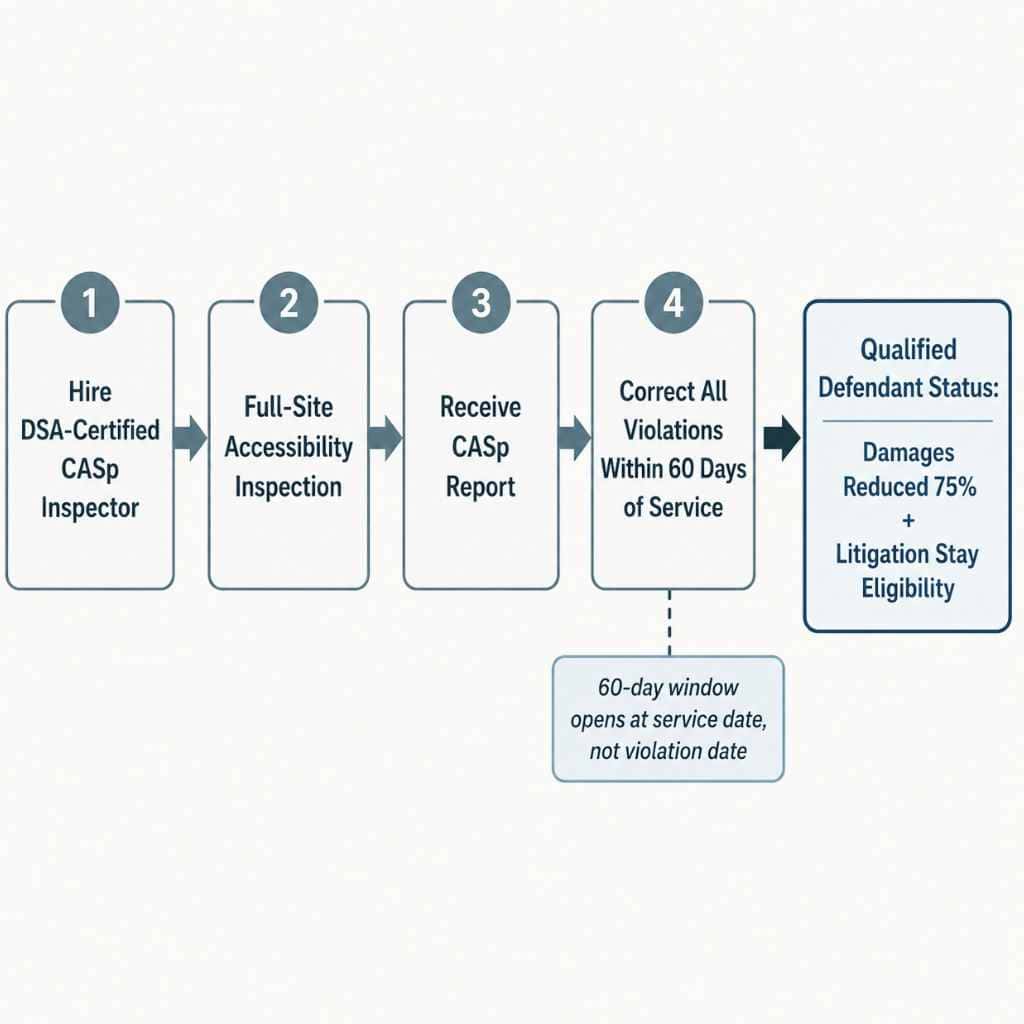
A California property owner who obtains a CASp inspection and meets the correction requirements under Civil Code §55.52–55.56 achieves Qualified Defendant status, which reduces statutory damages from $4,000 to $1,000 per occasion, a 75% reduction. That status also triggers a mandatory 90-day litigation stay and early evaluation conference, and was the basis for a summary judgment that resulted in full attorney’s fee recovery from a serial plaintiff.
The qualification pathway follows four steps, each governed by §55.52–55.56 and tied to the Division of the State Architect (DSA) CASp certification program.
- Hire a DSA-certified CASp inspector to conduct the evaluation.
- Complete a full-site accessibility inspection covering all public-facing areas of the property.
- Receive the CASp report documenting observed conditions against California Building Code Chapter 11B and the 2010 ADA Standards for Accessible Design.
- Correct all identified violations within 60 days of being served with a complaint.
Step four is where most property owners misread the framework. The 60-day correction window opens after a lawsuit is filed, not before. A property owner who receives a CASp report, sets it aside, and later gets served with a complaint still has 60 days from the date of service to complete remediation and access Qualified Defendant protections. That post-filing window means the CASp report does not need to exist at the time of the violation. It needs to exist at the time of service.
Qualified Defendant status reduces statutory damages from $4,000 to $1,000 per occasion under §55.52. That 75% reduction applies to every violation listed in the complaint. The property also becomes eligible for a mandatory 90-day stay and early neutral evaluation conference in state court, creating a structured window to remediate barriers and resolve the case before full litigation costs accumulate. These protections apply in state court proceedings. Federal courts exercising pendent jurisdiction generally do not recognize the CASp-based stay or ENE process.
Garcia v. Zarco Hotels demonstrates how Qualified Defendant status functioned as an affirmative defense in a serial litigation case. The Hollywood Hotel carried a current CASp report when it was targeted by a serial plaintiff responsible for more than 800 accessibility lawsuits. The hotel moved for summary judgment on the grounds that its CASp report and remediation history demonstrated compliance.
The court granted summary judgment. It found the lawsuit frivolous, unreasonable, and groundless. The hotel recovered $57,604.90 in trial-level attorney’s fees plus $84,980.00 on appeal. The total recovery of $142,584.90 was assessed against a plaintiff the court determined had filed a claim without legal merit.
Does the Unruh Act Apply to Website and Digital Accessibility?
California courts have extended the Unruh Act to websites and mobile applications operated by businesses selling to California residents, referencing WCAG 2.1 AA as the de facto compliance standard with WCAG 2.2 AA gaining traction in more recent decisions. Digital accessibility claims are now filed alongside traditional physical-barrier cases under the same Unruh Act framework.
The Ninth Circuit’s decision in Robles v. Domino’s Pizza (2019) established the foundational precedent for digital accessibility litigation in California. The court held that Domino’s website and mobile app qualified as extensions of its physical restaurant locations, rejecting the argument that ADA Title III applies only to physical spaces. That ruling applied the nexus test: whether the website connects to a brick-and-mortar establishment where goods or services are provided. Subsequent cases have extended coverage further, with some courts holding that purely online businesses selling to California residents qualify as business establishments under §51(b) even without a physical location in the state. [NEEDS SOURCE: identify a pure state-law Unruh digital claim case to supplement the Ninth Circuit ADA framework established in Robles.] The jurisdictional question is the same for digital claims as for physical access: whether the business operates as a place of public accommodation for California consumers.
WCAG 2.1 AA remains the most widely referenced standard in court decisions involving digital Unruh claims. WCAG 2.2 AA, published by the World Wide Web Consortium in late 2023, is gaining traction as courts and regulators update their benchmarks.
The most common violations triggering digital accessibility claims are specific and testable. Missing alternative text on images prevents screen reader users from interpreting any visual content on the page. Inaccessible forms prevent keyboard-only users from completing transactions. Navigation structures that require a mouse exclude users who rely on assistive technology.
The DOJ’s 2024 ADA Title II rule established WCAG 2.1 AA as the enforceable standard for state and local government websites under 28 C.F.R. §36.303, and while that rule applies to public entities rather than private businesses, it signals the direction federal enforcement is moving. Mobile applications face the same standards. An app that sells goods or services to California residents carries the same Unruh Act obligations as the website it mirrors.
What Steps Should a California Business Owner Take After Receiving an Unruh Act Claim?
A California business owner served with an Unruh Act claim should immediately preserve evidence, determine whether Qualified Defendant status applies, and begin remediating identified barriers within the 60-day correction window under §55.54. The correction window, the litigation stay, and the early evaluation conference all operate on statutory timelines that start running at the date of service.
Two decisions govern everything that follows. Does a CASp inspection report already exist for the property, and does the plaintiff qualify as a high-frequency litigant under CCP §425.55(b)?
- Preserve all evidence of current property conditions, including photographs, maintenance records, and any prior accessibility assessments.
- Verify whether a CASp inspection report exists for the property and confirm its currency.
- Determine whether the plaintiff qualifies as a high-frequency litigant under CCP §425.55(b) by filing 10 or more accessibility complaints in 12 months.
- Evaluate the CRD administrative complaint pathway as a parallel track, since a complainant may also file with the California Civil Rights Department, which investigates and issues a Right to Sue letter.
- ADA defense counsel with specific experience in Unruh Act claims is typically engaged at this stage to evaluate procedural options and available defenses.
- Begin correcting identified barriers to meet the 60-day remediation window under §55.54 and preserve eligibility for Qualified Defendant damage reduction.
The CRD pathway requires separate attention. A complainant can file an administrative complaint with the California Civil Rights Department (formerly DFEH) instead of or alongside a direct court action. The CRD investigates and mediates, then either resolves the complaint or issues a Right to Sue letter. Defendants should confirm early whether a CRD complaint exists, because the administrative and court tracks can run simultaneously and produce different procedural obligations.
The defenses available depend on the specific facts of the claim and the property’s pre-filing documentation.
Common defenses fall into four categories. Incorrect party applies when the defendant does not own, operate, or control the property where the alleged violation occurred. The readily achievable defense under ADA Title III argues that barrier removal was not achievable without significant difficulty or expense, assessed against the business’s size, resources, and the nature of the modification. Standing challenges argue that the plaintiff lacks demonstrated intent to return to or use the services of the business. Langer v. Kiser (2023) broadened tester standing in the Ninth Circuit, complicating this defense.
Statute of limitations bars any claim filed more than three years after the discriminatory event under the Unruh Act or more than two years under the ADA. A defendant holding a CASp report obtained before the lawsuit was filed has access to the full range of procedural protections. That includes Qualified Defendant damage reduction, eligibility for the 90-day stay and early evaluation conference in state court, and documented compliance efforts that support a summary judgment motion.

Written by Emily Johnson
Emily Johnson is a Certified Access Specialist (CASp) Inspector and is passionate about making spaces accessible for all. With over 10 years of experience and degrees in Civil Engineering and Architecture, she inspires others while championing ADA awareness.
RECENT POSTS
CATEGORIES
Get a free quote today!
By clicking “Submit”, you are signing up to receiving emails from us. You can unsubscribe whenever you like. SMS rates may apply.
Want To Know More About ADA Accessibility And How To Get Compliant?
Check out our blog!