Top 10 ADA Violations That Trigger California Lawsuits

Ten construction-related accessibility violations account for more than two-thirds of all ADA lawsuits filed in California each year. The California Commission on Disability Access (CCDA) tracks these violations through mandatory complaint data reported under Senate Bill 1186, producing a ranked list of the most frequently alleged deficiencies at places of public accommodation statewide. Parking and exterior path violations dominate the list because they are visible and documentable from the street without entering the building.
Each violation triggers liability under both Title III of the ADA at the federal level and the Unruh Civil Rights Act at the state level, where property owners face a minimum of $4,000 in statutory damages per occasion of denied access under Civil Code §52(a). No other state replicates that penalty structure. For commercial property owners and business operators, a CASp inspection documents existing conditions and identifies which of these violations are present on a property before a claim is filed. When multiple violation categories appear on the same property, the per-occasion statutory exposure compounds across each one.
Why California ADA Violations Cost More Than Any Other State
Every ADA violation in California automatically triggers a separate Unruh Civil Rights Act claim under Civil Code §51(f), exposing property owners to a minimum of $4,000 in statutory damages per plaintiff visit plus one-way attorney fee recovery. No other state attaches state-law monetary damages to every federal ADA violation by operation of statute. Under federal law, Title III limits plaintiffs to injunctive relief and attorney fees. California layers the $4,000 statutory floor on top of that federal claim under §52(a), and each plaintiff visit counts as a separate occasion under §55.56(e).
A serial plaintiff who visits a non-compliant property three times creates $12,000 in minimum statutory exposure before attorney fees are calculated. That math is why California leads the nation in ADA filings. Both property owners and tenants operating places of public accommodation carry independent liability under 42 U.S.C. §12182(a), so a commercial tenant can be sued for violations on leased premises even when the landlord controls the building’s physical condition. Federal courts have reinforced this system by upholding tester standing, confirming in Langer v. Kiser (9th Cir. 2023) that a plaintiff does not need to intend to use a business’s services to file a valid ADA claim.
California accounts for roughly 40% of all ADA litigation filed nationwide despite representing about 12% of the nation’s disabled population. The CCDA reported over 4,300 construction-related accessibility complaints during its most recent full reporting period, with the top 10 plaintiff law firms responsible for 95.8% of all submissions. Those firms run systematic case-generation operations, sending investigators to document violations at strip malls, medical offices, and restaurants along high-traffic commercial corridors. Settlement demands in these cases typically land between $10,000 and $20,000, a range calibrated below the cost of mounting a full defense. Most property owners settle regardless of whether the claim has merit, because the economics of litigation make fighting a $15,000 demand more expensive than paying it.
Where the CCDA Violation Data Comes From
The CCDA compiles its top 10 violation list from copies of legal complaints and demand letters that plaintiff attorneys submit under the mandatory reporting requirements of Civil Code §55.32, enacted through SB 1186 in 2012. Every attorney who files a construction-related accessibility claim or sends a demand letter in California is required to submit a copy to the CCDA. The commission tabulates these submissions quarterly and categorizes each alleged violation across six location categories: parking, accessible route and entry, toilet rooms and bathrooms, access within a public facility, equipment within a public facility, and general alleged violations.
Parking ranks first in every published period. It consistently accounts for over 30% of all alleged violations, which tracks with how serial plaintiffs operate: parking deficiencies require no building entry to identify.
The CCDA data is useful but incomplete. It captures only complaints from attorneys who comply with the §55.32 reporting requirement, not every ADA case filed in California state and federal courts. The statute does not specify penalties for non-reporting, so the actual volume of filed claims is higher than the dataset reflects. The data also draws no distinction between new construction and existing buildings, or between property types. A parking violation at a 1970s strip mall and one at a 2023 medical office appear as the same line item. The list functions as a frequency index of what gets alleged most often, not a comprehensive count of every accessibility deficiency statewide.
Non-Compliant Counter and Surface Heights
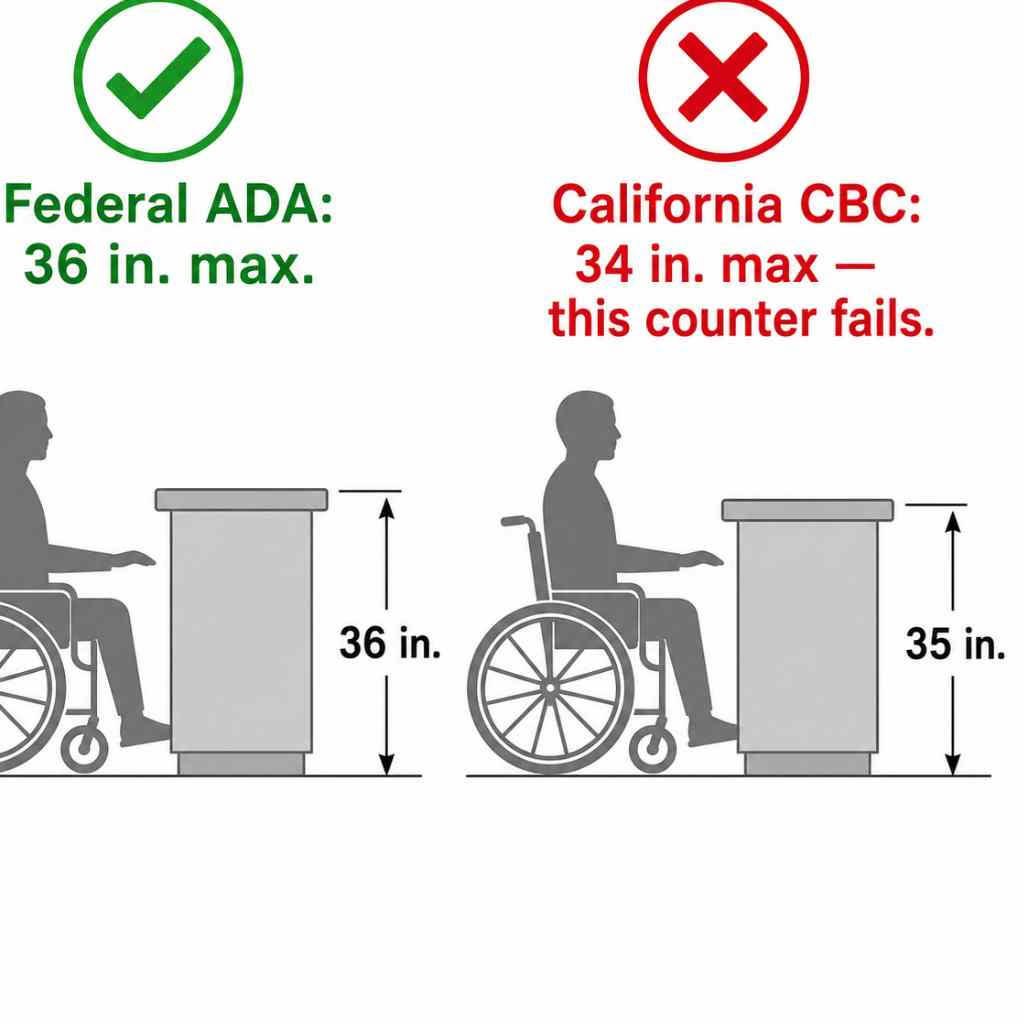
Non-compliant counter and surface heights are the most frequently alleged ADA violation in California, accounting for 21% of all construction-related complaints in the CCDA dataset. The reason is a 2-inch gap between federal and state standards. Standard commercial counters ship from manufacturers at 42 inches. The federal ADA requires a lowered service section at 36 inches maximum under 2010 ADA Standards §904.4.1. California drops that threshold to 34 inches under CBC 11B-904.4.1. A business that installs a counter at 35 inches passes federal inspection but violates California code from the day the doors open. Contractors and equipment suppliers design to the ADA standard and stop there, which is why this violation is built into properties at construction rather than developing over time.
The violation is not limited to front-desk counters. Every surface where a transaction or service occurs carries the same 34-inch CBC ceiling.
Restaurants face a compounding version of this problem. Accessible dining surfaces are required for each type of seating in a functional area under CBC 11B-226.2. A restaurant with booths, standard tables, bar-height tables, and patio seating must provide 5% accessible seating within each category separately. The federal standard allows a business to satisfy the 5% requirement with accessible seating concentrated in a single type. Retail checkout counters, pharmacy windows, and hotel front desks all fall under the same CBC 11B-904.4.1 maximum. The Ninth Circuit addressed counter accessibility directly in Antoninetti v. Chipotle Mexican Grill, holding that a service counter must allow a wheelchair user to see food preparation, not merely complete a transaction at a lowered payment surface.
Exterior Path of Travel Failures
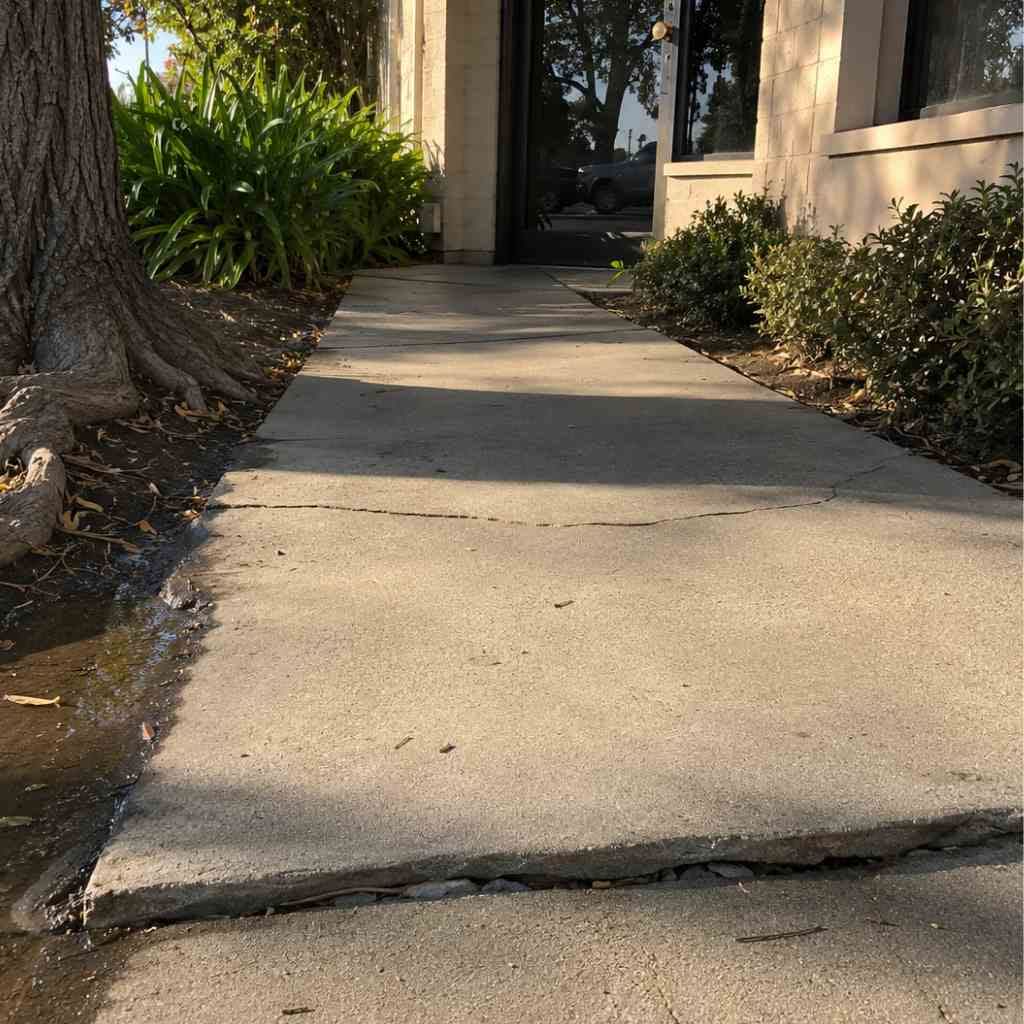
Exterior path of travel violations account for approximately 16% of all CCDA-reported complaints, combining two ranked categories: pathway conditions at 11% and door hardware at 5%. The accessible route from parking lot or public right-of-way to the building entrance must maintain a cross slope of 2% maximum (1:48 ratio) and a stable, firm, slip-resistant surface with no vertical discontinuities exceeding ¼ inch under CBC 11B-403.3. Door hardware on the same route carries its own set of requirements under CBC 11B-404. Every deficiency below is measurable with a digital level, a tape measure, and a force gauge, which is why plaintiffs can document an entire exterior route in a single visit:
- Cracked pavement, tree-root uplift, potholes, and uneven concrete panel transitions that create surface discontinuities above ¼ inch
- Cross slopes exceeding 2% due to asphalt settling, thermal expansion, or subgrade compaction, often without visible surface damage
- Missing or non-compliant curb ramps at vehicular crossings along the accessible route
- Round door knobs on accessible routes where lever-operated or U-shaped handles are required
- Exterior door thresholds exceeding the ½-inch maximum height
- Doors requiring more than 5 pounds of opening force, or closing faster than the 5-second minimum from 90 degrees to 12 degrees
- Insufficient maneuvering clearance at door approaches, blocking wheelchair positioning for independent operation
These deficiencies share a pattern that separates them from counter height violations: they worsen over time. A path that measured compliant at original construction can exceed 2% cross slope within a few years as subgrade material compacts beneath the surface. Door closers stiffen and hinges corrode. Thresholds shift with settling. A property that passed its initial CASp review can fall out of compliance without any visible change to the building itself. Any alteration that affects the accessible route also triggers the path-of-travel 20% rule under CBC 11B-202.4, which caps the upgrade obligation at 20% of the alteration’s construction cost.
Parking Lot Violations That Drive 30% of All Complaints
Parking-related violations account for over 30% of all construction-related accessibility complaints filed statewide, spanning four CCDA violation categories: insufficient number of accessible spaces, non-compliant existing spaces, deficient parking signage, and missing or undersized loading zones and van access aisles. These four categories cluster together in demand letters because a serial plaintiff can document all of them from the vehicle without approaching the building entrance.
Space Dimensions and Slope Non-Compliance
Accessible parking spaces in California must measure 108 inches wide under CBC 11B-502.2, 12 inches wider than the federal minimum of 96 inches. Maximum slope is 2% in any direction. A space that measured 1.8% at construction can read 2.3% or higher after a few years of settling, making slope drift the leading individual violation in the CCDA dataset. The most common dimensional and surface deficiencies include:
- Space width under 108 inches, often striped to the 96-inch federal standard by contractors using national templates
- Slopes exceeding 2% from asphalt settling, thermal expansion, or subgrade compaction, with no visible surface damage
- Faded or missing striping that obscures space boundaries and access aisle markings
- Cracked surfaces, potholes, and standing water that compromise the firm, stable, slip-resistant standard
- Missing access aisle markings or aisles narrower than the required 60-inch minimum
Parking violations are the top target for serial plaintiffs because every item on this list is visible from the vehicle. A plaintiff with a smartphone level app and a tape measure can document five or more citable violations in a single parking lot without leaving the car
Signage Deficiencies
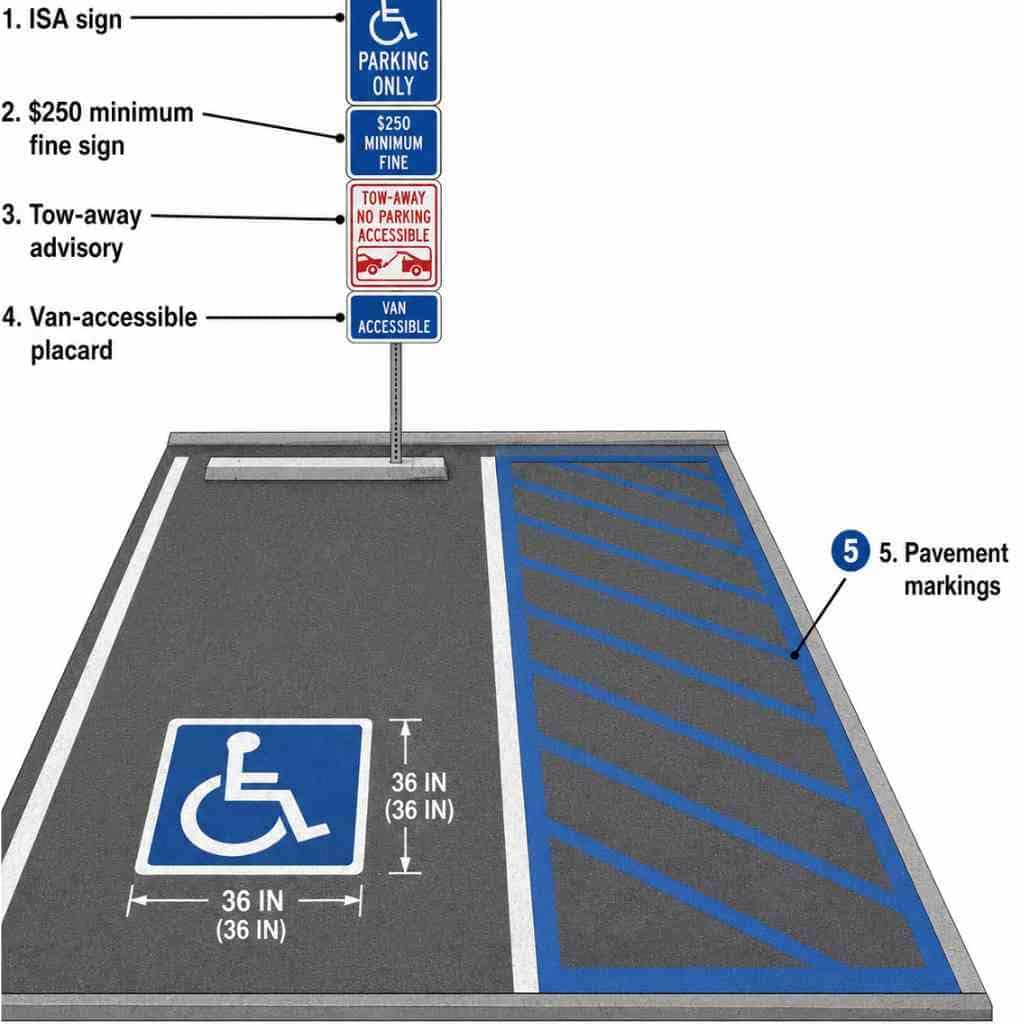
California requires five distinct sign and marking types at every accessible parking space, and the federal small-lot exemption for lots with 4 or fewer spaces does not apply. Small lots are exempt from signage requirements under ADA §216.5 Exception 1. California eliminates that waiver entirely under CBC 11B-216.5.1. The required elements are:
- International Symbol of Accessibility (ISA) mounted sign at each designated space
- $250 minimum fine warning sign posted visibly at each space
- Tow-away advisory sign
- Van-accessible designation sign at each van-accessible space
- Pavement surface markings: a 36×36-inch ISA symbol within 6 inches of the space centerline, plus blue-bordered access aisles with hatched lines, under CBC 11B-502.6.4
Property owners who purchase national sign packages designed for federal ADA compliance will be missing at least two CBC-required elements on every sign. The pavement marking and blue-bordered aisle requirements have no federal equivalent, so a lot that passes a federal checklist still fails in California.
Van Access Aisles and Loading Zones
At least 1 in every 6 accessible parking spaces must be van-accessible, with dimensions that exceed the standard space. Property owners who restripe lots routinely skip van spaces and loading zones because the oversized footprint reduces revenue-generating parking capacity:
- Van-accessible spaces at 132 inches (11 feet) wide with a 60-inch access aisle on the passenger side
- Alternative configuration allowed: 108 inches (9 feet) wide with a 96-inch aisle under a CBC exception
- Vertical clearance of 98 inches in covered or structured parking, 18 inches above the federal 80-inch minimum
- Passenger loading zones at least 60 inches wide by 240 inches (20 feet) long, on the same level as the vehicle pull-up space
- Access aisle and loading zone markings with blue borders and hatched lines matching the space they serve
Missing or undersized van zones and loading areas rank as the #8 violation in the CCDA dataset under CBC 11B-502.2 and CBC 11B-503. These violations rarely appear alone. They compound alongside space dimension and signage deficiencies in a single demand letter, stacking the per-visit statutory exposure across multiple violation categories on the same property.
Interior Path of Travel Barriers
Interior path of travel violations account for 5% of all CCDA-reported complaints, a lower frequency than exterior path and parking categories but a higher detection difficulty for property owners. The interior accessible route must maintain 36 inches of clear width at all points under CBC 11B-403.5.1. When tables, shelving, or displays line both sides of an aisle, California requires 44 inches minimum, 8 inches wider than the federal 36-inch standard. The most common interior deficiencies include:
- Aisle widths below 36 inches at any point along the accessible route, or below 44 inches in double-loaded configurations
- Protruding objects such as wall-mounted displays, fire extinguishers, or coat hooks that reduce overhead clearance below 80 inches or project more than 4 inches into the path between 27 and 80 inches above the floor, under CBC 11B-307
- Floor surface transitions exceeding ¼ inch vertically without beveling, or exceeding ½ inch without full ramp slope and landing treatment
- Interior carpeting with pile height above ½ inch, or loose-lay carpet tiles with curled edges that create trip hazards
- Furniture, merchandise displays, or temporary signage placed within the accessible route
Businesses that rearrange inventory or furniture seasonally create and destroy interior path compliance without realizing the accessible route has been blocked. A retail floor plan that measured compliant in January can fail by March.
These deficiencies concentrate in older commercial office buildings, medical office suites, and retail spaces where tenant improvements have been layered over original construction without accessibility review. Each layer of renovation inherits the previous tenant’s floor transitions, carpet choices, and fixture placements, compounding violations that no single tenant created.
Curb Ramp and Entrance Ramp Deficiencies
Ramp violations round out the CCDA’s top 10 list at 3% of all complaints but carry disproportionate remediation costs, typically ranging from $3,000 to $25,000 per ramp. The cost disparity exists because ramp corrections require concrete demolition, regrading, and often building permits. Under CBC 11B-405, ramps must maintain a maximum running slope of 1:12 (8.33%), cross slope not exceeding 2%, minimum clear width of 36 inches, and top and bottom landings of at least 60 inches in length. Every ramp with more than 6 inches of rise requires handrails on both sides.
Handrails must be continuous, graspable, and mounted at 34 to 38 inches height, with edge protection at least 2 inches high to prevent wheel drop-off. Missing edge protection is among the most frequently cited ramp findings in CASp reports, routinely omitted during field retrofits performed without architectural drawings.
Curb ramps at vehicular crossings require detectable warning surfaces covering the full ramp width under CBC 11B-406. The truncated dome field must be completely contained within the designated crossing markings without projecting into traffic lanes, parking spaces, or access aisles. A ramp that measured compliant at construction can fail years later when concrete settling or root intrusion shifts the surface grade by fractions of an inch. Those fractions push a 1:12 slope past the threshold. The same settling pattern that changes parking lot slopes affects ramps, but ramp corrections cannot be patched with asphalt overlay the way a parking surface can.
Restroom and Bathroom Accessibility Failures
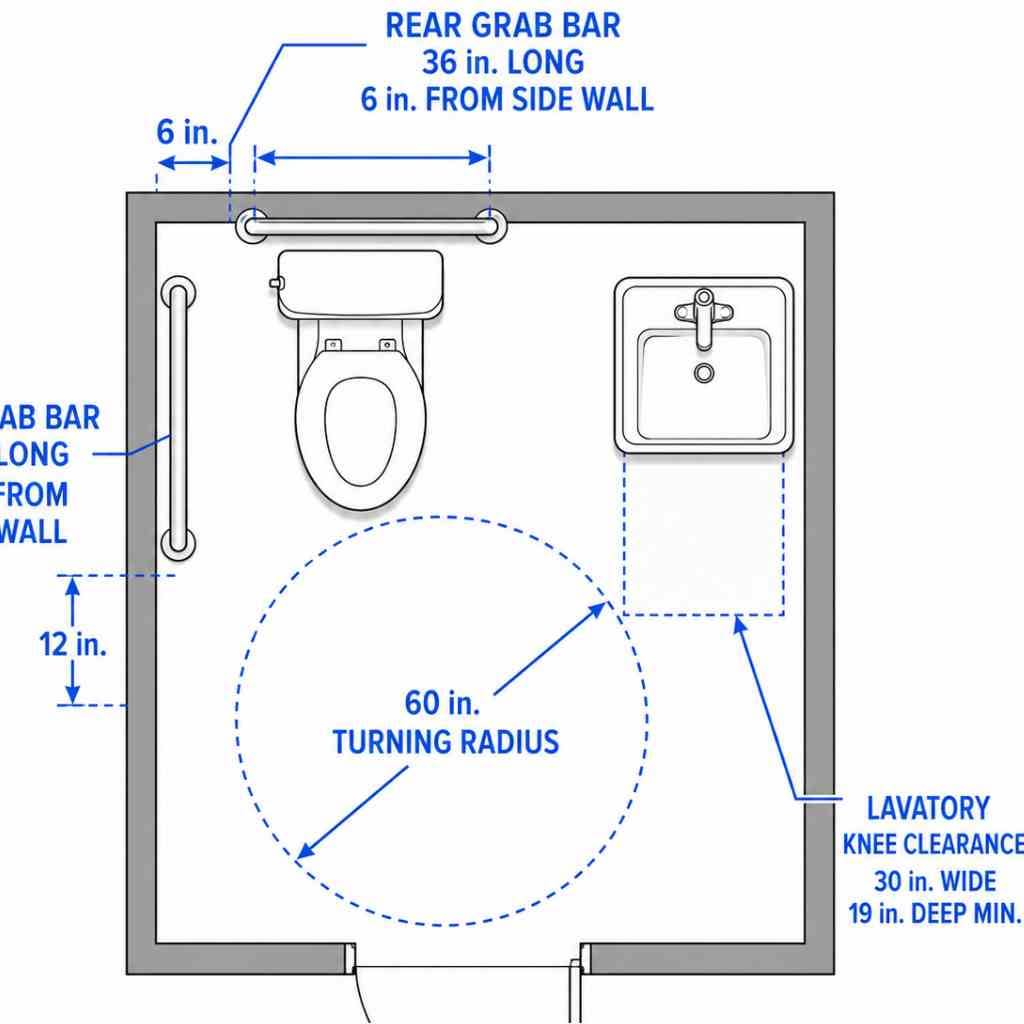
Restroom violations rank as the third highest location category in CCDA filings by total volume, even though individual restroom deficiencies fall outside the top 10 construction-issue list. Grab bar placement, toilet seat height, wheelchair turning radius, and missing signage account for the largest share of restroom complaints. The deficiencies most frequently cited under CBC 11B-604 include:
- Side grab bar shorter than 42 inches or mounted more than 12 inches from the rear wall
- Rear grab bar shorter than 36 inches or mounted more than 6 inches from the side wall
- Toilet seat height outside the 17-to-19-inch range, with standard commercial toilets commonly installing at 15 inches
- Wheelchair turning radius below the 60-inch diameter minimum
- Lavatory counter above the 34-inch maximum height, or knee clearance below 27 inches with uninsulated drain pipes
- Geometric restroom signage missing or incorrect: triangle for men’s, circle for women’s, triangle-within-a-circle for all-gender, required under CBC 11B-703.7.2.6
- Door opening force exceeding 5 pounds, or inward-swinging doors that encroach on the required turning space
Grab bar placement errors of 2 inches constitute a citable violation. That margin is narrow enough that a contractor installing by eye rather than measuring from wall centerlines will miss it on most installations.
A restroom that passes every dimensional requirement but lacks geometric signage is non-compliant under California law. The geometric shapes are a CBC-only mandate with no federal equivalent, and tactile characters with Braille must be mounted at 48 to 60 inches on the latch side of the door. Property owners who install federal-spec restroom signage will pass ADA review but fail a California inspection on signage alone. Floor slip resistance and uninsulated drain pipes under lavatories round out the most common restroom findings beyond signage and dimensions.
How the Unruh Act Multiplies Liability for Every Violation
Without Qualified Defendant status, every ADA violation triggers $4,000 minimum statutory damages per plaintiff visit under §52(a) with no cap on the number of visits. A pre-litigation CASp inspection establishes Qualified Defendant status under Civil Code §55.52, reducing the statutory minimum to $1,000 per occasion if violations are corrected within 60 days of service. That is a 75% reduction in the statutory floor. The table below compares the two positions.
| Without CASp Inspection | With CASp Inspection (Qualified Defendant) | |
|---|---|---|
| Minimum statutory damages per occasion | $4,000 under §52(a) | $1,000 under §55.56(f)(1); $2,000 for small businesses (≤25 employees, <$3.5M revenue) under §55.56(f)(2) |
| Correction window | None | 60 days from service; 30 days for small businesses under §55.56(f)(2) |
| Attorney fee exposure | Full plaintiff attorney fees, one-way recovery | Reduced; court considers good-faith correction efforts |
| Court stay | None available | 90-day stay of proceedings |
| Early evaluation conference | Not available | Mandatory under §55.54; requires meet-and-confer before discovery |
| SB 269 grace period | Not applicable | 120-day window for properties with current CASp report |
Only 0.9% of defendants in California construction-related accessibility cases invoked Qualified Defendant protections during the most recent CCDA reporting period. The remaining 99.1% paid full statutory damages and full attorney fees. A CASp inspection typically costs $1,500 to $5,000 depending on property size, while a single ADA lawsuit without QD status typically settles for $10,000 to $25,000 including attorney fees. A property owner without the inspection pays more responding to one demand letter than the inspection itself costs. Five or more violations on a single property visited multiple times by the same plaintiff can generate $60,000 or more in statutory exposure alone before attorney fees are calculated.
Which Violations to Fix First Based on Litigation Risk
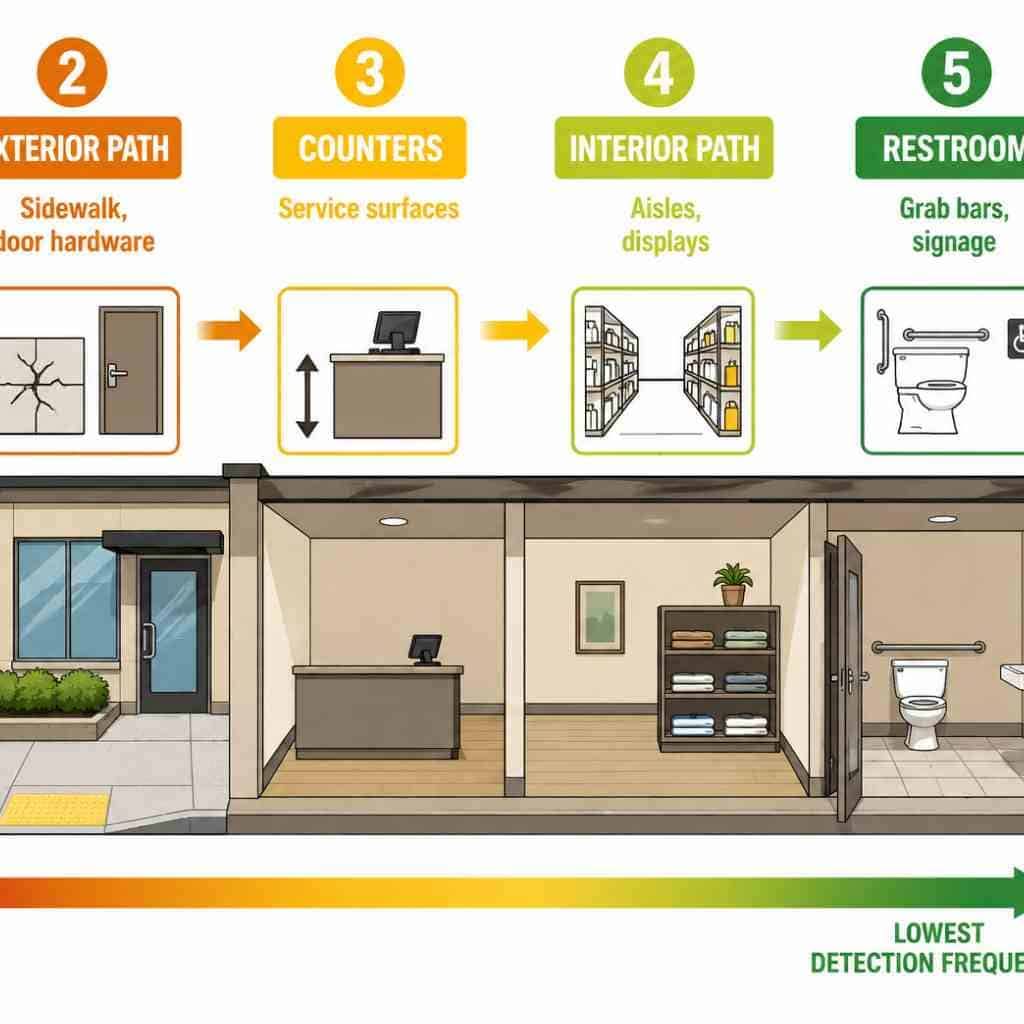
Fix parking violations first. Serial plaintiffs follow a predictable detection sequence: parking lot, then exterior path and entrance, then interior. They prioritize by what is documentable without interacting with the business, which means the most visible violations carry the highest litigation probability regardless of their code severity. Remediate in the order a plaintiff scans:
- Parking signage and striping deficiencies: lowest remediation cost, highest detection risk, documentable from the vehicle
- Parking space slopes exceeding 2%: moderate cost, highest individual violation volume in the CCDA dataset
- Exterior pathway cross slopes, surface discontinuities, and door hardware: visible from the sidewalk without building entry
- Counter heights and interior path of travel barriers: require building entry to detect, lower filing frequency
- Restroom dimensional and signage deficiencies: require entering the building, locating the restroom, and documenting inside a confined space
Each step down the list requires more effort from the plaintiff and generates fewer filings statewide.
A CASp inspection report sequences these priorities with more granularity, assigning each identified barrier a correction urgency ranging from immediate (safety hazards and high-litigation-risk items) to phased (corrections scheduled within a remediation plan). Use the report as the remediation roadmap. For properties where full remediation exceeds the budget, the readily achievable standard under 42 U.S.C. §12181(9) defines the legal obligation: barrier removal is required when it can be carried out without significant difficulty or expense. The disproportionate cost threshold under CBC 11B-202.4 caps the path-of-travel upgrade obligation at $209,208 for 2026, meaning remediation costs that exceed 20% of the alteration budget are not required in that cycle. Document every correction with dates, costs, and photographs. That record becomes evidence of good faith if a claim is filed.

Written by Emily Johnson
Emily Johnson is a Certified Access Specialist (CASp) Inspector and is passionate about making spaces accessible for all. With over 10 years of experience and degrees in Civil Engineering and Architecture, she inspires others while championing ADA awareness.
RECENT POSTS
CATEGORIES
Get a free quote today!
By clicking “Submit”, you are signing up to receiving emails from us. You can unsubscribe whenever you like. SMS rates may apply.
Want To Know More About ADA Accessibility And How To Get Compliant?
Check out our blog!