What Is a CASp Inspection?

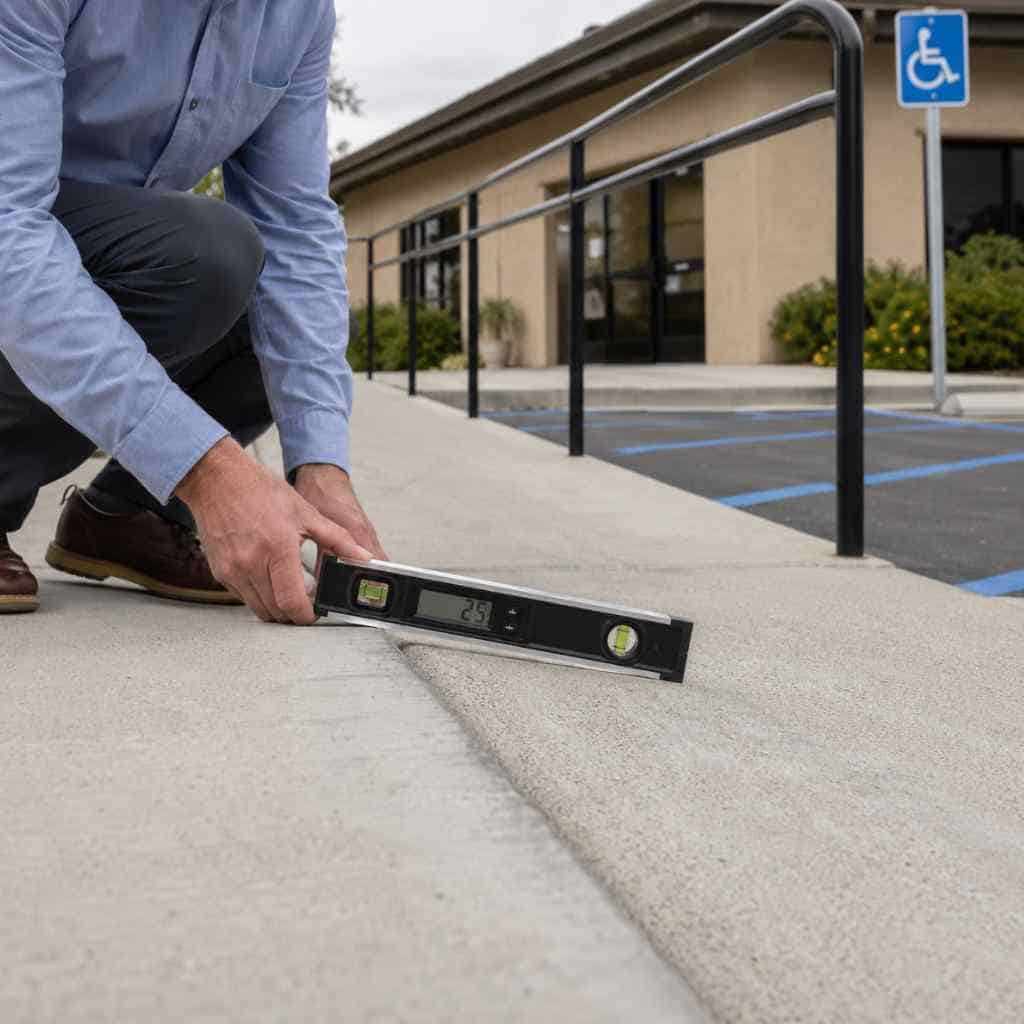
A CASp report is the formal inspection document produced by a Certified Access Specialist after evaluating a commercial property for disability access compliance. The Certified Access Specialist credential is issued exclusively through the Division of the State Architect, and only inspectors holding this credential are authorized to produce CASp reports under California Government Code §4459.8. No other accessibility professional, regardless of architecture or engineering credentials, can issue a report that carries CASp legal standing.
The report evaluates every inspected element against CBC Chapter 11B and the 2010 ADA Standards for Accessible Design. Beyond compliance documentation, a CASp report is the only accessibility document in California that activates qualified defendant protections, which entitle the property owner to an early evaluation conference and a mandatory stay of proceedings when a construction-related accessibility claim is filed. Property owners without a filed CASp report face full Unruh Civil Rights Act exposure at a statutory minimum of $4,000 per violation per encounter. A single property with multiple barriers can generate five or six figures in damages from one plaintiff visit alone.
What Is a CASp Report?

A CASp report is the formal document issued by a Certified Access Specialist after inspecting a commercial property for compliance with CBC Chapter 11B and the ADA, authorized under §4459.8, that inventories accessibility conditions, classifies each finding by compliance status, and serves as the foundation for qualified defendant protections under Civil Code §55.53. Only inspectors credentialed through the Division of the State Architect can produce a report that carries this legal standing.
The CASp credential requires passing the DSA examination, which tests applied knowledge of both CBC Chapter 11B dimensional standards and the 2010 ADA Standards for Accessible Design. Certification is valid for three years and requires 15 continuing education units per renewal cycle, including a minimum of five CEUs addressing regulatory updates to the California Building Code. A report citing superseded code sections gives opposing counsel a basis to challenge the report’s findings, which is why the renewal structure ties directly to the CBC’s triennial code cycle. An architect, engineer, or general consultant who does not hold active CASp certification can produce an accessibility evaluation, but that evaluation carries zero qualified defendant protections regardless of its thoroughness.
The credential determines the legal standing. Not the scope of work.
The report functions as two things simultaneously: a compliance audit and a legal instrument. As a compliance audit, it documents every inspected element against current CBC 11B and ADA dimensional standards, classifying each as compliant, corrected during inspection, or not in compliance. As a legal instrument, it activates the qualified defendant framework under Civil Code §55.53 when the property owner files the report with the local building department and demonstrates either full compliance or documented progress on a remediation schedule.
No other accessibility document in California serves both functions. A property owner who commissions a standard ADA audit receives compliance documentation but gains no access to the early evaluation conference or mandatory stay of proceedings when a construction-related accessibility claim is filed. The CASp report is the only document that bridges inspection findings to those procedural protections.
What Sections Does a CASp Report Contain?

A complete CASp report contains:
- An executive summary identifying the property, inspection date, inspector credentials, and overall compliance status
- A facility description and inspection scope statement defining the physical boundaries of what was and was not inspected
- A findings inventory classifying every inspected element by compliance status with the applicable CBC 11B and ADA standard section cited for each finding
- Corrective action recommendations for every non-compliant finding, with priority assignments and a remediation timeline
- Photo documentation cross-referenced to individual findings by finding number and location
- Code reference citations to the exact CBC 11B section and corresponding ADA standard for each identified barrier
- Appendices containing measurement data, site plans, and manufacturer specification sheets referenced to specific findings
A report missing a clear scope statement is the single most common quality deficiency property owners encounter. The facility description identifies building type, square footage, number of stories, year of construction, and occupancy classification. The scope statement specifies which elements were included in the inspection and which were excluded. Parking, path of travel, restrooms, service counters, and signage are standard scope items. A report that does not clearly state what was excluded leaves the property owner unable to determine which portions of the property remain uninspected and carry no CASp coverage.
The findings inventory is the core of the report. Each finding documents the specific element inspected, its physical location within the property, the applicable code section, the measured condition versus the required standard, and the compliance classification assigned. Classifications follow the three categories established in §55.53 report requirements: inspected and in compliance, inspected and corrected during inspection, or inspected and not in compliance.
Every non-compliant finding includes a corrective action recommendation specifying what must be changed and the code section that mandates the change. The corrective action names the specific deficiency, the required dimensional or operational standard, and the priority level assigned based on severity of access restriction and frequency of public encounter with the barrier. Property owners use these priority assignments to build a phased barrier removal schedule, which is the document that demonstrates good-faith compliance progress when qualified defendant status is evaluated.
Photo documentation must be referenced to specific findings, not presented as a generic photo appendix. Each photograph is labeled with the finding number it supports, the physical location within the property, and the condition being documented. A photo appendix without finding-level cross-referencing cannot direct a contractor to the exact remediation location and cannot substantiate the property owner’s compliance record if the report is challenged.
Appendices contain supplemental materials referenced from the main findings inventory: measurement data tables, site plans or floor diagrams marking inspected elements, and manufacturer specification sheets for installed accessibility features. Every appendix item must be cross-referenced to the specific finding it supports.
Appendices that are not tied to specific findings create ambiguity about which documented conditions they substantiate and add bulk without adding value.
How Does a CASp Report Classify Inspection Findings?
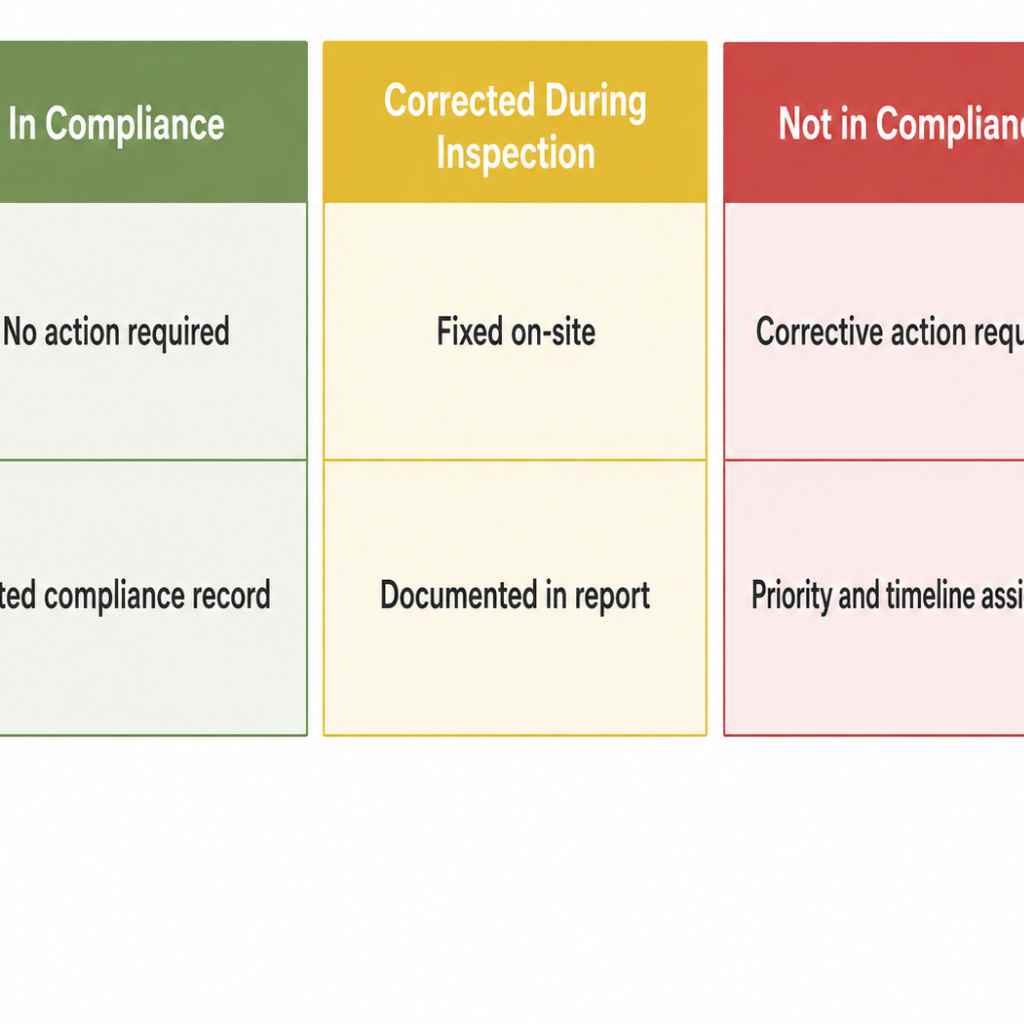
CASp reports classify every inspected element into one of three categories: inspected and in compliance, meaning the element meets current CBC 11B and ADA standards and requires no action; inspected and corrected, meaning a deficiency was identified and corrected during the inspection itself; or inspected and not in compliance, meaning the element fails current standards and requires corrective action with a specified remediation priority and timeline. The classification assigned to each element determines what the property owner must do next and what documentation supports their compliance record.
The in-compliance classification confirms that a specific element met the applicable CBC 11B and ADA standard at the time of inspection. That timestamp matters. It establishes a documented, professional evaluation of compliance at a defined point, which becomes the property owner’s reference point if the same element is later disputed in a construction-related accessibility claim. The classification does not mean the element will remain compliant indefinitely, because standards update and physical conditions change, but it does create a verifiable record that the element was evaluated and met the standard on a specific date.
Elements classified as compliant still require reinspection when the property undergoes renovations that trigger path-of-travel obligations under CBC §11B-202.4. Any alteration to a primary function area requires an accessible path of travel to the altered area, with compliance costs capped at 20% of the alteration cost. A renovation that crosses this threshold can change the compliance status of elements the original CASp report classified as meeting the standard.
Inspected and not in compliance is the classification that drives remediation. Each non-compliant finding in a properly constructed report specifies the exact deficiency, the applicable code section, the required corrective action, and a priority level.
The priority level is not arbitrary. It follows a framework that weighs three factors: severity of access restriction, frequency of public encounter with the barrier, and whether the barrier affects a primary function area or a secondary space. Property owners use priority assignments to sequence corrections in a phased barrier removal schedule, starting with the barriers that restrict the most access in the most trafficked areas. That phased schedule is the document the court evaluates when determining whether the property owner has demonstrated good-faith compliance progress for qualified defendant status.
What Building Elements Does a CASp Inspection Evaluate?

A CASp inspection evaluates every element along the accessible path of travel from the public right-of-way through the building interior, with each element measured against CBC 11B and the 2010 ADA Standards. The evaluation covers:
- Parking facilities, including accessible space count, van-accessible dimensions, access aisle widths, signage, and surface slope
- Exterior accessible routes from the public sidewalk or right-of-way to the building entrance, including curb ramps, running slope, and cross-slope
- Entrance clearances, door hardware, threshold heights, and automatic door operator controls
- Interior path-of-travel elements, including corridor widths, protruding objects, floor surfaces, and elevator controls
- Restrooms, including turning radius, grab bar placement, lavatory clearances, mirror height, and dispensing device reach ranges
- Service counter heights, transaction surfaces, and queue configurations
- Signage, both tactile and visual, including room identification, directional signage, and exit signs
- Drinking fountains, including spout height, knee clearance, and operability standards
Parking generates more accessibility claims in California than any other element category. Accessible parking is evaluated under CBC §1133B, which specifies the number of required accessible spaces based on total parking count, van-accessible space dimensions at a minimum of 144 inches wide with a 96-inch access aisle, signage height and content requirements, and surface slope at a maximum of 2% in any direction. Every accessible space is measured individually. The report records the measured slope, aisle width, and signage condition for each space and compares every measurement against the §1133B requirement.
Parking documentation is the section of the report most likely to be scrutinized if the property’s compliance record is reviewed.
For properties with public right-of-way elements such as sidewalks, curb ramps, or pedestrian access routes, the inspection scope extends beyond CBC 11B. PROWAG, the Public Right-of-Way Accessibility Guidelines issued by the U.S. Access Board, governs accessibility features in the public right-of-way and applies in addition to CBC 11B requirements at the private property boundary. The code boundary matters. The CASp report documents which elements fall under PROWAG jurisdiction versus CBC 11B, because the applicable code determines both the required dimensional standard and the responsible party for remediation. A curb ramp on a public sidewalk leading to a private entrance may fall under municipal responsibility for construction but under the property owner’s responsibility for maintaining an accessible route to the entrance. That jurisdictional line is documented in the report so the property owner knows which corrections are theirs and which require coordination with the municipality.
Interior path-of-travel elements are measured at every transition point from the entrance through the building. Door opening widths require a minimum of 32 inches clear, thresholds cannot exceed ½ inch in height and must be beveled if between ¼ and ½ inch, corridor widths must accommodate wheelchair passage, and protruding objects cannot reduce the accessible route below the required clearance. Every transition is a measurement point. Floor surfaces, elevator controls, and any operable hardware along the path are each measured against the specific CBC 11B section that governs them, with the report documenting the measured value alongside the required value for every element.
That measured-versus-required documentation is what allows a contractor to price remediation from the report without returning to the property for independent measurements.
Restroom evaluations cover turning radius at a 60-inch diameter minimum, grab bar height and placement between 33 and 36 inches above the finished floor, lavatory knee clearance at a minimum of 27 inches, mirror mounting height, and dispensing device reach ranges. Tolerances are tight. Each measurement is compared against its governing CBC 11B section, and a single inch of deviation can change a finding from compliant to non-compliant.
How Does a CASp Report Establish Qualified Defendant Protections?

A CASp report establishes qualified defendant protections under §55.53 only when the property owner completes three steps beyond the inspection itself. Possessing a report without completing these steps provides no procedural protections:
- File the CASp report with the local building department that has jurisdiction over the property
- Post the correct disability access notice at the property entrance — either a notice stating that a CASp inspection has been completed or a notice stating that a CASp inspection has not yet been obtained
- Demonstrate either full compliance with the findings or documented progress on a remediation schedule addressing non-compliant items
Meeting all three conditions entitles the property owner to request an early evaluation conference and a mandatory stay of proceedings if a construction-related accessibility claim is filed.
A construction-related accessibility claim, defined under Civil Code §55.3, is a claim specifically alleging a construction-related barrier to access at a place of public accommodation. This is distinct from a federal claim under Title III of the ADA. The qualified defendant framework under §55.53 applies only to state-level CRCs, not to federal claims. Property owners who assume their CASp report provides blanket protection across both state and federal proceedings are operating on an incorrect understanding of what the framework covers.
The notice requirement is where the framework becomes specific. The disability access notice is not a generic sign. It is one of two prescribed forms: a notice confirming that a CASp inspection has been completed, posted at properties with a filed report, or a notice stating that a CASp inspection has not yet been obtained, posted at properties without one. Posting the wrong notice type or failing to post any notice negates the entire qualified defendant framework regardless of whether the report is filed and the property is in compliance.
Qualified defendant status also carries weight outside of claims proceedings. In commercial lease negotiations, Civil Code §1938 requires landlords to disclose whether the property has been CASp-inspected and to provide the report to prospective tenants. In sale transactions, buyers and their counsel verify qualified defendant status as part of due diligence because it affects the property’s risk profile and insurance underwriting assessment.
The filing step is where most property owners fail to secure the protections they paid for. A CASp report stored in a desk drawer, filed with the property management company, or held only by the inspector does not activate §55.53. The report must be filed with the local building department having jurisdiction over the property. Some jurisdictions charge a filing fee. The filing creates the public record that establishes the property’s CASp-inspected status.
The property owner should retain proof of filing as part of the compliance record. A date-stamped receipt or written confirmation from the building department serves this purpose. The burden of proving qualified defendant status falls on the defendant, which means the property owner must be able to produce evidence of filing, notice posting, and compliance progress if their status is challenged.
What Is the Difference Between a CASp Report and a Standard ADA Audit?
A CASp report is produced by a DSA-certified Certified Access Specialist and activates qualified defendant protections under §55.53. A standard ADA audit may be produced by any architect, consultant, or contractor, carries no CASp certification, and provides no statutory protections in California regardless of how thorough the audit is. The table below identifies the specific differences that determine whether a report carries legal standing.
| Element | CASp Report | Standard ADA Audit |
|---|---|---|
| Inspector credential | DSA-certified Certified Access Specialist | Architect, consultant, contractor, or other professional — no state certification required |
| Authorizing statute | California Government Code §4459.8 | None — no California statute governs standard ADA audits |
| Qualified defendant status | Activates §55.53 protections when filed with the local building department | Does not activate — no filing mechanism exists for non-CASp reports |
| Early evaluation conference | Available upon filing application with the court | Not available regardless of audit quality |
| Mandatory stay of proceedings | 90-day stay available in construction-related accessibility claims | Not available |
| Statutory damages reduction | Potential reduction from $4,000 to $1,000 per violation if corrected within 60 days | No statutory damages reduction pathway |
| Report filing | Filed with the local building department to create a public compliance record | No building department filing mechanism |
| Commercial lease disclosure | Required under Civil Code §1938 — landlord must provide report to prospective tenants | No disclosure obligation under §1938 |
The distinction is not about thoroughness. A well-executed ADA audit by a qualified architect may evaluate the same physical elements, reference the same CBC 11B and ADA standard sections, and produce equally detailed findings. The difference is that the audit carries no legal standing in California’s construction-related accessibility claim framework. The credential of the inspector determines whether the document activates §55.53 protections. The scope of work does not.
Property owners who received a document titled “ADA compliance report” or “accessibility audit” from a non-CASp professional should not assume they hold qualified defendant protections. The report title does not determine legal standing. The credential does. Verify whether the inspector holds an active CASp certification by checking the DSA’s CASp directory at dgs.ca.gov. If the inspector is not listed, the report retains its value as a compliance planning tool — it identifies barriers, references code sections, and guides remediation sequencing.
It carries zero value for §55.53 protections, and the property owner needs a CASp inspection to obtain a document with legal standing.
How Long Is a CASp Report Valid?
California law does not set an expiration date for CASp reports. A report’s practical value diminishes, however, when the code edition it references is superseded, when the property undergoes renovations that change its accessibility profile, or when federal ADA Standards are amended.
The California Building Code updates on a three-year cycle. The 2025 CBC took effect on January 1, 2026, superseding the 2022 edition. A CASp report written under the 2022 CBC references dimensional standards and code sections that may no longer reflect current requirements. The 2025 edition, for example, added a new requirement that wheelchair clear floor space at dining surfaces cannot overlap the accessible route, which means a restaurant report under the 2022 code would not have evaluated this condition. Property owners should plan reinspection at three points: when a new CBC edition is adopted, when renovations exceed the path-of-travel cost threshold under §11B-202.4, or when ADA Standards are amended at the federal level.
The practical window for relying on a CASp report without reinspection is the duration of the code cycle under which it was produced.
A preliminary CASp report documents initial inspection findings before all corrective actions are completed. A follow-up reinspection report documents the property’s compliance status after remediation work has been performed against the original findings. These are distinct document types from the standard CASp report. The preliminary report captures the property’s condition at inspection. The follow-up report confirms whether the remediation brought the property into compliance with the findings.
Property owners who hold a preliminary report should verify whether their qualified defendant protections are active under that document or whether the follow-up reinspection report is required to fully establish §55.53 eligibility. A report classified as “meets applicable standards” means the CASp determined the property is fully compliant, while “inspected by a CASp” means the inspection occurred but a compliance determination is still pending, and the procedural protections that attach to each status differ.
What Should You Verify Before Accepting a CASp Report?
Before accepting a CASp report, verify five elements that determine whether the document is complete, properly executed, and legally operative:
- The inspector holds an active DSA CASp certification that matches the CASp number printed on the report
- The inspection scope statement covers every public-facing area of the property, with exclusions clearly identified
- Every non-compliant finding cites the specific CBC 11B or ADA code section it violates, with the measured dimension alongside the required dimension
- Photo documentation is cross-referenced to individual findings by finding number and location, not presented as a generic appendix
- Corrective action recommendations include priority assignments and a remediation timeline with specific deficiency descriptions
Confirm the inspector’s active certification through the DSA CASp directory at dgs.ca.gov before relying on any report for §55.53 protections. Match the CASp number printed on the report against the current directory listing. Certifications are valid for three years and require 15 continuing education units for renewal, which means an inspector who was certified when hired may have lapsed by the time the report is delivered.
A report signed by a lapsed CASp may carry no qualified defendant protections regardless of its thoroughness.
Compare the inspection scope statement against every physical area of the property that the public accesses. A report that covers the building interior but excludes the parking lot, the exterior path of travel from the sidewalk to the entrance, or any public right-of-way approach has left those areas without CASp coverage. Barriers in excluded areas carry no qualified defendant protection. In California’s high-volume accessibility claim environment, plaintiffs and their counsel routinely identify uninspected elements as the basis for claims precisely because those elements have no CASp documentation supporting the property owner’s defense.
The scope statement is the first page a property owner should read.
Evaluate the specificity of corrective action recommendations. A finding that states “restroom is not compliant” without identifying which element fails, what the measured dimension is, what the required dimension is, and which CBC 11B section governs the requirement is not actionable. That level of vagueness is a quality deficiency in the report itself.
Contractors cannot price remediation from vague findings. A corrective action that names the specific element, the measured condition, the required standard, and the governing code section allows a contractor to scope the work, estimate materials, and schedule the correction without returning to the property for independent measurements.

Written by Emily Johnson
Emily Johnson is a Certified Access Specialist (CASp) Inspector and is passionate about making spaces accessible for all. With over 10 years of experience and degrees in Civil Engineering and Architecture, she inspires others while championing ADA awareness.
RECENT POSTS
CATEGORIES
Get a free quote today!
By clicking “Submit”, you are signing up to receiving emails from us. You can unsubscribe whenever you like. SMS rates may apply.
Want To Know More About ADA Accessibility And How To Get Compliant?
Check out our blog!