California ADA Sink & Knee/Toe Clearance Requirements for Commercial Restrooms
ADA sink and knee/toe clearance compliance in California commercial restrooms refers to the specific dimensional requirements that determine whether a sink can be safely approached and used by a person in a wheelchair, as evaluated under the federal ADA and the California Building Code, Title 24 Chapter 11B. These requirements govern sink height, knee space, toe space, and the clear floor area beneath and in front of the fixture. In California, these conditions are measured in the finished, built restroom and evaluated during plan review, field inspections, and CASp assessments.
Here’s what that means in practice. Sink compliance is not determined by product labels, design intent, or what worked in a previous project. It is determined after flooring, cabinetry, wall finishes, and plumbing are installed. Small changes such as thicker tile, added panels, or shifted drain lines frequently alter knee or toe clearance enough to affect how the sink is evaluated.
This article focuses on the sink height and knee/toe clearance conditions that most often trigger findings in commercial restrooms. It does not address residential bathrooms. In California, federal ADA criteria establish the baseline, but Title 24 provisions control how those criteria are enforced in the field. Most sink-related issues arise not from missing fixtures, but from finished conditions that no longer meet the required clearances once construction is complete.
What Makes a Sink Accessible Under California ADA Rules?
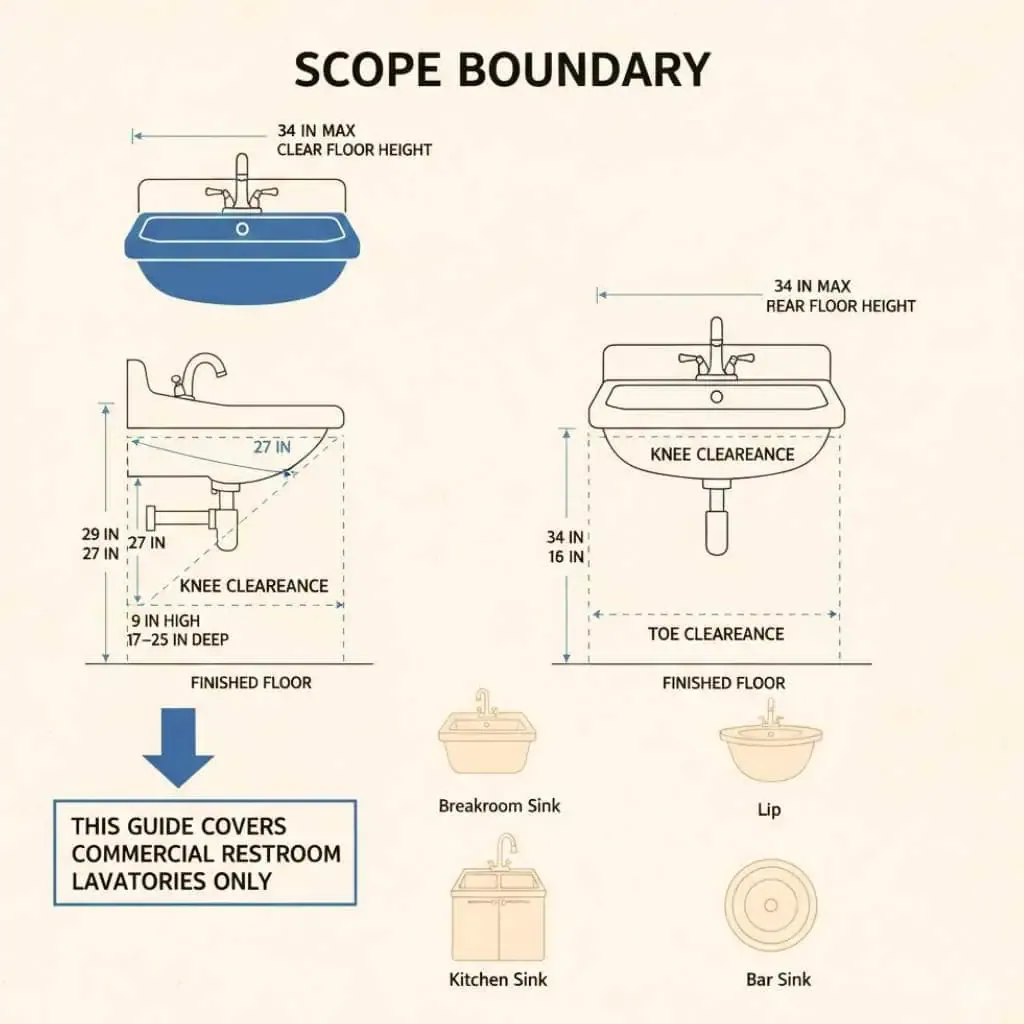
An accessible sink in a California commercial restroom is not defined by appearance, branding, or intent. It is defined by how the sink functions for a person using a wheelchair, based on measurable conditions evaluated under the federal ADA and enforced through the California Building Code, Title 24 Chapter 11B. Inspectors are not asking whether a sink looks accessible. They are evaluating whether a user can approach the sink, position their knees and feet underneath it, reach the controls, and use it without obstruction.
At a baseline level, the ADA establishes national requirements for accessible lavatories, including limits on sink height, required knee clearance, toe clearance, and clear floor space for a forward approach. California adopts those requirements but applies them through its own building code and inspection process. When provisions overlap, Title 24 governs how those ADA requirements are evaluated in the field, using measured, finished conditions rather than design assumptions.
Scope matters here. This section applies only to sinks located in commercial restrooms, often referred to as lavatories. It does not apply to sinks in breakrooms, kitchenettes, bars, or food preparation areas, which are evaluated under different code sections and involve additional reach-range and work-surface criteria. Misclassifying sink type is a frequent cause of inspection disagreements, even when individual dimensions appear correct.
Sink accessibility is evaluated as part of the overall restroom condition, not as a standalone fixture, which is why commercial restroom accessibility evaluations look at how sink clearances interact with surrounding elements such as walls, partitions, and adjacent fixtures.
Proof references:
ADA Standards for Accessible Design, Section 606
California Building Code, Title 24, Chapter 11B, Section 11B-606
Which Accessibility Standards Control Sink Compliance in California?
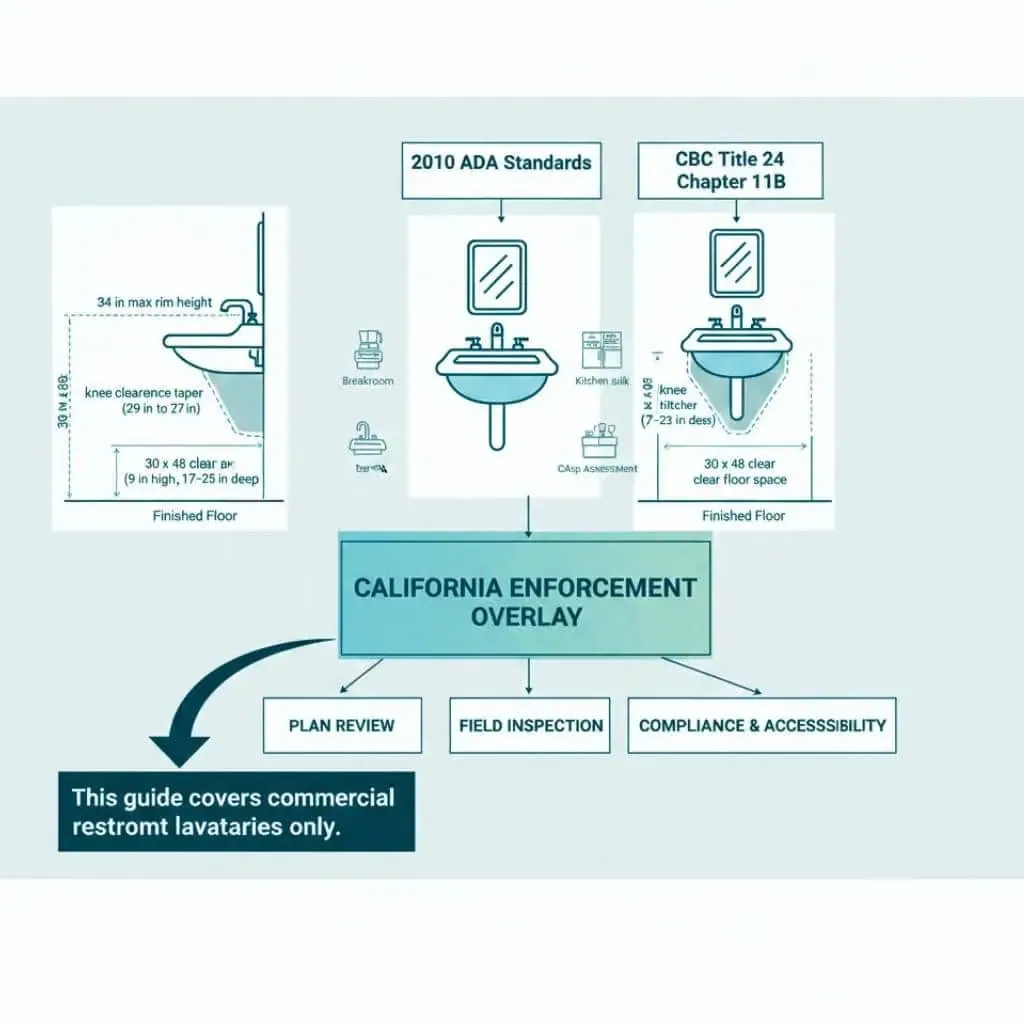
An accessible sink in a California commercial restroom is not defined by appearance, branding, or intent. It is defined by how the sink functions for a person using a wheelchair, based on measurable conditions evaluated under the federal ADA and enforced through the California Building Code, Title 24 Chapter 11B. Inspectors are not asking whether a sink looks accessible. They are evaluating whether a user can approach the sink, position their knees and feet underneath it, reach the controls, and use it without obstruction.
At a baseline level, the ADA establishes national requirements for accessible lavatories, including limits on sink height, required knee clearance, toe clearance, and clear floor space for a forward approach. California adopts those requirements but applies them through its own building code and inspection process. When provisions overlap, Title 24 governs how those ADA requirements are evaluated in the field, using measured, finished conditions rather than design assumptions.
Scope matters here. This section applies only to sinks located in commercial restrooms, often referred to as lavatories. It does not apply to sinks in breakrooms, kitchenettes, bars, or food preparation areas, which are evaluated under different code sections and involve additional reach-range and work-surface criteria. Misclassifying sink type is a frequent cause of inspection disagreements, even when individual dimensions appear correct.
Here’s why this definition matters in practice. Sink accessibility is evaluated as part of the overall restroom condition, not as a standalone fixture. A sink that meets height requirements on paper may still be evaluated differently once cabinetry, pipe protection, wall finishes, or floor thickness alter the available knee or toe space. Accessibility is not a product attribute. It is a condition created by how the sink is installed, finished, and measured during inspection.
Source references:
ADA Standards for Accessible Design, Section 606 [NEEDS SOURCE]
California Building Code, Title 24, Chapter 11B, Section 11B-606
What Clear Floor Space Is Required at an Accessible Sink?
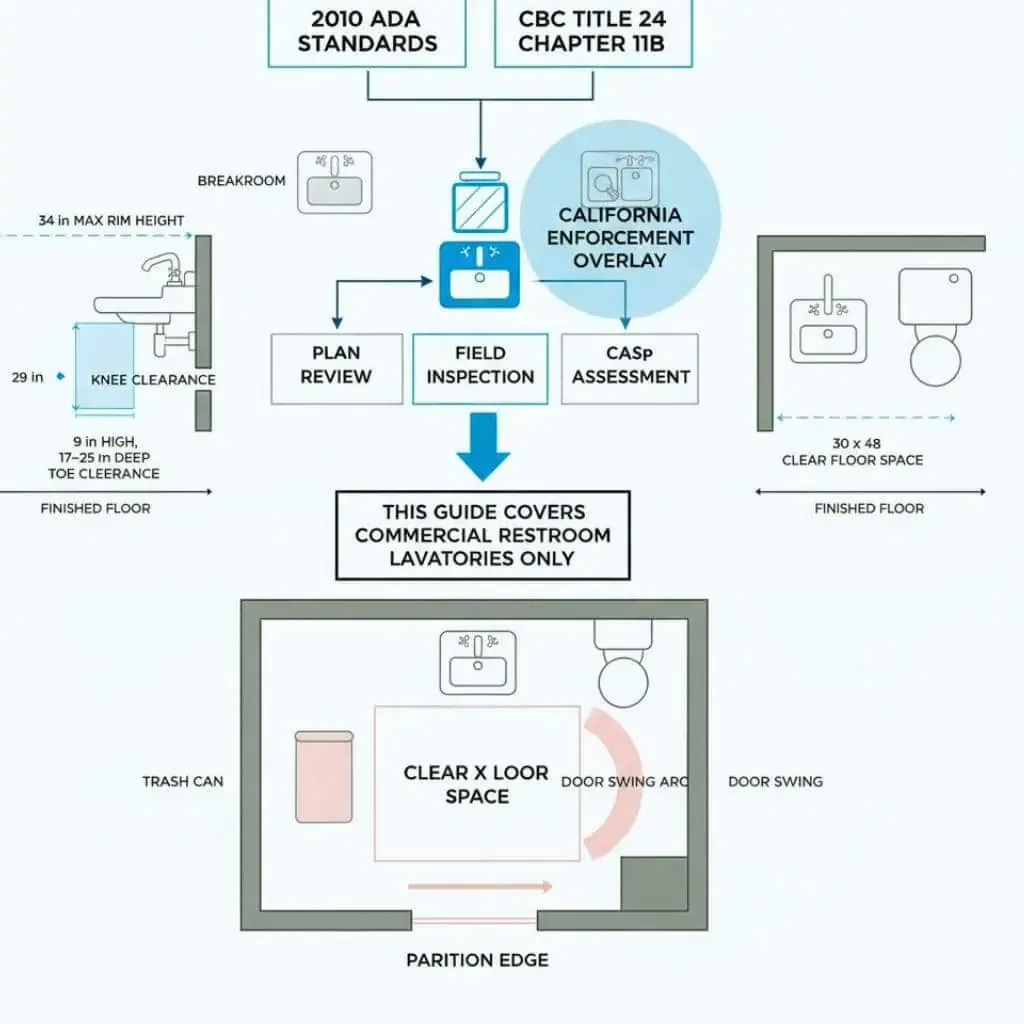
Before sink height or knee clearance is evaluated, inspectors first look at the clear floor space that allows a person using a wheelchair to approach and position at the sink. Clear floor space is the unobstructed area on the floor that supports a usable approach. If this space is compromised, other compliant dimensions may not matter.
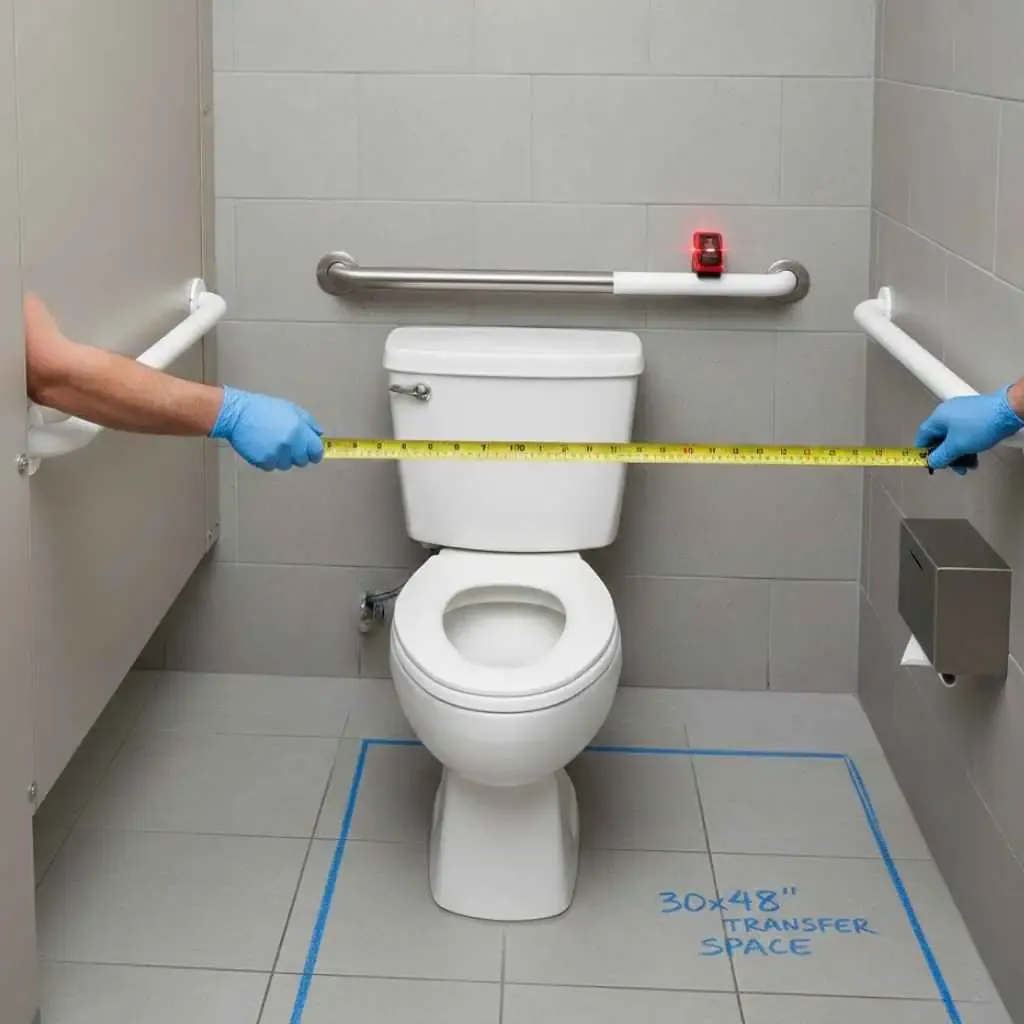
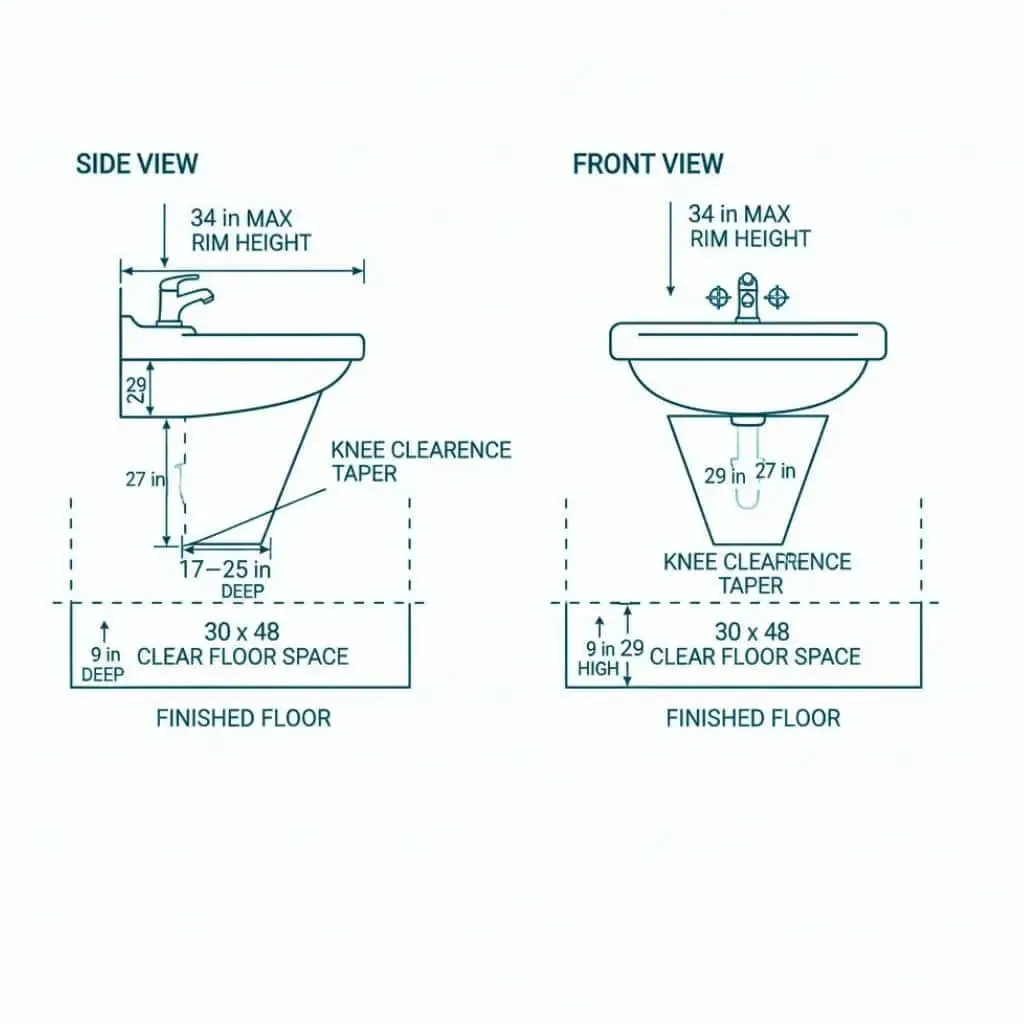
Under the ADA and California Title 24, an accessible sink must be served by a clear floor space at least 30 inches wide by 48 inches deep. This space is measured on the finished floor and must be positioned to allow a forward approach to the sink. The clear floor space can overlap knee and toe clearance below the sink, but it cannot be blocked by cabinets, partitions, doors, or fixtures that interfere with approach or positioning.
The type of approach matters. Sinks in commercial restrooms are evaluated for forward approach, meaning the wheelchair user rolls directly toward the sink. This is why the clear floor space must extend under the sink to accommodate knee and toe clearance.
Here’s where many restrooms fail. Clear floor space must remain clear in actual use, not just on drawings. Trash cans, soap dispensers mounted too low, paper towel bins, or door swings that overlap the required 30-by-48-inch area invalidate the clearance. In reality, inspectors evaluate as-found conditions. Some items may be movable, but if they routinely occupy the space, they are treated as obstructions. If they encroach on the approach zone at the time of inspection, the sink is evaluated as nonconforming regardless of other dimensions.
This is why clear floor space is evaluated first. Without an unobstructed approach zone, a sink cannot function as accessible, even if the sink height and knee clearance meet dimensional requirements.
Proof references:
2010 ADA Standards for Accessible Design, Section 305 (Clear Floor or Ground Space)
2010 ADA Standards for Accessible Design, Section 606.2 (Clear Floor Space at Lavatories)
What Is the Required Height of an Accessible Sink?
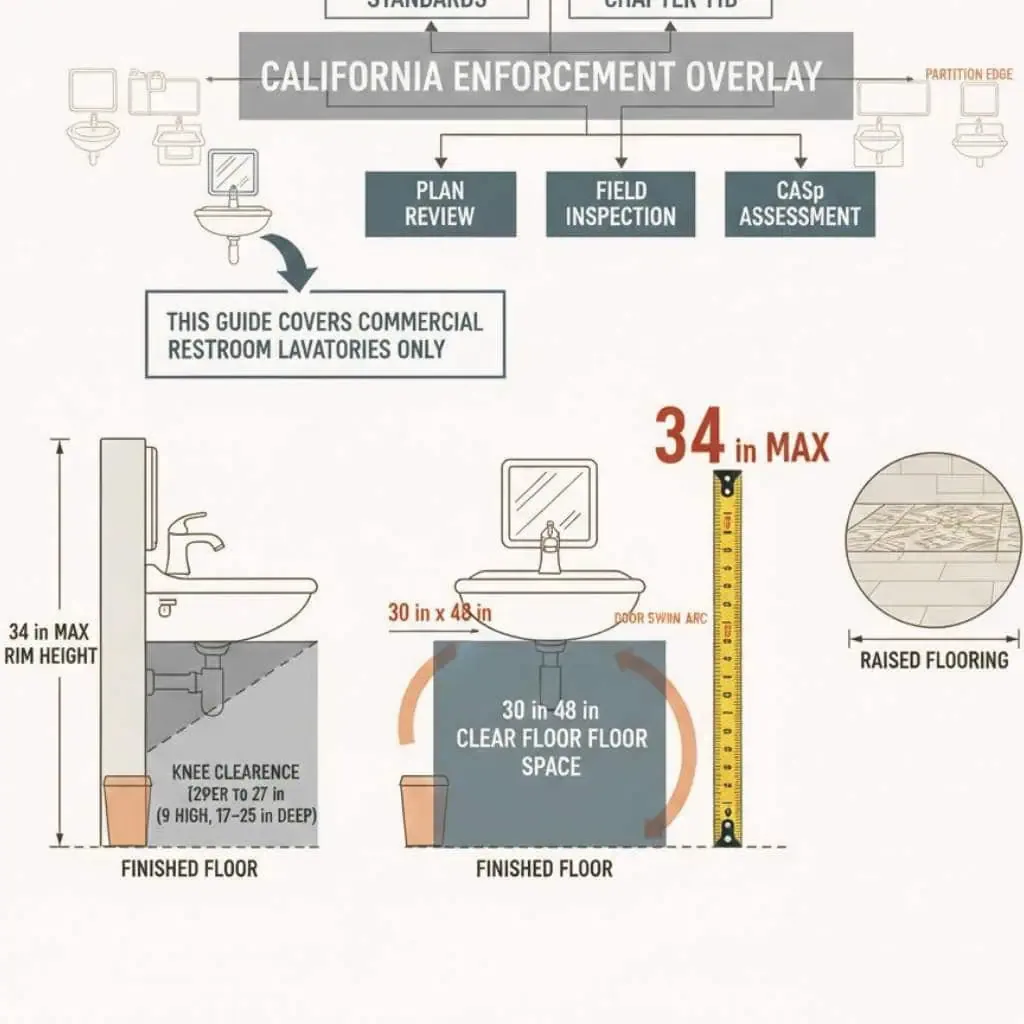
Sink height is one of the first dimensions inspectors verify because it directly affects reach and usability. In California commercial restrooms, the requirement is straightforward, but it is often misunderstood in practice.
Under the ADA and California Building Code Title 24, the maximum allowable height of an accessible sink is 34 inches, measured from the finished floor to the top of the sink rim or counter surface. This limit applies to the highest usable surface at the sink, not to plumbing rough-in dimensions or cabinet design intent.
The reference point matters. Inspectors measure from the finished floor surface, not from the subfloor or slab, and they measure to the actual top edge of the sink or counter as installed. This means flooring thickness, tile buildup, or finish transitions can raise the final height enough to affect how the sink is evaluated. The measurement is taken at the highest point of the rim or counter, not at a lower basin edge.
Installed condition controls compliance. Product specifications, manufacturer labels, or “ADA-compliant” marketing descriptions do not override field measurements. A sink designed to meet height limits on paper can exceed the maximum once installed within cabinetry, set on a countertop, or paired with thicker finishes. Inspectors evaluate what exists at the time of inspection, not what the product was intended to achieve.
This is why sink height is evaluated alongside knee and toe clearance, not in isolation. A sink that meets the height limit but is installed in a way that reduces usable clearance below may still be evaluated differently once the full condition is measured.
Proof references:
2010 ADA Standards for Accessible Design, Section 606.3 (Height)
California Building Code, Title 24, Part 2, Chapter 11B, Section 11B-606.3
What Is ADA Knee Clearance at a Sink?
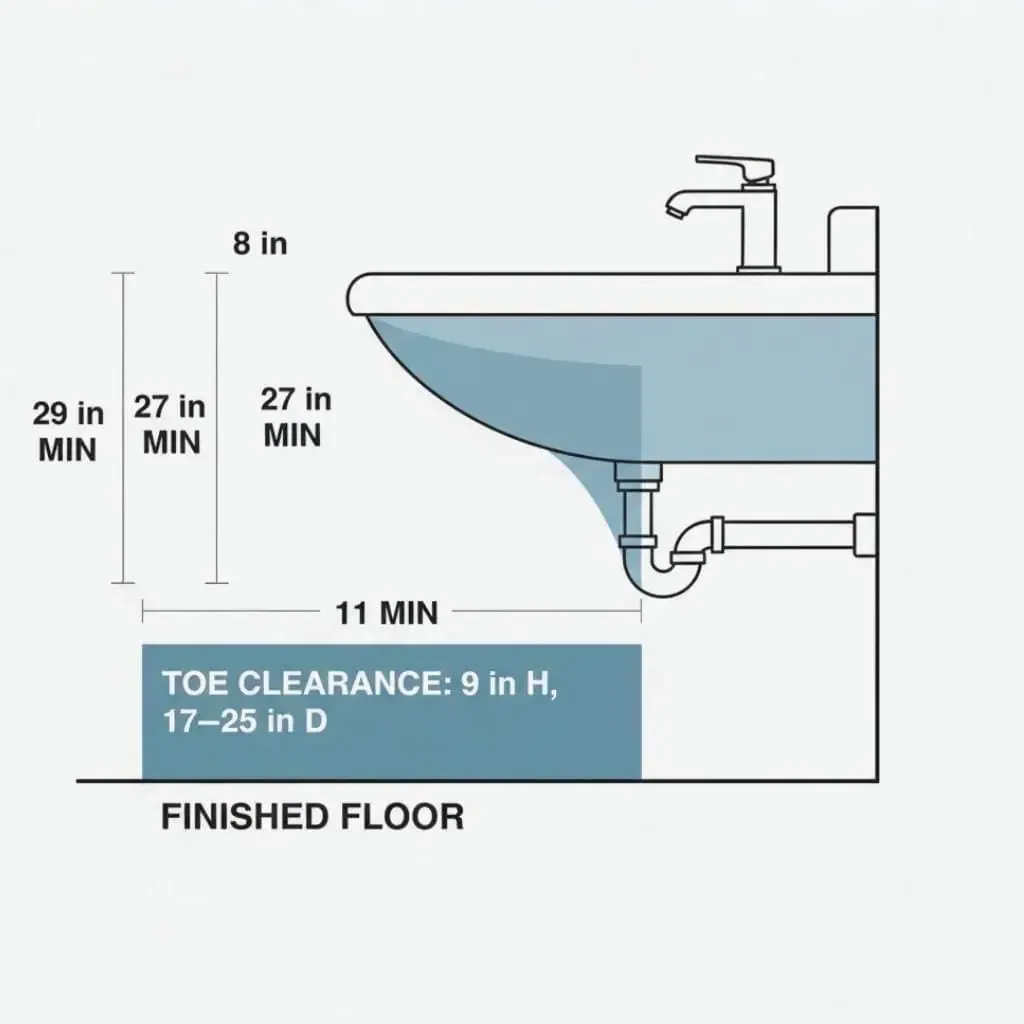
ADA knee clearance at a sink refers to the unobstructed vertical and horizontal space beneath the sink that allows a wheelchair user to roll forward and position their knees under the fixture. In California commercial restrooms, this clearance is not optional or flexible. It is a dimensional requirement evaluated as part of the sink’s overall accessibility, alongside sink height and clear floor space.
The core requirement is functional access, not appearance. Knee clearance ensures a user can approach the sink close enough to reach controls and use the basin without leaning or twisting. When this space is reduced or blocked, the sink may meet height limits and still fail evaluation.
Under federal ADA standards, which California enforces through Title 24, knee clearance is defined by both vertical height and horizontal depth, measured from the finished floor and the front edge of the sink.
Required knee clearance dimensions for accessible lavatories include:
Vertical height: A minimum of 29 inches of clear height is required at the front edge of the sink, measured from the finished floor to the underside of the sink or counter.
Tapered height allowance: The knee space may slope downward to 27 inches minimum at a point 8 inches back from the front edge.
Horizontal depth: A minimum of 11 inches of clear horizontal depth must be provided beneath the sink.
Clear width: The knee clearance must extend across a minimum 30-inch-wide space, aligned with the required clear floor space.
These dimensions are evaluated in the installed condition, not based on fixture specifications or design intent.
How Is Knee Clearance Measured During Inspection?
Inspectors measure knee clearance from the finished floor upward and inward, using multiple reference points to confirm both height and depth. The measurement is taken in the installed condition, not from drawings or manufacturer specifications.
Vertical knee clearance is measured from the finished floor to the underside of the sink or counter at its lowest point. The required clearance must be maintained across the usable width of the sink, not just at a single spot. Inspectors then verify horizontal depth by measuring inward from the front edge of the sink to ensure sufficient space for knee placement.
Depth is not checked once and assumed. Inspectors typically confirm clearance at multiple heights because knee space tapers in many vanity designs. A sink that appears open at the front can still fail if the clearance narrows too quickly underneath.
Common mismeasurement scenarios include:
Measuring from unfinished subfloor instead of finished floor
Measuring to the cabinet face instead of the lowest obstruction
Assuming removable panels or doors “don’t count” when they are installed at inspection
Proof / Sources:
2010 ADA Standards for Accessible Design, Section 306 (Knee and Toe Clearance Measurement Methodology)
California Building Code, Title 24, Chapter 11B, Section 11B-306
California ADA Lavatory Knee and Toe Clearance Requirements (Reference Table)
| Clearance Zone | Dimension Type | Requirement | Measurement Reference | Technical Framing Note |
|---|---|---|---|---|
| Knee Clearance | Vertical Height (Front Edge) | 29 in minimum | Finished floor to underside of sink or counter at front edge | Lavatory-specific requirement under §606.2 modifies general knee clearance rules |
| Knee Clearance | Vertical Height (at 8 in depth) | 27 in minimum | Finished floor to underside measured 8 in back from front edge | Permitted taper from 29 in to 27 in over first 8 in |
| Knee Clearance | Horizontal Depth | 11 in minimum | Measured inward from front edge beneath sink | Depth must be clear of all obstructions |
| Knee Clearance | Clear Width | 30 in minimum | Aligned with required clear floor space | Width must be continuous across knee zone |
| Toe Clearance | Vertical Height | 9 in minimum | Finished floor to lowest obstruction | Applies beneath knee clearance zone |
| Toe Clearance | Horizontal Depth | 17 in minimum, 25 in maximum | Measured inward from front edge | Toe space may extend beyond knee space up to 25 in |
| Toe Clearance | Clear Width | 30 in minimum | Same lateral alignment as clear floor space | Width must remain unobstructed |
| Combined Geometry | Relationship Rule | Toe clearance supplements knee clearance | Evaluated as a single approach geometry | Knee space alone is insufficient for forward approach |
| Measurement Basis | Evaluation Condition | Installed condition only | Finished surfaces, fixed elements in place | Product labels and drawings are not controlling |
These dimensions reflect the enforceable requirements for accessible lavatories under the 2010 ADA Standards and the California Building Code, Title 24, Chapter 11B. Measurements are evaluated in the finished condition during inspection. While toe clearance standards allow depths up to 25 inches for some elements, lavatories are functionally governed by knee clearance geometry, which limits usable toe depth in practice. Always reference the adopted code edition in effect at the time of permit issuance.
What Is ADA Toe Clearance at a Sink?
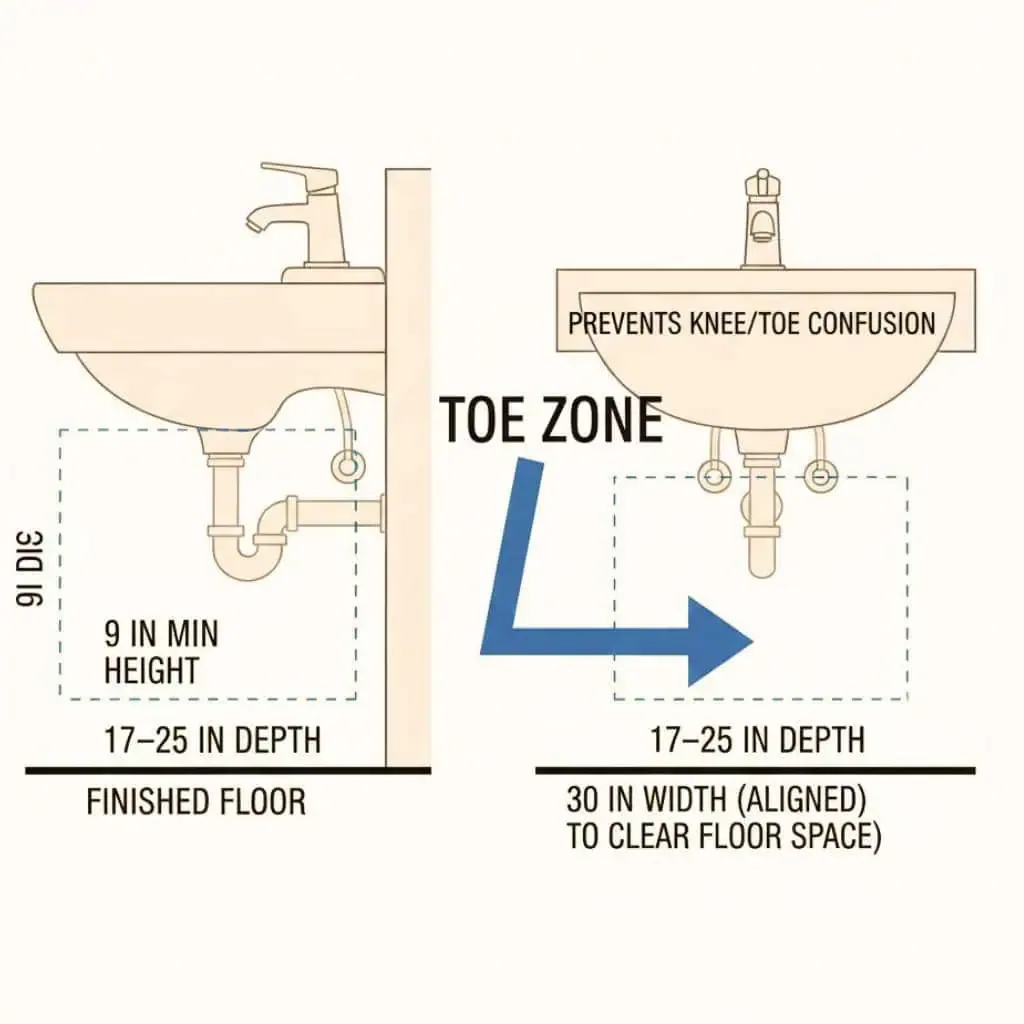
ADA toe clearance is a required open space beneath an accessible sink that allows a wheelchair user’s footrests to move under the fixture during approach. It is a separate requirement from knee clearance and is evaluated independently during inspection.
Toe clearance exists because knee space alone does not allow a full forward approach. Wheelchair footrests extend lower and farther forward than knees. Without dedicated toe space, the user cannot position close enough to the sink to use it safely, even if knee clearance is technically compliant.
Under both the ADA and California Building Code Title 24, toe clearance is treated as part of the required approach geometry, not an optional accommodation.
Required toe clearance dimensions include:
Height: At least 9 inches of vertical clearance measured from the finished floor to the underside of the sink or cabinetry.
Depth: Up to 17 inches maximum of horizontal depth at the toe level beneath the sink, measured from the front edge of the sink or counter.
Width: The clearance must align with the required clear floor space for the sink approach.
Toe clearance is most often lost when base cabinets, decorative panels, or retrofit enclosures extend too low beneath the sink. These conditions commonly appear compliant on drawings but fail once measured in the finished condition.
Inspectors evaluate the condition as present at inspection
Items that routinely occupy the space are treated as obstructions
Intent or assumed removal does not control evaluation
Proof / Sources:
ADA Standards for Accessible Design §306.2, §606.2
California Building Code Title 24, Chapter 11B §306, §11B-606
Forward Approach vs Side Approach Sink Requirements
Sink accessibility is evaluated based on how the finished layout actually allows a user to approach the sink, not how the approach was intended during design. Under the ADA and California standards, inspectors first determine whether the built condition supports a forward approach or a side approach. That determination controls which knee clearance, toe clearance, and reach range measurements are applied during plan review and field evaluation.
A forward approach is permitted only when a user can roll directly toward the sink, centered on the basin, with unobstructed space in front. In this configuration, knee and toe clearance must be provided directly beneath the sink, and reach ranges are evaluated from a frontal position. This approach is typical in layouts where walls, cabinetry, and adjacent fixtures allow full frontal alignment without interference.
A side approach applies when a forward roll-in position is physically blocked by walls, casework, partitions, or adjacent fixtures. In these cases, inspectors evaluate reach ranges and clearances from a lateral position relative to the sink. Knee and toe clearance requirements still apply, but the measurement relationships shift. A layout that prevents frontal alignment cannot be evaluated as a forward approach, even if forward-approach dimensions appear compliant on drawings.
This distinction is a common source of plan review and inspection findings. A frequent error is designing clearances for a forward approach in spaces that only support side access once doors, partitions, or fixtures are installed. Another recurring issue is assuming that providing knee clearance alone establishes the approach type. It does not. Inspectors apply the approach dictated by the physical layout, and measurements are evaluated accordingly.
Understanding which approach a sink truly supports matters because approach type determines how compliance is measured, not the reverse.
What Operable Parts and Faucet Controls Are Required at Accessible Sinks?
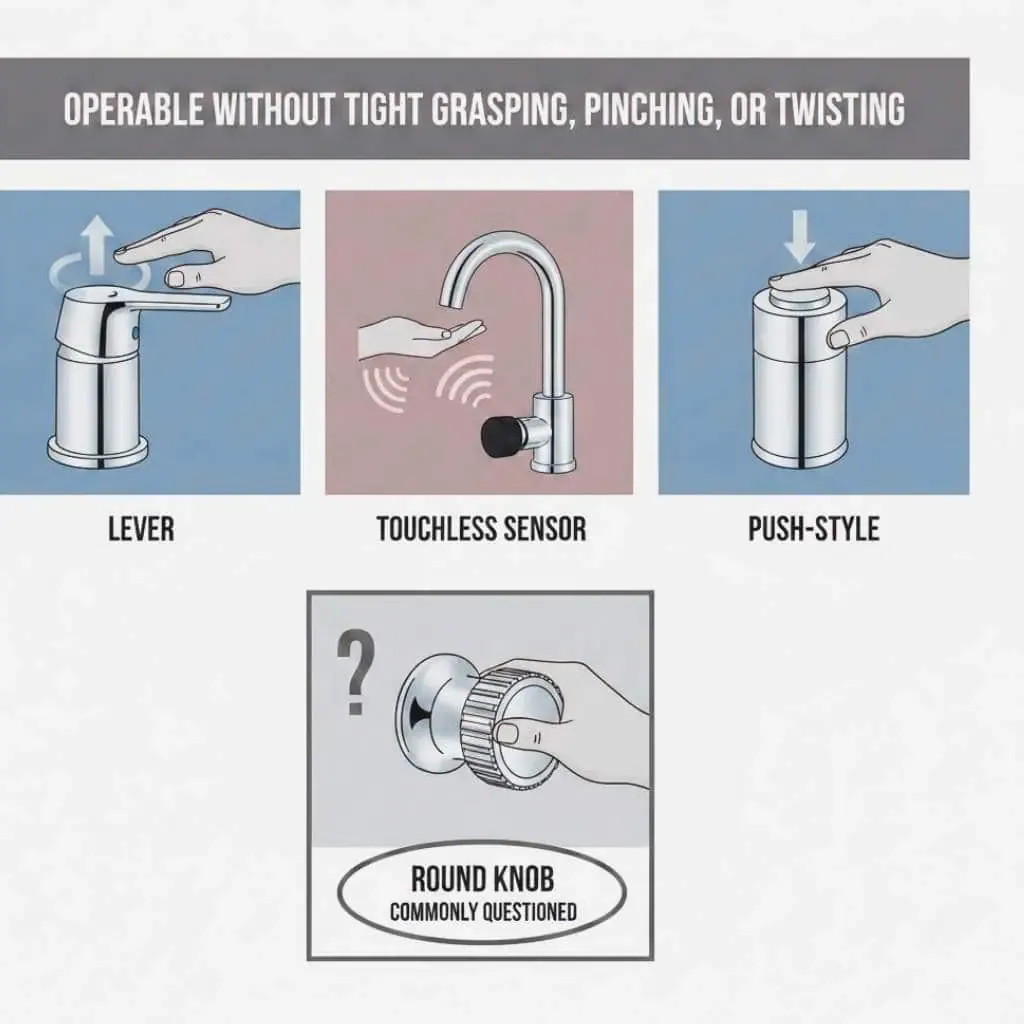
Sink accessibility is evaluated not only on clearances and heights, but also on whether a user can operate the faucet controls as installed. Under the ADA and California accessibility standards, operable parts are assessed independently because a sink that cannot be turned on or adjusted without difficulty does not function as intended, even when all dimensional criteria are met.
Accessible faucet controls must be operable without tight grasping, pinching, or twisting of the wrist, and must function using one hand with limited force. During inspection, this is evaluated based on physical operation, not manufacturer labeling or product descriptions. Controls that require finger strength, rotational grip, or sustained pressure are commonly identified as inconsistent with operability requirements.
Both manual and sensor-operated faucets are permitted, but inspectors evaluate them differently. Lever-type, push-style, touchless, and electronically controlled faucets are often compatible with accessibility standards when their activation method functions reliably in the installed condition. Fixtures with round knobs, small recessed actuators, or spring-loaded mechanisms are more frequently questioned because their operation depends on grip strength, dexterity, or sustained effort.
Certain fixture conditions are repeatedly documented during evaluation, including:
Twist-handle faucets that require wrist rotation to adjust flow or temperature
Small or recessed controls that limit full hand contact
Push-button faucets that require continuous force to maintain water flow
Sensor faucets with delayed, inconsistent, or narrowly calibrated activation zones
These issues are identified because operable parts are tested during inspection, not inferred. If a control cannot be activated and adjusted in a straightforward manner using one hand and minimal effort, it may not align with operability requirements, regardless of sink height or clearance compliance.
Proof / Sources:
2010 ADA Standards for Accessible Design, §309 (Operable Parts)
2010 ADA Standards for Accessible Design, §606.4 (Faucets and Controls)
What Under-Sink Conditions and Pipe Protection Are Required?
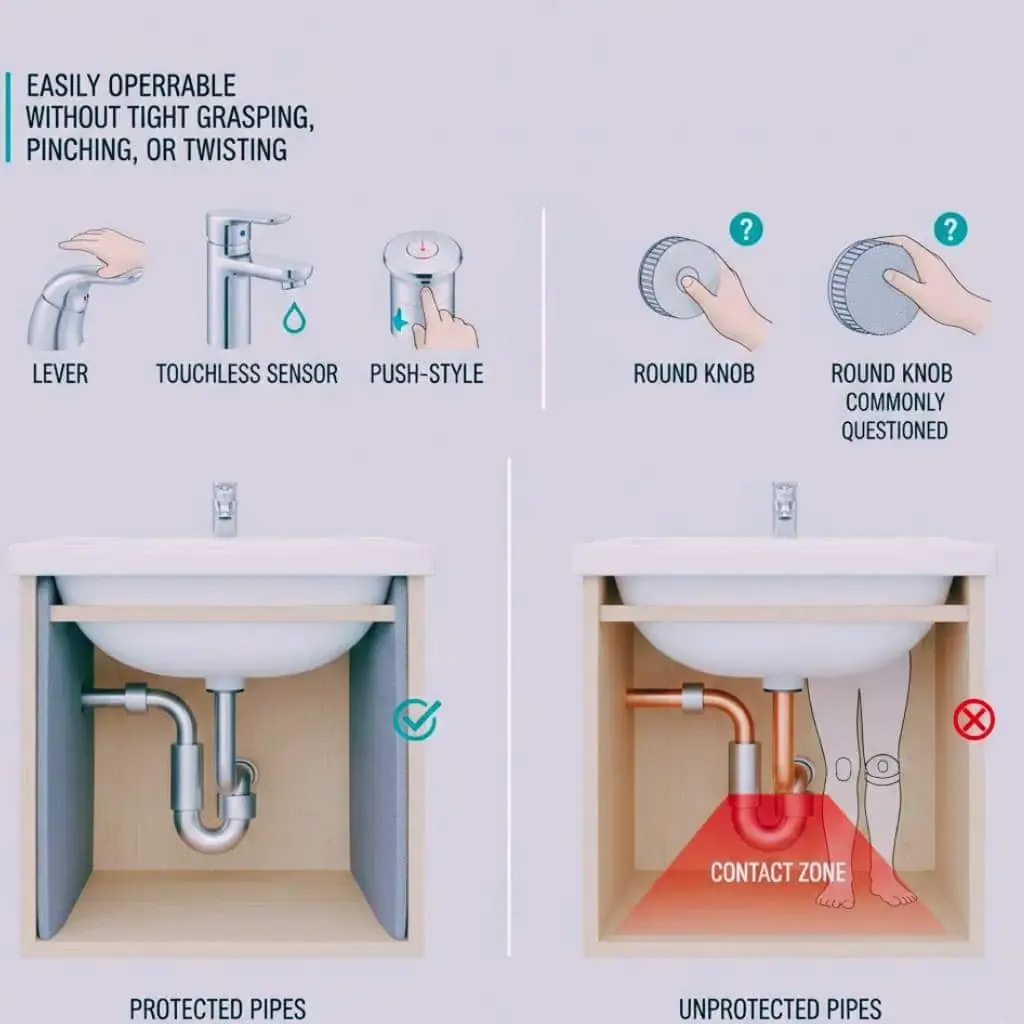
Under California and federal accessibility standards, conditions beneath an accessible sink are evaluated separately from clearance requirements. Knee and toe clearance address space for approach and use. Pipe protection addresses contact safety during normal operation.
Accessible sinks must not expose users to hot surfaces, sharp edges, or abrasive components beneath the basin. During evaluation, inspectors assess whether incidental contact is likely when a person approaches, reaches, or positions their legs under the sink, not whether contact is intentional.
Both supply and drain pipes located within the knee and toe clearance zone are required to be protected. This typically includes insulation or protective coverings that fully shield exposed surfaces. The requirement applies to the installed condition, not the fixture design or manufacturer intent.
What matters during inspection is not how the space was designed, but whether any exposed surface beneath the sink could reasonably be contacted during normal use. If contact is possible and the surface is unprotected, the condition does not align with applicable accessibility requirements.
Common failures occur during retrofits. Pipe insulation is often omitted after plumbing work, removed during maintenance, or interrupted by brackets, valves, or offsets added later. In other cases, sharp cabinet edges, unfinished panels, or exposed traps introduce hazards even when pipe insulation is present.
These provisions are applied consistently because under-sink conditions directly affect usability and physical safety during sink use, independent of whether clearances elsewhere meet dimensional criteria.
Proof / Sources:
2010 ADA Standards for Accessible Design §606.5
California Building Code, Title 24, Chapter 11B §11B-606.5
What Obstructions Are Not Allowed Under or Around Accessible Sinks?
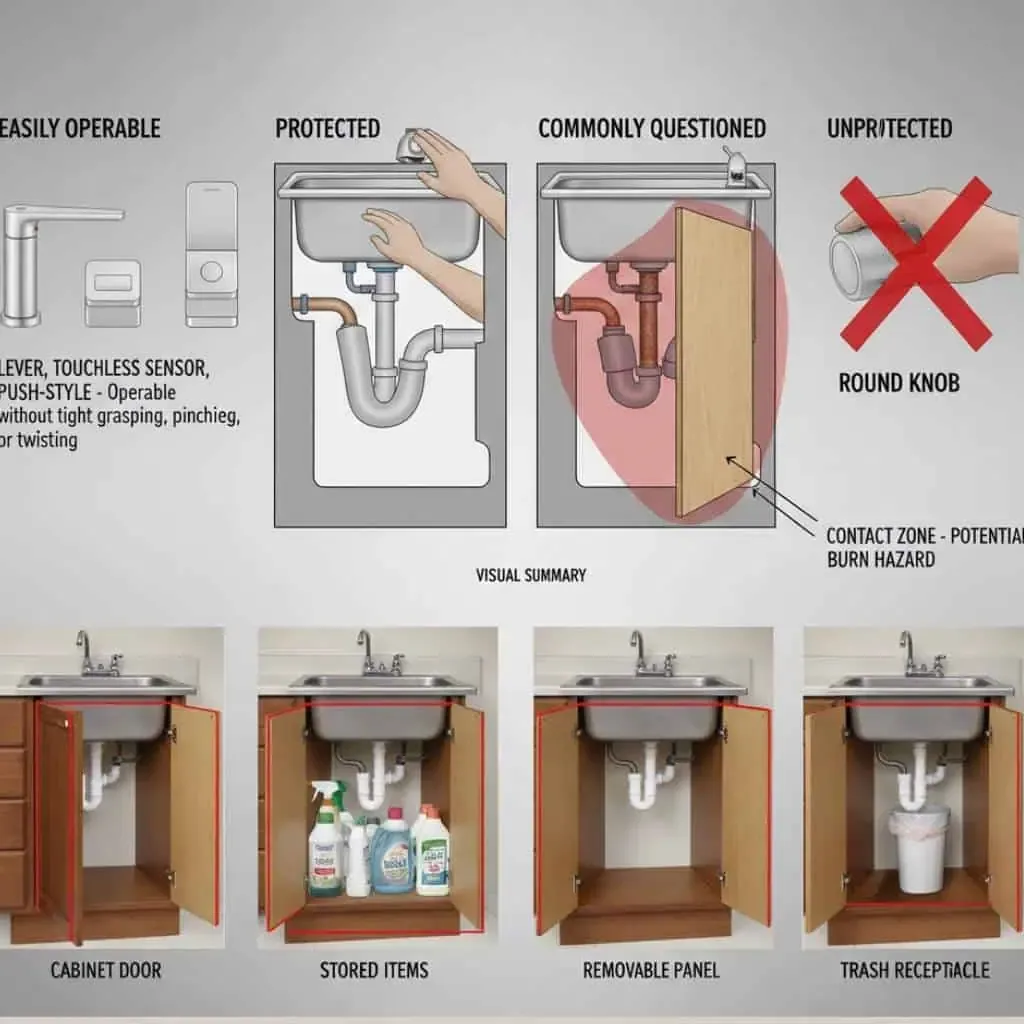
Accessible sink requirements extend beyond height and clearance measurements. Inspectors evaluate the entire sink use zone as it exists at the time of inspection, including what occupies the space below and around the fixture. Elements that interfere with knee or toe clearance are not treated as secondary details. They are evaluated as part of the sink’s functional accessibility.
Under California enforcement, objects located beneath or immediately adjacent to an accessible sink are assessed in their installed condition, not based on how they are intended to be used or removed.
The following conditions are not permitted where they interfere with required clearance:
Cabinet bases or fixed storage
Base cabinets, drawer units, or built-in storage beneath the sink eliminate required knee and toe clearance. Even shallow cabinets reduce usable depth and are Commonly cited during field and CASp evaluations.Doors or panels that obstruct clearance
Hinged or sliding cabinet doors that swing into the knee or toe space are treated as obstructions, regardless of how often they are left open. Inspectors evaluate clearance with doors in their closed and operable position, not in a preferred or assumed state.Removable or lockable access panels
Panels described as removable, temporary, or “maintenance access” do not preserve clearance. If a panel is installed at inspection, it is evaluated as a fixed obstruction. Lockability does not change this assessment.Stored items or informal barriers
Trash receptacles, cleaning supplies, or stored materials placed under or beside the sink reduce required clearance. These are not considered temporary during inspection and are frequent causes of noncompliant findings.
These obstructions matter because knee and toe clearance are not optional allowances. They are required to ensure a user can approach, position, and use the sink independently. Any element that intrudes into that space changes how the sink functions and is evaluated accordingly.
Proof / Sources:
ADA Standards for Accessible Design §606, §306
California Building Code Title 24, Chapter 11B §11B-606, §11B-306
How Inspectors Measure Sink Clearance in the Field
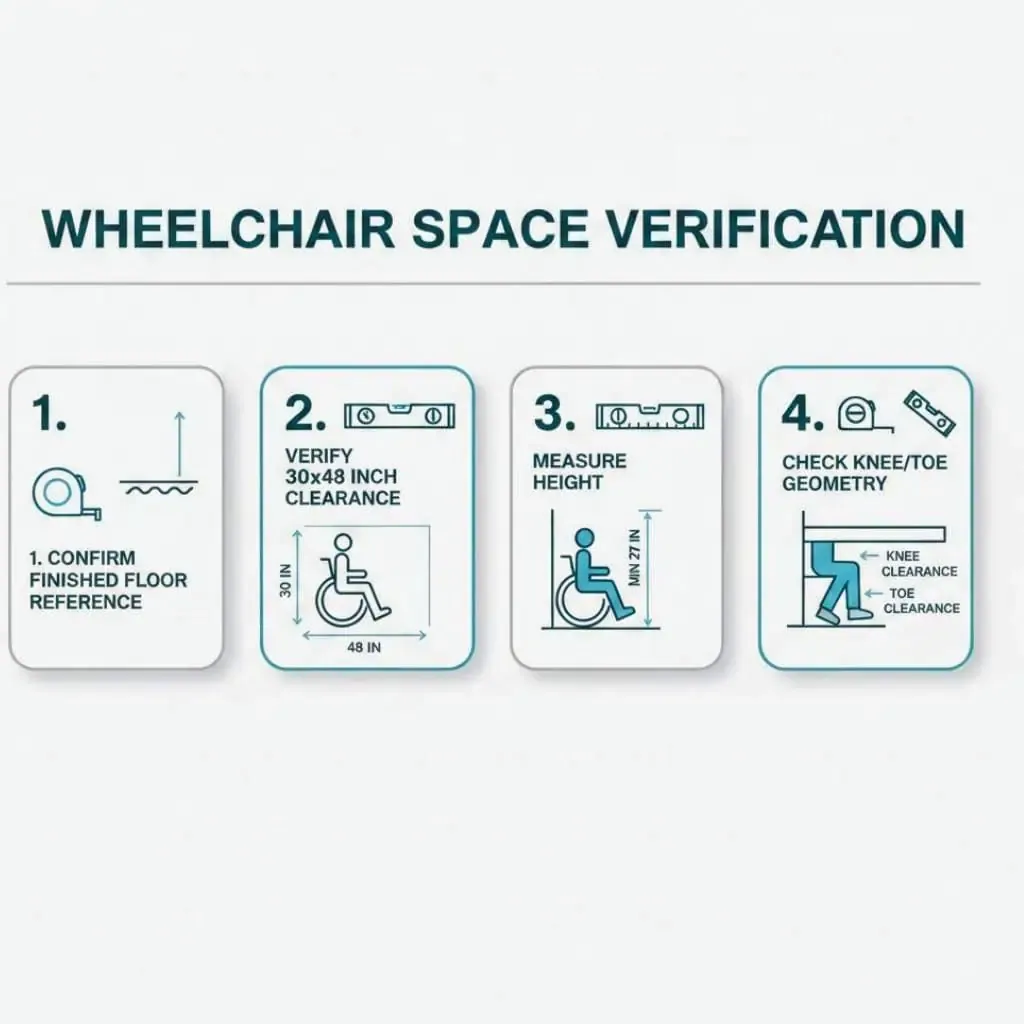
Once dimensional requirements are defined, enforcement depends on how conditions are evaluated as built, not how they appear on plans or product specifications. Sink clearance compliance is determined through field measurement of the installed condition, using fixed reference points and standardized inspection practices.
Inspectors measure what physically exists at the time of inspection. Drawings, manufacturer cut sheets, and stated product dimensions are not controlling if the installed condition differs. Flooring thickness, mounting height, cabinetry depth, and pipe routing all affect final clearances and are evaluated together.
Measurements are taken from the finished floor surface and adjacent finished elements. Inspectors typically verify clear floor space first, then confirm sink height, followed by knee and toe clearance dimensions beneath the sink. Each dimension is checked independently, but compliance is assessed based on how the sink functions as a single accessible use zone.
This approach explains why conditions that appear close to compliant are still cited. Small encroachments from cabinetry, angled pipe covers, or shallow knee space often reduce usable clearance below required dimensions. Because accessibility standards are dimension-based and use measurable thresholds, inspectors document actual measurements rather than intent or tolerance.
Source references:
ADA Standards for Accessible Design §§305, 306, 606
California Building Code, Title 24, Chapter 11B §§11B-305, 11B-306, 11B-606
Common CASp Findings Related to Sink Clearance
After reviewing enough commercial restrooms, certain sink clearance issues appear repeatedly across CASp evaluations. These findings are not edge cases or subjective interpretations. They reflect conditions that consistently interfere with usable knee and toe space in the installed condition, which is a core factor inspectors document during accessibility evaluations.
The most frequent findings involve conditions that technically exist on plans but fail once the space is built. Added finishes, cabinetry choices, or late-stage fixture substitutions often reduce required clearances below enforceable thresholds. These changes are rarely intentional. They occur because sink compliance is evaluated based on actual, finished conditions, not design intent or product specifications.
Commonly documented findings include reduced knee clearance caused by under-sink cabinetry, toe space blocked by base panels or storage, and clear floor space intruded upon by doors or accessories added after rough-in. These conditions are cited because they directly affect whether a user can approach and use the sink as intended, not because they are visually obvious or labeled as violations during construction.
Corrections that require the most rework typically involve conditions discovered after finishes are complete. Cabinet removal, pipe reconfiguration, wall repairs, and fixture relocation are common outcomes once clearance conflicts are documented. These issues are prioritized in CASp reports because they are usability-critical and cannot be resolved through minor adjustments alone.
Early verification matters in this context because sink clearance conditions are evaluated as a system, not as isolated dimensions. When knee space, toe space, approach clearance, and operable parts interact incorrectly, the sink no longer functions as an accessible element, even if individual measurements appear close. This is why these findings appear consistently and are documented early during evaluations.
Proof / Sources: CASp field evaluation practices [NEEDS SOURCE]
Can ADA Compliant Sinks Still Fail in California?
Yes. An ADA compliant label on a sink does not determine compliance in California. That label reflects how a product was designed or tested in isolation. California enforcement is based on how the sink is installed and functions in the finished restroom, not how it is marketed or specified.
Here’s what that means in practice. Accessibility standards are enforced against measured field conditions, not product labels or manufacturer designations. A sink that meets dimensional criteria on a cut sheet can fall out of compliance once it is installed with real-world variables such as floor finishes, wall construction, cabinetry, or plumbing layout. Inspectors evaluate what exists in the field, measured from the finished floor and surrounding surfaces, not what a manufacturer intended.
Installation choices are the most common disconnect. Counter thickness, mounting height, decorative panels, pipe routing, and added insulation all affect knee clearance, toe clearance, and reach. Even small finish changes can reduce required clearances below minimums. The sink itself has not changed, but the condition being evaluated has.
Inspection outcomes reflect this distinction. During plan review, field inspection, or CASp evaluation, inspectors document the installed condition at the time of inspection. Product labels, catalog descriptions, or prior approvals do not override measured conditions. Compliance is determined by how the sink performs within the completed restroom layout, not by its designation as “ADA compliant.”
Sources:
ADA enforcement guidance and inspection practice principles [NEEDS SOURCE]
When Do Sink Alterations Trigger Compliance Requirements?

Before focusing on dimensions, it is critical to understand when sink work is treated as regulated alteration versus routine maintenance. This distinction determines whether accessibility requirements are re-evaluated or left unchanged. Many compliance issues arise not from new construction, but from small restroom updates that quietly cross this line.
Under both the ADA and the California Building Code, accessibility obligations are triggered by regulated alterations, not basic upkeep. Maintenance preserves existing conditions. Alterations modify them. That difference controls whether sink height, knee clearance, toe clearance, and approach space are re-examined.
Maintenance vs alteration is not about cost or effort. It is about whether the work changes usability, layout, or fixed elements.
Common scenarios that are typically treated as alterations include replacing a sink with a different model, modifying cabinetry below a sink, changing counter thickness, relocating plumbing, or reconfiguring walls or partitions around a lavatory. These changes affect clearances and reach ranges, which brings accessibility requirements back into scope.
By contrast, routine maintenance generally includes in-kind repairs such as replacing faucet cartridges, repairing leaks, or restoring finishes without changing dimensions or configuration. These actions usually do not expand compliance scope on their own.
Once work is classified as an alteration and permitted, accessibility standards apply to the altered elements and, in some cases, to related features within the same restroom, which is why commercial building accessibility evaluations consider sink conditions within the broader context of the building and project scope.
There is no blanket exemption for limited work. When alterations affect restroom usability, accessibility requirements apply to the elements within the scope of work, based on the adopted code in effect at the time of permitting. This is why sink-related alterations are a common point where previously acceptable layouts are re-evaluated and documented differently during inspection.
Sources:
Americans with Disabilities Act Standards for Accessible Design, Alterations Provisions (28 CFR Part 36)
California Building Code, Title 24, General Accessibility and Alteration Triggers
Understanding California ADA Sink and Clearance Requirements as a System
California ADA sink and knee/toe clearance requirements are not a checklist of isolated measurements. They function as a single accessibility system that determines whether a person can approach, position, and use a lavatory independently. Sink height, knee clearance, toe clearance, clear floor space, approach type, operable controls, and under-sink conditions are evaluated together, based on how the sink performs in its installed condition.
What often creates confusion is not the standards themselves, but how they are applied. Federal ADA provisions establish the baseline, while California’s Building Code adds enforcement specificity. Once a sink is altered under permit, inspectors document the as-built condition, not product labels, design intent, or prior approvals. Small changes such as added cabinetry, finish thickness, or fixture substitutions can alter clearance relationships enough to change how requirements apply.
This is why accessibility outcomes vary between projects that appear similar on paper. Compliance is evaluated contextually, based on building use, project scope, and adopted code edition. There is no universal shortcut, no labeling that overrides measurement, and no assumption that past conditions remain acceptable after alteration.
Property owners, designers, and project teams who understand sink accessibility as an integrated system are better equipped to interpret inspection findings, evaluate project scope responsibly, and plan restroom modifications with fewer surprises. Clarity comes from understanding how requirements interact, not from treating individual dimensions in isolation.

Written by Emily Johnson
Emily Johnson is a Certified Access Specialist (CASp) Inspector and is passionate about making spaces accessible for all. With over 10 years of experience and degrees in Civil Engineering and Architecture, she inspires others while championing ADA awareness.
Recent Posts
Categories
Subscribe to our Newsletter
Join our mailing list and receive special offers, updates, and discounted packages directly to your email.
By clicking “Submit”, you are signing up to receiving emails from us. You can unsubscribe whenever you like. SMS rates may apply.
Other Blog Posts
From average costs to expert advice, get all the answers you need to get your job done.