ADA Bathroom Dimensions in California: Exact Measurements You Must Meet
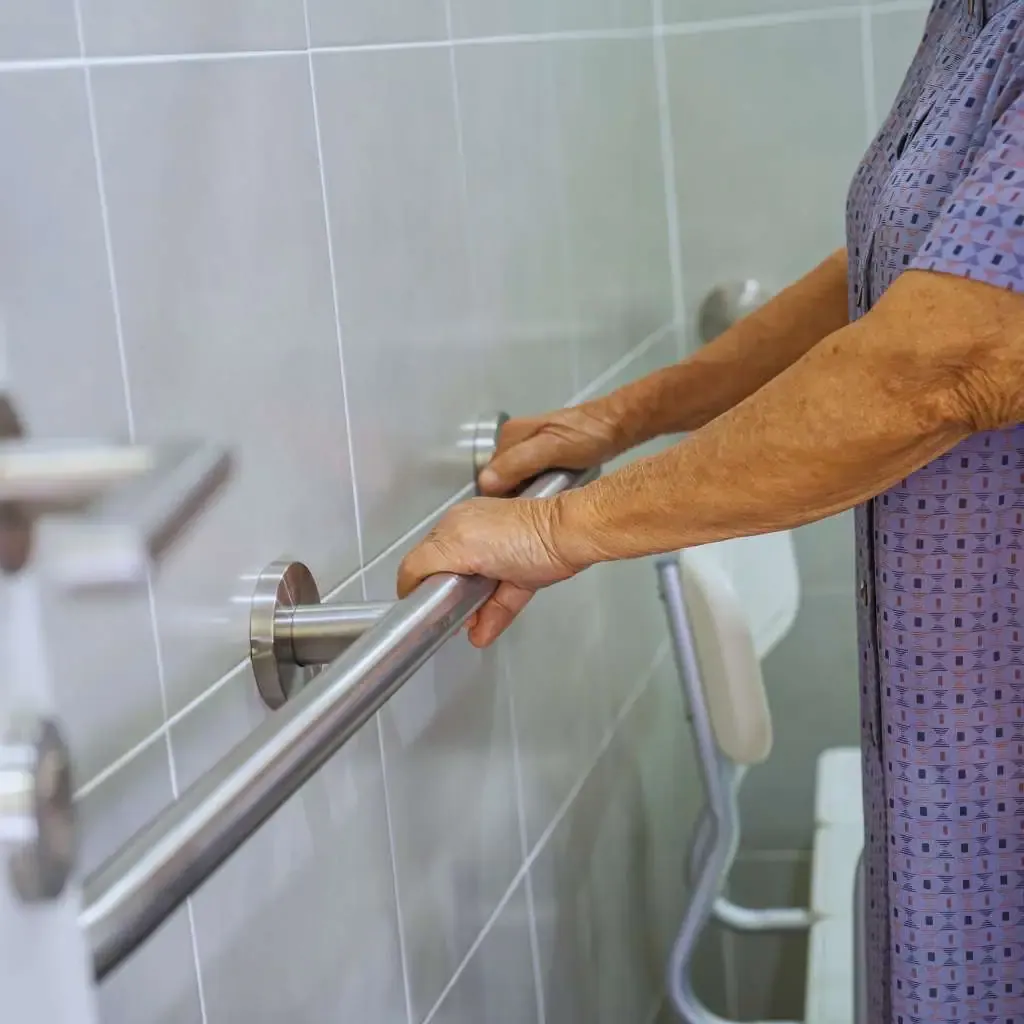
ADA bathroom dimensions refer to the legally required clearances, heights, reach ranges, and maneuvering spaces that ensure a restroom is fully accessible under federal ADA Standards and California Title 24. In California, these measurements aren’t optional. They decide whether your bathroom passes a CASp inspection, qualifies for Safe Harbor protections, and avoids the lawsuits that hit many owners each year.
You’re expected to meet two systems at the same time: federal ADA rules and California’s stricter building code. Here’s what that means for you. Every clearance must be measured accurately. Every fixture must fall within a narrow dimension range. And remodels or tenant improvements can trigger immediate compliance.
This article explains the exact measurements you must follow today, why California adds requirements the federal ADA doesn’t cover, and how to avoid the dimensional mistakes that repeatedly show up in inspection failure.
What Bathroom Dimensions Mean Under ADA and California Title 24

When people talk about bathroom dimensions in accessibility law, they’re not describing design preferences. They’re talking about legally required clearances that control how much space a wheelchair user has to move, turn, reach, and transfer safely. California applies two rulebooks the federal ADA Standards and the stricter California Title 24 and both must be followed whenever bathroom spaces are built, remodeled, or inspected. These measurements decide whether a restroom passes a CASp inspection or becomes a liability risk.
What Codes Set Bathroom Dimensions in California?
Before you measure anything, you need to know which codes apply. Here’s the structure California uses:
ADA 2010 Standards set nationwide accessibility rules.
California Title 24, Part 2, Chapter 11B adds state-specific requirements that are often more demanding.
CASp inspectors verify compliance by measuring every clearance against both sets of rules.
Here’s what that means: if California’s measurement is stricter, that is the one you must meet. This is why owners sometimes fail inspections even when they believe they followed “ADA guidelines” they found online those guides rarely reflect California’s additional dimensional rules.
Which California Bathrooms Must Meet These Dimensions?
If a bathroom is accessible to the public or employees, you’re expected to meet these measurements. That includes small cafés, large retail centers, medical offices, gyms, schools, and any restroom a customer, patient, or visitor can access.
Even employee-only restrooms must follow the dimensional rules once the space is part of an accessible work area. And for single-user rooms, the same turning clearances, approach routes, and fixture spacing apply the code doesn’t loosen just because it’s a private, lockable room.
If someone can walk in, the law applies.
Why Dimensions Matter for Compliance and CASp Inspections
Dimensions aren’t abstract numbers; they solve real hazards. A missing inch of clearance beside the toilet can prevent a safe side transfer. A door that swings too far into a room can trap someone who uses a mobility device. A mirror mounted a few inches too high excludes entire groups of users.
This is why dimensional errors are the number-one cause of CASp inspection failures across California. Owners usually think their contractor “got it close enough.” In accessibility work, close isn’t compliant the measurement must meet the code exactly.
When a CASp inspector checks your restroom, these are the clearances they verify down to the fraction of an inch. Any shortfall becomes a recorded violation, and if the space is under scrutiny because of a complaint or lawsuit, those measurements matter even more.
Essential Dimension Rules to Get Right in California Bathrooms
- 60-inch turning radius
A full five foot circle is required so a wheelchair user can pivot without obstruction. Anything intruding into that circle sinks, waste bins, dispensers, baby changing tables is a violation, and this is one of the most common CASp failures. - 17-inch toilet centerline (California-specific)
Title 24 requires a strict 17-inch centerline, not the ADA range of 16–18 inches. Many bathrooms miss by half an inch once tile, drywall, or grab bar backing is added. - 34-inch maximum sink height
California pairs this with stricter knee and toe clearances, which means cabinetry, traps, or exposed piping often cause failure even when the top surface is compliant. - 56–59-inch stall depth
This depends on whether the toilet is floor-mounted (56 inches) or wall-mounted (59 inches). Older buildings often fall short and cannot simply “move the partition” because it requires adjusting clearances and door swing. - Reach ranges (typically 15–48 inches)
Controls, dispensers, and hand dryers must be within reach without twisting, leaning, or obstruction. California imposes tighter limits when objects sit in an alcove or above counters, so placement must be precise.
Why this matters
These measurements determine whether a disabled user can safely enter, turn, position, transfer, and exit the restroom without assistance. In real inspections, these are the five points where entire restrooms fail and where small mistakes carry big legal and financial consequences.
Required Stall Dimensions in California (ADA + Title 24 Differences)
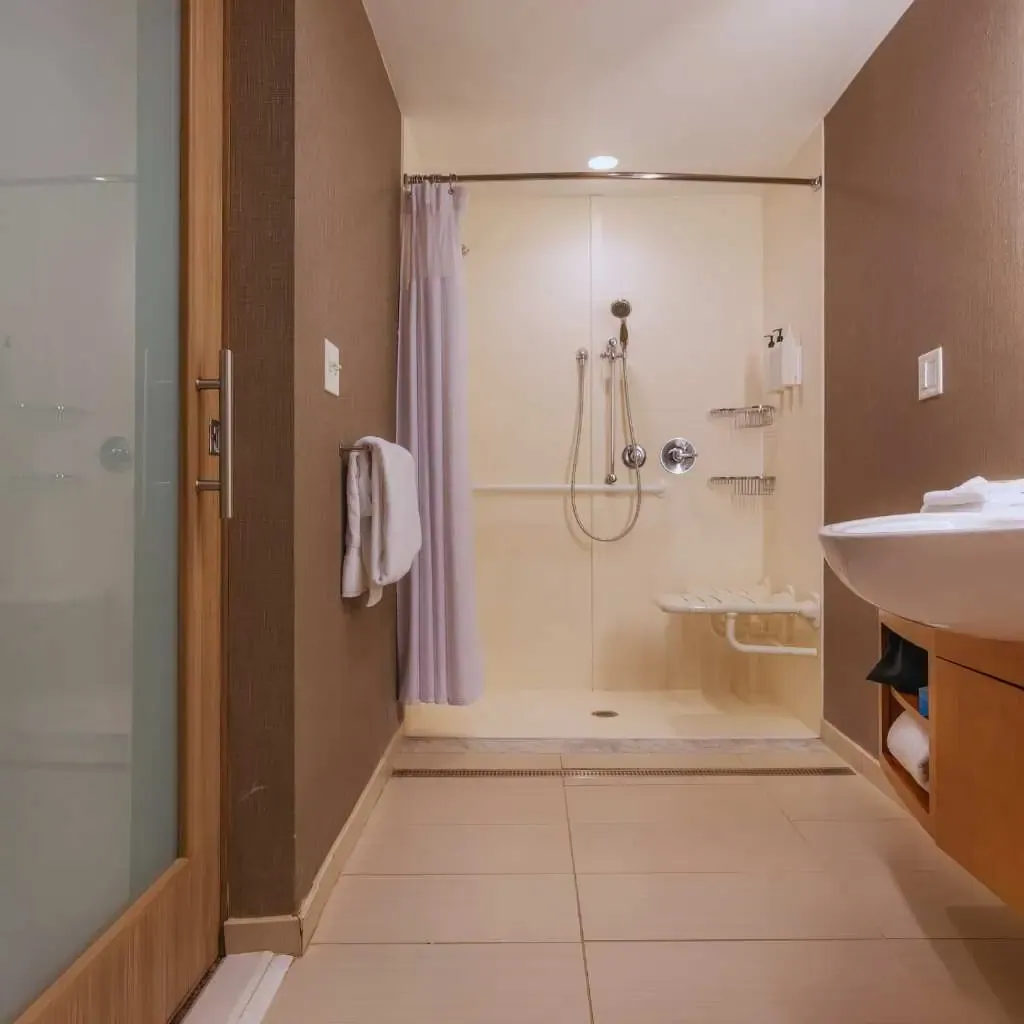
Stall sizing is the backbone of bathroom accessibility. When a stall is too narrow, too shallow, or misaligned by even an inch, a wheelchair user cannot make a safe transfer. Both ADA and California Title 24 define very specific measurements, and a CASp inspection will check every one of them. Here’s what these rules actually require and why stalls fail so often in California.
What Is the Minimum ADA Stall Size?
Yes. The ADA sets a minimum stall width of 60 inches and a depth of 56–59 inches.
The exact depth depends on the toilet type:
56 inches deep for wall-mounted toilets
59 inches deep for floor-mounted toilets
California accepts these dimensions as the federal baseline. The problems start when contractors “round” measurements or install partitions that steal an inch of the required width. ADA stalls are unforgiving the dimensions must be exact, not approximate.
California Title 24 Stall Size Requirements (Where Rules Differ)
California adds several rules that tighten the ADA baseline. These differences often catch owners off guard during a CASp inspection.
Exact 17-inch centerline requirement
ADA allows a range of 16–18 inches. California does not. The centerline must land at exactly 17 inches, and CASp inspectors measure this with precision.Stricter toe clearance rules
California requires specific amounts of toe space beneath partitions to allow mobility devices to maneuver correctly. When this space is closed off, the stall effectively becomes smaller than the code permits.Partition thickness affects stall width
Many builders forget that the 60-inch width is measured clear inside dimension, not wall-to-partition. A modest partition thickness can instantly make a compliant design non-compliant.Door swing limitations
A door that swings into clear floor space can void the entire layout. California enforces this strictly because it directly affects transfer safety.
Here’s what that means: even if you believe the stall meets ADA rules, it can still fail under Title 24 because the measurements must work under both systems.
Side-Approach vs Forward-Approach Stalls (Which One Applies?)
Bathroom stalls are designed for different transfer methods. CASp inspectors look closely at which layout you use and whether the measurements support that type of transfer.
Side-approach stalls require enough clear space beside the toilet for a lateral transfer.
Forward-approach stalls require deeper clearance in front of the toilet.
A frequent issue in California is that owners design a stall with one method in mind but unintentionally create dimensions suited for the other. That confusion leads to violations, even when the stall appears “large enough.”
Door Swing and Latch Clearance Requirements
The way the door swings and how much room the user has to reach the latch is a major compliance factor.
You need enough maneuvering space for a wheelchair user to enter, close the door, and exit without obstruction. Problems usually appear in compact rooms where the door cuts into turning space or blocks access to the grab bar.
Three patterns cause most failures:
Inward-swinging doors that reduce the usable clearance
Latches positioned too far from the approach side
Rooms that lose turning radius once the door is closed
Many of these issues are invisible on paper but become obvious the moment a CASp inspector measures the real space.
Most Frequent Stall Violations Found in CASp Reports
These are the stall problems that show up again and again across California:
Incorrect toilet centerline measurement — anything other than 17 inches triggers a violation.
Door swinging into the turning radius — prevents safe entry and exit.
Grab bars installed outside the allowable height range — often caused by misreading Title 24 diagrams.
Stall too narrow because of partition thickness — the design appears correct, but installation reduces the clear width.
Each of these issues is preventable when measurements are taken early and verified before construction finishes. Once the stall is built, fixing these errors becomes far more expensive. Once tile, partitions, and plumbing are in place, even a one-inch correction may require demolition. That’s why many owners ask for ADA bathroom consulting early in the process to confirm these dimensions before construction is finalized:
Turning Radius Requirements in California Bathrooms
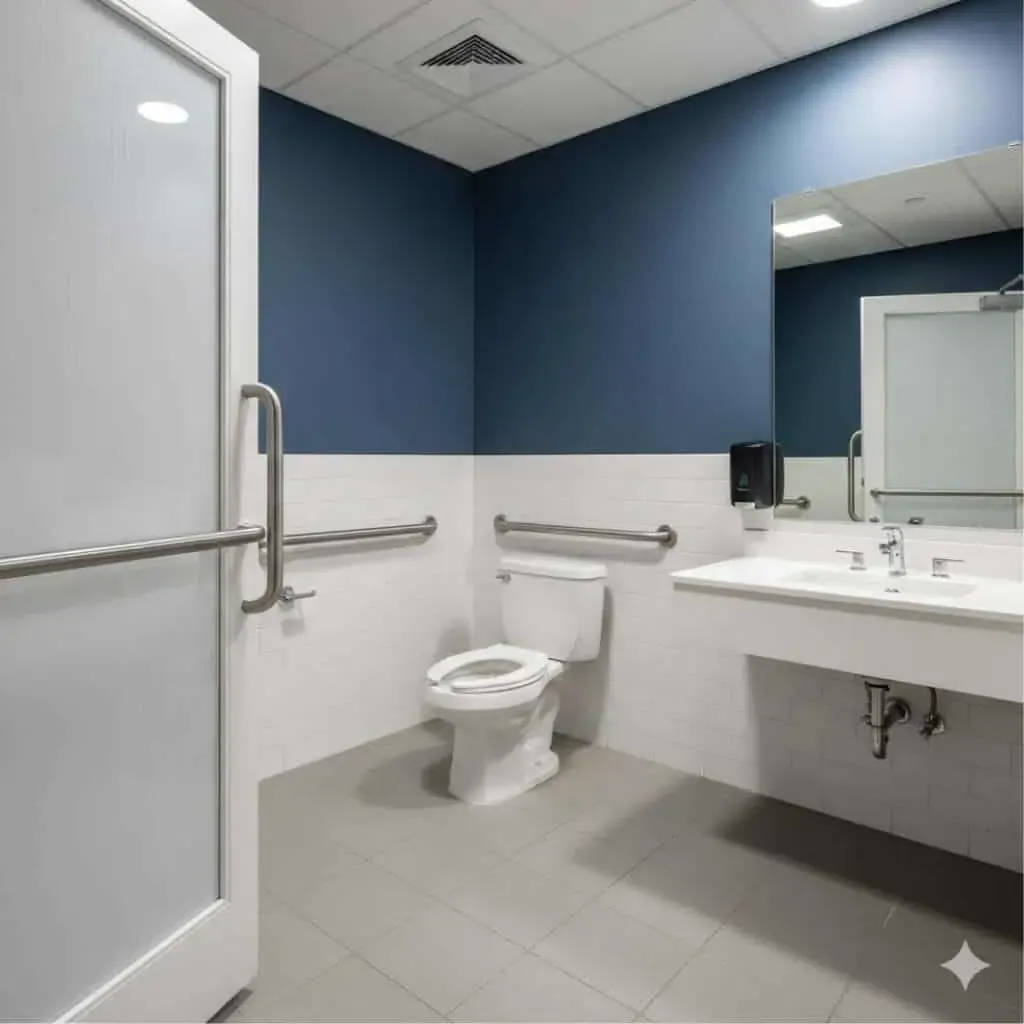
Urning space is one of the most common reasons bathrooms fail accessibility checks. Even when drawings look compliant, the real room often tells a different story. Fixtures drift, door swings get overlooked, and tight layouts leave wheelchairs with no clear way to rotate. California enforces this space strictly because even a small obstruction can trap a user or block a safe transfer.
What Is the Required Turning Space?
Yes. You must provide a 60-inch turning circle or a compliant T-turn.
This space has to be fully usable, not theoretical. Inspectors measure from finished surfaces and look at how a wheelchair actually moves not how the plans intended it to move. California Title 24 follows the same minimum diameter but applies far less tolerance during field inspections, which is why marginal layouts often fail here.
When California Requires More Than the Federal Standard
A room can “meet the numbers” yet still fail if movement is restricted in practice. California flags these issues more aggressively:
Protruding objects
Items like shelves and coat hooks extend into the turning arc and cut usable space. Inspectors check the real-world clearance, not the paper layout.Recessed fixtures
Dispensers and hand dryers—even recessed ones—can narrow the turning path if placed too close to the diameter.Alcoves
A turning circle partly inside an alcove only works if the wheelchair can enter and exit cleanly. Many rooms fail here because the geometry works but the movement doesn’t.
How to Measure Turning Radius in a Tight Bathroom
One of the most common complaints on Reddit is: “My bathroom was compliant in the plans but failed inspection.”
That usually means measurements were taken to theoretical lines instead of the surfaces users touch. Turning space must be measured edge to edge, including partition thickness, door intrusion, and fixture projection. Tight rooms leave no room for rounding errors, which is why CASp inspections catch mistakes that plan reviewers missed.
Fixtures That Commonly Intrude Into Turning Space
Certain fixtures routinely create violations because their real footprint is larger than their spec sheet:
Lavatories
Bowls and aprons extend further into the room than many drawings allow, reducing space to rotate.Waste bins
Freestanding bins shift over time and end up inside the turning arc—one of the most frequent CASp failures.Dispensers
Paper and soap dispensers placed a few inches too close can break compliance without anyone noticing.Baby-changing tables
Even closed tables project far enough to interrupt the turning diameter. Open tables eliminate compliance entirely.
Owners trying to fix tight layouts often rely on commercial building accessibility evaluations so fixture placement doesn’t trigger avoidable violations.
Fixture Spacing Requirements (Toilets, Sinks, Urinals, Dispensers)
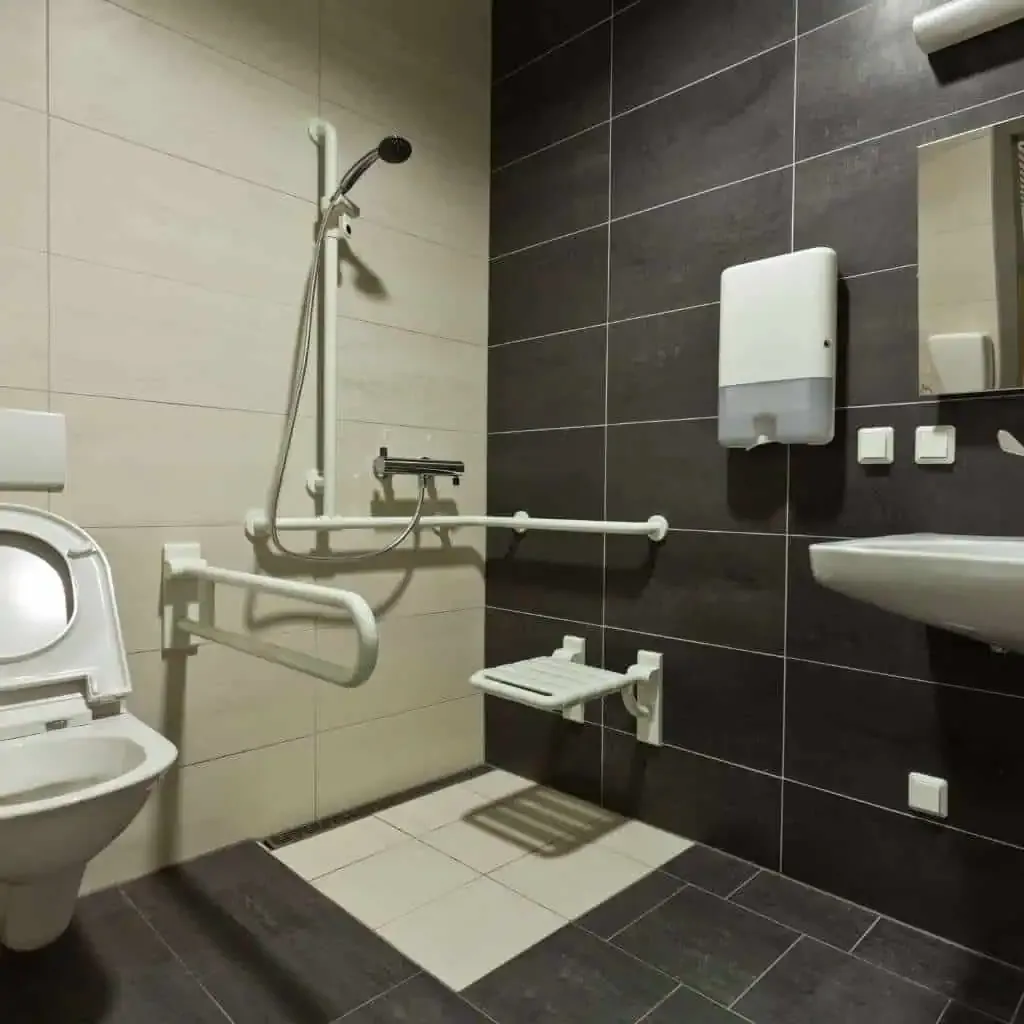
Spacing errors are one of the fastest ways a restroom fails a CASp inspection. The numbers are simple, but the real-world execution is not. A toilet installed one inch off-center, a sink set too close to a sidewall, or a mirror mounted an inch too high can force a full correction. If you’ve dealt with layout changes or inherited an older restroom, this is where a focused bathroom accessibility consulting review can prevent costly rework.
Toilet Centerline Distance Requirements (ADA vs Title 24)
Yes. California requires a strict 17-inch centerline from the side wall.
Federal ADA allows a range of 16–18 inches, but California Title 24 removes the flexibility. CASp inspectors measure from the finished wall surface to the toilet’s centerline, and a half-inch error can trigger a violation. This is one of the most common spacing mistakes contractors make during rough-in and final placement.
Clearance in Front of Toilets and Sinks
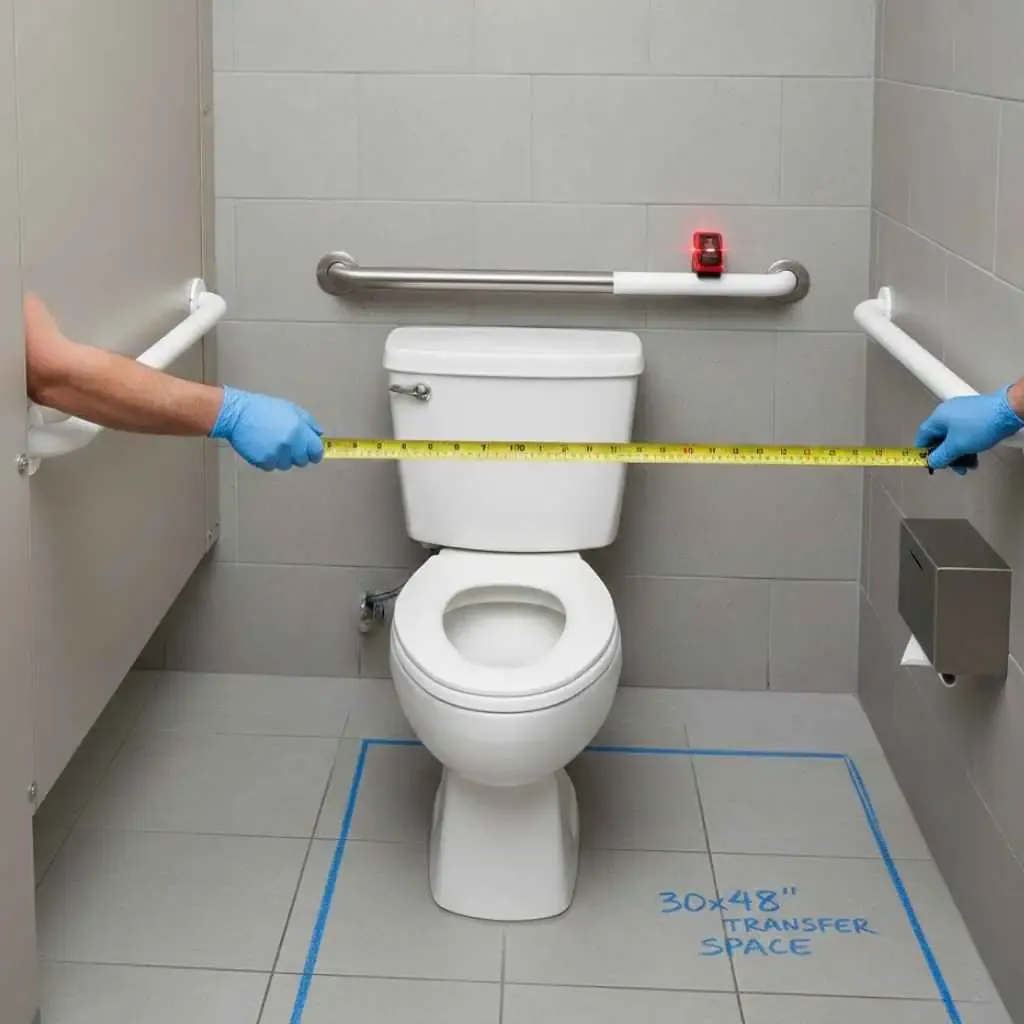
California enforces the 30×48-inch clear floor space more tightly than ADA. This area has to be flat, unobstructed, and fully usable for forward or side approaches.
Two issues regularly show up in failed inspections:
Door swing cutting into the clearance
Even a partial intrusion invalidates the required space. Titles 24 and ADA treat this as a functional barrier, not a minor oversight.Fixtures projecting too far into the maneuvering envelope
The clearance must extend past the sink apron, toilet front edge, or any dispenser within the approach zone.
Urinal Dimensions Required in California
Urinals are simple on paper but frequently fail in the field.
Yes. The rim must be no higher than 17 inches. California requires full compliance with ADA’s height limit and also evaluates the surrounding clear floor space. A compliant urinal still fails if a partition, waste bin, or door swing reduces the usable approach width.
Sink & Lavatory Dimension Requirements
Lavatories carry several California-specific rules that are easy to miss on the job site. Yes. The maximum lavatory height is 34 inches.
Inspectors measure to the front edge, not the backsplash or faucet deck.
Additional requirements include:
Toe and knee clearance
California follows ADA dimensions but checks both depth and height more strictly, especially in narrow rooms.Insulated pipes
Exposed hot pipes or traps fail under Title 24 because they pose burn and abrasion risks. This is one of the simplest corrections yet one of the most frequently overlooked.
Frequent Fixture Placement Violations
Certain mistakes repeat across almost every type of building restaurants, offices, medical suites, retail stores. These are the failures CASp inspectors document most often:
Sink installed too close to a sidewall
Even a one-inch reduction makes the 30×48 approach space unusable.Incorrect reach range for dispensers
California enforces the 40–48-inch operable parts rule tightly, especially for items placed above counters.Mirror mounted higher than 40 inches
The reflective surface, not the frame, must meet the limit. Many mirrors miss the requirement by an inch or two and fail immediately.
These violations often appear in restrooms that “passed” informal checks but do not meet the measurable standards used in a formal inspection
Additional Bathroom Dimensions Required in California
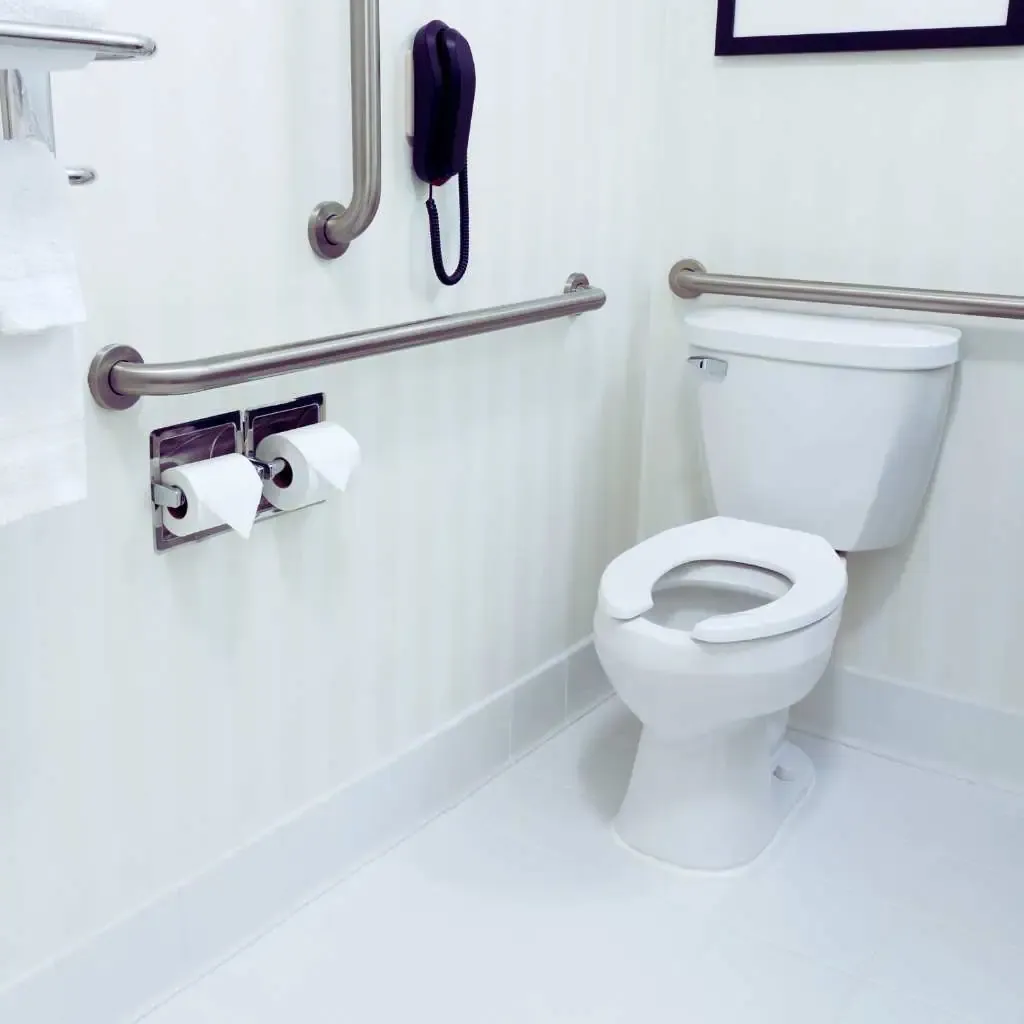
Many violations show up in the small details not the stall size or turning radius, but the measurements that control how someone actually moves inside the room. These are the elements owners often overlook during construction, and they’re the ones CASp inspectors flag most. A half-inch error in these areas can make a bathroom unusable for someone with limited mobility, which is why California treats them as non-negotiable.
What Door Maneuvering Clearances Are Required?
Door maneuvering clearance is the open floor space needed to approach, pull, or push a door without getting trapped.
Most failures happen on the pull side, especially when the door sits in a tight corner or when a restroom doubles as storage space. Even small changes a trash bin moved near the latch, a new dryer installed too close can break compliance overnight.
When you measure this clearance, think in terms of movement, not math. The space must stay open during real use, not just on the day the inspector walked through.
Which Alcove and Approach Types Must Be Measured?
Bathrooms tucked into alcoves change the geometry of access. A front approach is the most forgiving, but once walls narrow the entry, California looks more closely at parallel and side approaches. This is where older buildings struggle. Partitions shift by fractions of an inch, plumbing layouts evolve, and alcove depths rarely match the original drawings.
When evaluating approaches, focus on this core idea:
Front approach offers the most space, but only if nothing protrudes into the path.
Parallel approach narrows your margin, especially when the alcove forces a turn into the room.
Side approach becomes the default when layout changes restrict direct entry.
A CASp inspector looks at the usable route, not just the dimensions printed on a plan set.
What Are the Required Reach Ranges for Controls and Dispensers?
Most controls must fall between 15 and 48 inches, but California limits this range when anything blocks the reach path.
Counters, sinks, and baby-changing tables often complicate what should be a simple measurement. A soap dispenser mounted at a compliant height can still fail because the counter increases the forward reach distance. The same issue appears with dryers installed above trash bins or next to deep shelves.
Before installing anything, ask yourself one question: Can someone with limited reach operate this without leaning, twisting, or stretching across another surface?
If the answer is no, the installation needs to move.
What Dimensions Apply to Mirrors, Coat Hooks, and Shelving?
These pieces seem minor, but they’re common failure points because they’re usually installed last, often without consulting the plans. The bottom edge of accessible mirrors must remain at or below 40 inches, and coat hooks must land within a reachable zone without creating a protruding object hazard. Shelving brings its own issues when it juts too far into circulation paths or sits higher than the reach range.
A small oversight here can invalidate an otherwise compliant room, which is why many owners seek early guidance through commercial accessibility consulting when finishing interiors.
Why These Small Dimensions Often Fail CASp Inspections
The pattern is predictable. These items are installed during final punch-out, usually by subcontractors who weren’t briefed on accessibility tolerances. A mirror goes up too high. A hook gets placed where it’s convenient, not where it’s compliant. A dispenser shifts slightly because a stud wasn’t where the installer expected.
Individually, these mistakes look harmless. Collectively, they create the kind of dimensional conflicts CASp inspectors see every week and they’re far more expensive to adjust once the bathroom is in service.
California-Only Bathroom Dimension Rules That Exceed ADA
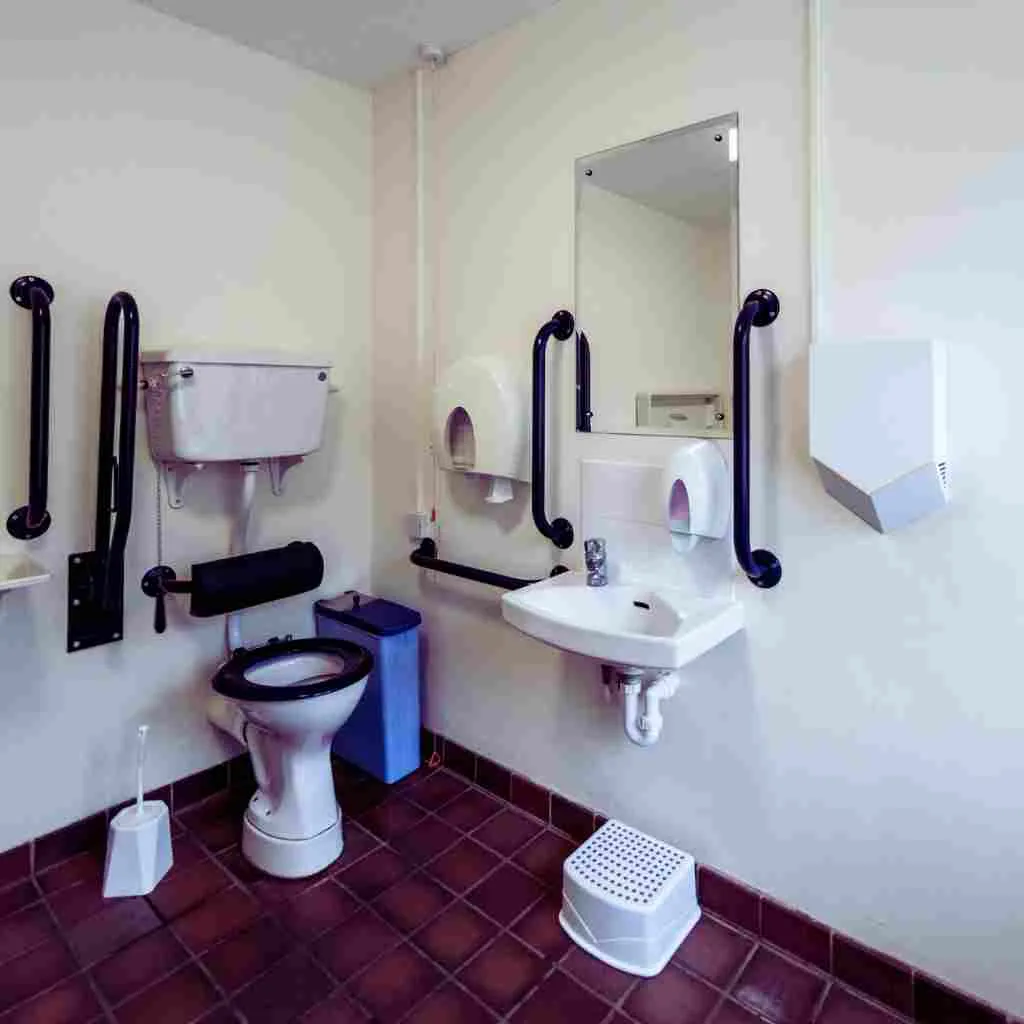
California’s accessibility rules don’t simply mirror the federal ADA they stack on top of it. When a measurement differs, California Title 24 controls, and that’s where most owners get caught. Here’s what that means in real inspections: even a restroom that “passes ADA” on paper can still fail under California law because the dimensional tolerances are tighter and the measurement methods are stricter. Let’s break down the four requirements that consistently create problems.
17-Inch Toilet Centerline (The Rule Most Businesses Miss)
California requires a fixed 17-inch centerline, measured from the finished wall to the center of the toilet. ADA allows 16–18 inches, but Title 24 does not. This single-inch swing is one of the leading causes of CASp failures, especially in older buildings or in restrooms with thick tile or paneling.
Here’s why this matters: even a ¼-inch shift from tile buildup, partition thickness, or sloppy installation can push the toilet out of compliance. If the centerline slips to 16¾ or 17⅜, the room fails—period. A CASp inspector measures this dimension before anything else because it determines whether side transfers are even possible.
Toe and Knee Clearance Differences
California expands the required toe-clearance envelope, which means the lavatory or partition must provide enough open space beneath it for wheelchair users to advance fully into position. The 27-inch knee clearance and 9-inch toe clearance must extend the proper depth; otherwise the user cannot align with the sink or transfer safely onto the toilet.
In real inspections, this is where many owners are surprised. A vanity that looks “open enough” visually often fails because the plumbing box, traps, or cabinetry intrude into the required clearance. California expects the full dimensional envelope to be clear not just the visible front portion.
Additional Maneuvering Clearances Under Title 24
ADA sets a base measurement for maneuvering space, but California often demands more especially around doors and at approach paths. Title 24 accounts for actual usability, not just theoretical space.
Here’s where owners get caught: a room may appear large enough, but once partitions, dispensers, or a recessed door are factored in, the remaining maneuvering space falls below the minimum. A CASp inspector will measure the usable space, not the architectural plan footprint.
California’s Stricter Requirements for Signage Placement
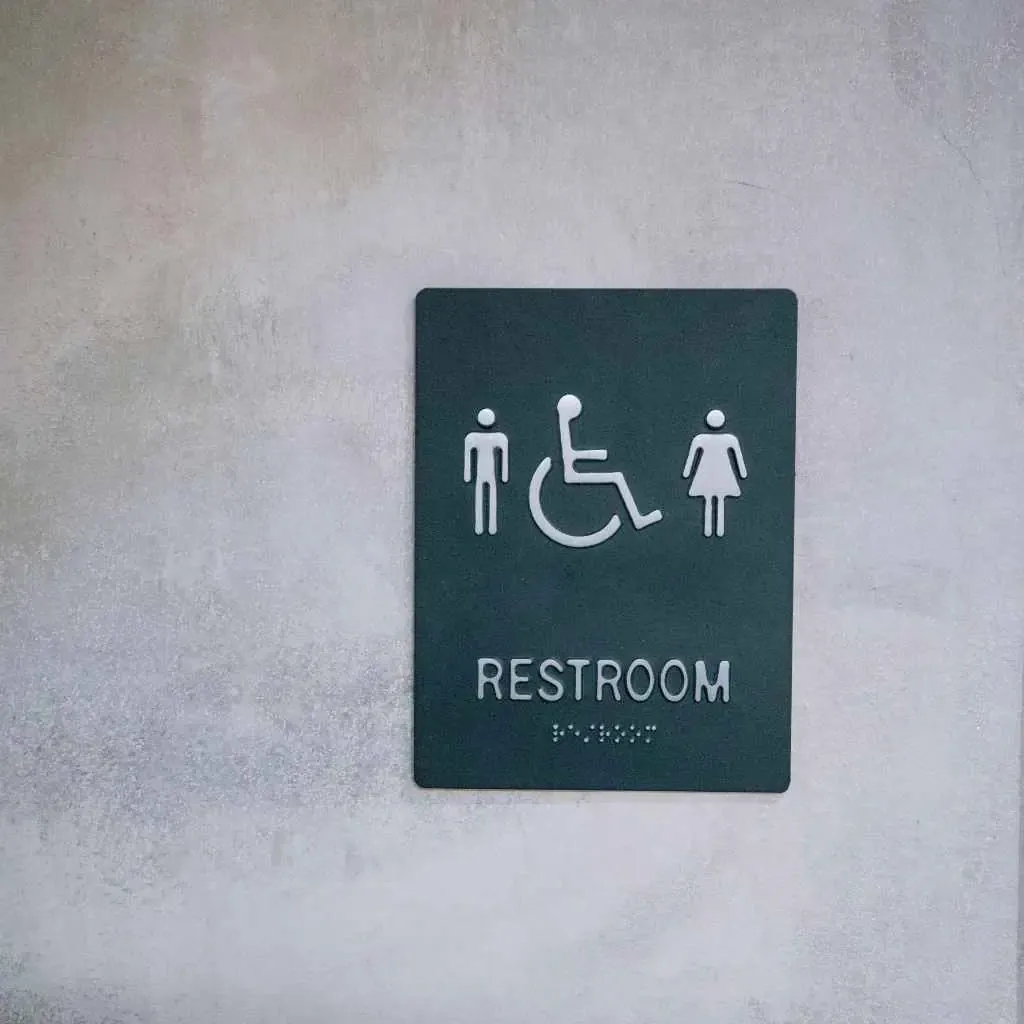
California enforces precise mounting heights for restroom identification signs, including tactile lettering. The bottom of the sign must sit 48–60 inches above the floor, and placement must be on the latch side of the door, not on the door surface itself. ADA provides general guidance; Title 24 dictates the exact location.
Why this matters: even a sign placed a few inches too high creates a violation because people with visual impairments depend on predictable placement. CASp inspectors document signage errors as formal barriers even when every dimensional measurement in the room is perfect.
Ambulatory, Unisex, and Family Bathroom Dimensions in California
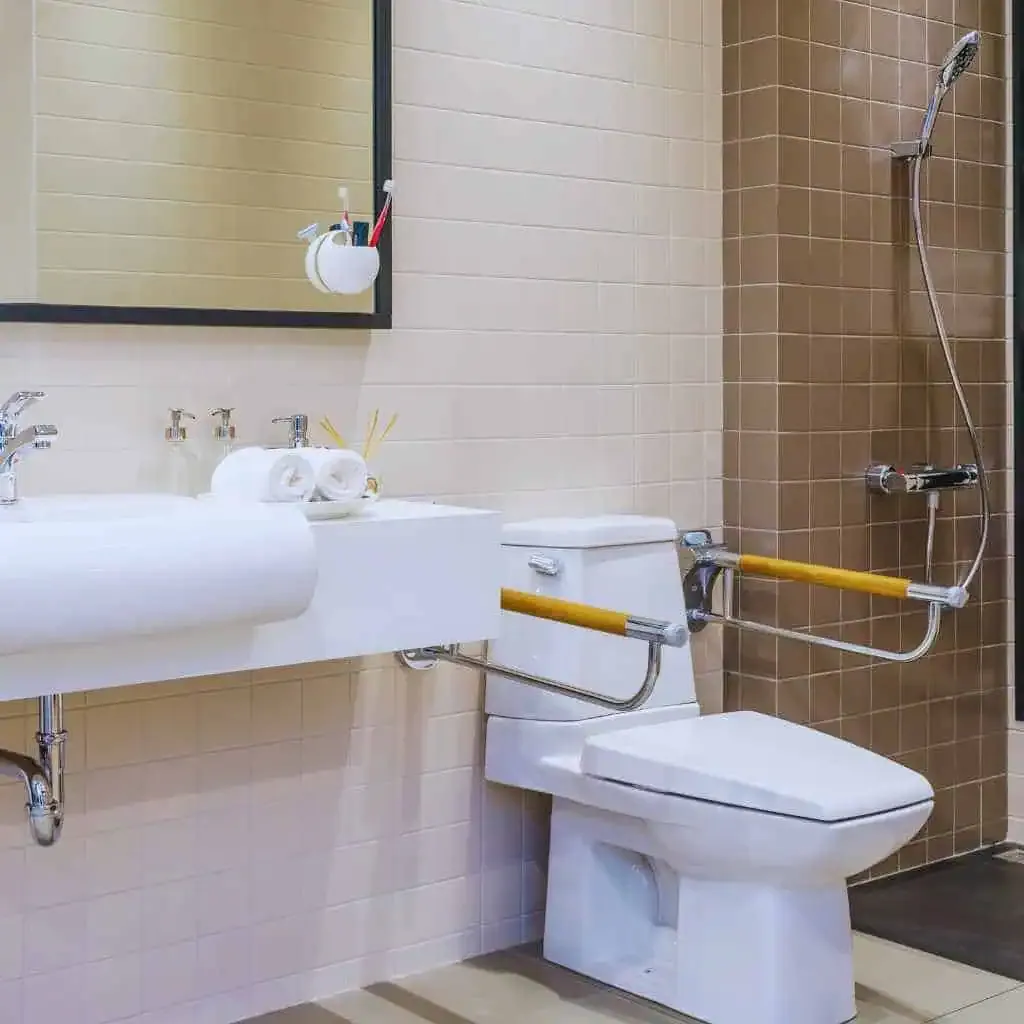
Ambulatory stalls serve people who walk but rely on crutches, canes, or other supports. These users need stability, not wheelchair turning space, so California sets its own dimensional rules that go beyond the federal baseline.
The width is intentionally narrow so users can reach both grab bars without shifting their balance. Here’s where owners get caught: they install a stall that “looks fine,” but the distance between the bars is too wide or one bar gets pushed out of reach by a partition. California enforces these dimensions because a missed grab point is a fall risk. In real inspections, this is one of the most common failures in older buildings and tenant improvements.
Ambulatory Stall Dimensions
An ambulatory stall is designed for people who walk but need handhold support. Title 24 sets a 36-inch minimum width with grab bars on both sides, plus an approach space that allows a user to enter and turn without obstruction.
Why this matters: many owners assume ambulatory stalls are “smaller and simpler,” but California enforces the width measurement aggressively. If partitions or tile add thickness, the usable width can drop below 36 inches, triggering a failure even in newly renovated spaces.
Unisex/SingleUser Restroom Dimensions
A unisex restroom must function as a fully accessible room, not just a private one. California expects an unobstructed 60-inch turning circle, a compliant approach to the door, and enough clear floor space for the user to reach each fixture without repositioning multiple times.
Here’s where issues appear: inward-swinging doors often cut into the turning space. Owners install a compliant toilet and sink but lose compliance because the door arc crosses the turning circle. CASp inspectors measure that arc every time, and it’s one of the most common points of failure in compact commercial spaces.
Family Bathroom Dimensional Requirements
A family restroom must maintain the same clearances as a unisex room while also accommodating equipment such as baby-changing tables. When the table is down, the required 30×48-inch approach space must still remain open.
This surprises many owners. If the open table cuts into the turning circle or blocks the toilet approach, the room fails even if everything else is correct. In real inspections, this is one of the most common obstacles in restaurants, clinics, and airports.
ADA vs Title 24: Side-by-Side Dimension Comparison Table
Business owners often ask where ADA stops and where California begins. The truth is simple: when the two codes conflict, Title 24 is stricter, and that’s what your inspector will enforce. These tables show the differences that matter most during a CASp inspection, so you can see—at a glance—where California tightens the rules.
Toilet Dimensions Table
Before you look at the numbers, here’s the real-world takeaway: ADA gives a range; California gives a fixed measurement. This is why so many restrooms fail. Even a half-inch shift caused by tile thickness or partition alignment creates an instant violation under Title 24.
| Requirement | ADA Standard | California Title 24 Standard | What This Means for You |
|---|---|---|---|
| Toilet centerline | 16–18 inches from wall | Exactly 17 inches | California allows zero deviation. |
| Seat height | 17–19 inches | 17–19 inches | Both codes match here. |
| Grab bar height | 33–36 inches | 33–36 inches | Differences appear in placement, not height. |
| Clearance beside toilet | 60 inches min. width | 60 inches min. width | Partition thickness can reduce usable width. |
Sink & Lavatory Dimensions Table
Sinks look simple, but Title 24 treats the space under and around them with more precision. Here’s what that means: the lavatory might “look compliant,” yet still fail because the toe or knee clearance wasn’t measured correctly.
| Requirement | ADA Standard | California Title 24 Standard | Field Impact |
|---|---|---|---|
| Max sink height | 34 inches | 34 inches | Same height; California enforces tighter clearance rules. |
| Knee clearance | 27 inches high | 27 inches high, deeper envelope | CA often requires a longer clear depth. |
| Toe clearance | 9 inches high | Stricter depth + obstruction rules | Plumbing boxes cause many failures. |
| Pipe insulation | Required | Required + specific coverage expectations | California inspects insulation more closely. |
Stall Dimensions Table
Stalls are where most dimensional failures occur. If you’ve ever wondered why an architect’s plan “looked right” but still failed, the comparison below explains it.
| Requirement | ADA Standard | California Title 24 Standard | Field Impact |
|---|---|---|---|
| Width | 60 inches | 60 inches | Partition thickness reduces usable width. |
| Depth (wall-mounted toilet) | 56 inches | 56 inches | Same dimension; CA often checks turning overlap more strictly. |
| Depth (floor-mounted toilet) | 59 inches | 59 inches | Same dimension; real failure happens at the door. |
| Door swing | Must not reduce clear space | Stricter maneuvering interpretation | CA measures usable space, not plan space. |
Turning Space Table
Turning space is simple on paper but difficult in small rooms. The biggest surprise for owners: California counts every object that intrudes—even minor ones ADA often ignores.
| Requirement | ADA Standard | California Title 24 Standard | Field Impact |
|---|---|---|---|
| Turning radius | 60-inch circle | 60-inch circle | Identical, but CA applies stricter “usable space” rules. |
| T-turn option | Allowed | Allowed | Must remain fully unobstructed. |
| Intrusions allowed | Limited | Far more restrictive | Waste bins, dispensers, and baby-changing tables often cause failures. |
Reach Range Table
Reach ranges are one of the most misunderstood requirements. California narrows the acceptable placement zone, especially for dispensers and controls.
| Requirement | ADA Standard | California Title 24 Standard | Field Impact |
|---|---|---|---|
| Forward reach (unobstructed) | 15–48 inches | 15–48 inches | Same range; CA enforces obstruction limits more strictly. |
| Side reach | 15–48 inches | Full compliance required even with deep counters | CA rejects many dispenser placements. |
| Flush control placement | On open side | On open side | Same rule; CA checks handle operability during inspection. |
| Baby-changing table reach | ADA allows more flexibility | Must not block clear spaces in any position | Often fails in family restrooms. |
Bathroom Dimension Checklist for California Owners
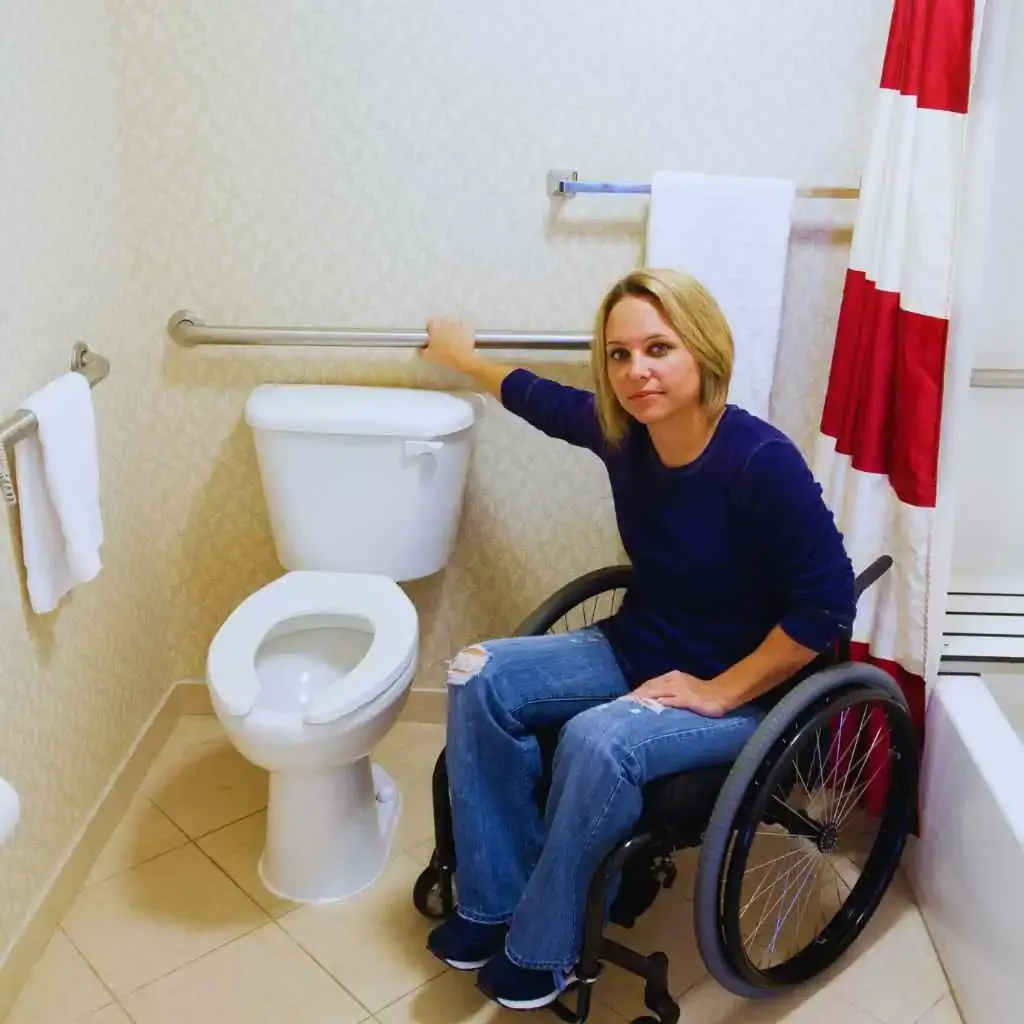
What Measurements Should Contractors Verify?
You only need a handful of dimensions to tell whether a restroom is likely compliant. The challenge is getting them right the first time, because California’s tolerances are tight and inspectors measure down to the quarter-inch. Here’s what matters most.
Before listing them, here’s the principle that drives all of Title 24: if any required clearance is obstructed, reduced, or misaligned, the space fails no matter how new the restroom is.
Key dimensions contractors must confirm include:
Toilet centerline (must be exactly 17 inches off the side wall under Title 24)
Turning radius (a 60-inch clear circle or a fully unobstructed T-turn)
Stall width and depth (60 inches wide; 56–59 inches deep depending on toilet type)
30×48-inch clear floor space in front of toilets, sinks, and dispensers
Sink height and clearance (34-inch max height; correct knee and toe envelope)
Door maneuvering clearance on both push and pull sides
Reach ranges for flush controls, toilet paper dispensers, soap, and hand dryers
Here’s what that means in practice: if any one of these measurements is off even by a half-inch California counts it as a functional barrier.
If you want, I can convert this into a printable one-page checklist at the end of the article.
When Should You Request a CASp Inspection?
Owners usually wait too long. By the time a project is built, it’s often too expensive to fix a dimensional error buried under tile, partitions, or plumbing. Here’s the clearer rule: request a CASp inspection any time the layout is being created, changed, or questioned.
You should consider a CASp inspection when:
Starting a remodel or tenant improvement that affects restroom layout
Submitting plans where stall placement, door swing, or reach ranges look tight
Opening a new business in an older building with unknown construction history
Receiving a complaint about access, even if it seems minor
Preparing for plan check and want dimensional issues resolved before submittal
Why this matters: a CASp inspector looks for the dimensional flaws that architects often miss and that contractors cannot “fix” later without demolition. A single review can prevent thousands in rework or legal exposure.
What Dimension Mistakes Most Often Lead to Citations?
Dimensional mistakes are the number one reason restrooms fail CASp inspections. They’re rarely dramatic—they’re usually half-inch oversights that create barriers for wheelchair users. In real inspections, these are the problems that appear repeatedly.
Common issues include:
Toilet centerline drift caused by tile thickness, resulting in violations of the 17-inch rule
Turning radius blocked by waste bins, dispensers, or a misplaced lavatory
Stall width reduced by overly thick partitions
Incorrect grab bar spacing because the installer measured to the tile edge, not the finished wall
Reach ranges exceeded when dispensers are mounted above counters or too far from the user
Door swing encroaching on required maneuvering clearance
Here’s why this matters: these mistakes are usually invisible until someone measures the room properly. By that point, fixing them means moving walls, shifting plumbing, or replacing fixtures far costlier than preventing them upfront.
Why Bathrooms Fail CASp Inspections (Dimension Edition)
When a restroom fails a CASp inspection, it’s rarely because of an exotic code issue. It usually comes down to dimensional mistakes—the simple measurements that should have been caught early but weren’t. Here’s the thing: most failures aren’t about intent. They’re about inches, tolerances, and overlooked clearances that quietly break ADA and Title 24 rules. Let’s break down where owners get caught and what fixes are realistic.
What Are the Most Common Measurement Errors CASp Inspectors See?
The top failure points almost always trace back to basic spacing errors. These issues show up in new builds, remodels, and older facilities that never received a compliance review.
Incorrect toilet centerline. Even half an inch off the required 17-inch Title 24 centerline can create an automatic failure.
Obstructed turning radius. Lavatories, trash bins, dispensers, and baby-changing stations often intrude into the 60-inch turning space.
Door swing blocking required clearance. The latch-side approach or inside swing blocks the clear floor space needed to enter or exit safely.
Grab bars installed at the wrong height. Title 24’s 33–36-inch rule is strict, and installers often miss it by an inch.
Insufficient toe or knee clearance. California enforces deeper clearance than federal ADA, especially under sinks.
These might look minor, but measurements are binary: either compliant or not. That’s why dimensional errors are the number one cause of CASp failures.
How Can You Fix Dimensional Violations Without a Full Demo?
Yes, many dimensional errors can be corrected without tearing the room apart. The fix depends on what’s out of alignment and how the room is configured.
You can often resolve issues by:
Shifting fixtures slightly. Moving a toilet or sink an inch or two can bring the space back into compliance if plumbing allows.
Adjusting door swing direction. Switching from an inward to outward swing can restore clear floor space.
Swapping partitions. Thinner or better-placed partitions can recover lost width inside stalls.
Relocating accessories. Paper dispensers, dryers, waste bins, and shelves can be moved to restore reach ranges and clearance.
Re-mounting grab bars. Reinstalling at the correct height is straightforward and often resolves one of the most common failures.
Why this matters: a full remodel isn’t always the starting point. Many dimensional problems are “micro errors” that create macro liability, and correcting them early prevents expensive downstream issues.
Bathroom Dimension Questions California Owners Ask Most
What Is the Minimum ADA Bathroom Size in California?
Yes. There is a minimum bathroom space requirement, but it depends on the layout.
The ADA doesn’t define a single “bathroom size,” but it does set minimum clearances around toilets, sinks, and doorways. In California, these clearances tighten under Title 24. A compliant bathroom must support a 60-inch turning radius, a 30×48-inch approach space at fixtures, and the 17-inch centerline rule for toilets. When these elements overlap or conflict, the room often needs to be larger than the typical national ADA layout. Here’s what that means: California designs rarely match federal “minimums” because Title 24 requires more precise spacing.
Is a 60-Inch Turning Circle Always Required?
Yes. California requires a full 60-inch turning diameter in nearly all accessible bathrooms.
The only exception is where a Title 24-approved T-turn is permitted, and even then, the room must support the full maneuvering envelope without intrusion from doors, dispensers, waste bins, or vanity cabinets. This is why turning space failures remain one of the most common CASp findings. When a bathroom “measures correctly on paper,” real-world obstacles often shrink the usable turning space.
What Are the 2025 Changes to ADA/Title 24 Bathroom Dimensions?
No major dimensional changes have been approved for 2025, but California enforcement is tightening.
Current updates affect EV facility reach ranges, signage clarity, and protruding object interpretations, but the core bathroom dimensions—stall size, centerline spacing, turning radius, and knee/toe clearance remain unchanged. Why this matters: enforcement pressure often increases before code cycles change, which means CASp inspectors are documenting dimensional issues with far less tolerance for borderline layouts.
Are Single-User Bathrooms Required to Follow ADA Dimensions?
Yes. Single-user bathrooms must follow ADA and Title 24 dimensions when accessible to the public.
Many owners assume a “private-use” design means more flexibility, but if a restroom can be entered by customers, patients, students, or visitors, full compliance applies. This includes 32-inch door clearances, turning radius, clear floor space, and correct fixture spacing. Even single-occupancy rooms fail CASp inspections because door swings or vanities cut into the maneuvering area.
Do Employee-Only Bathrooms Need to Meet ADA Dimensions?
Yes and no. Employee-only restrooms must follow ADA dimensions when the restroom serves employees with disabilities or when the route to the restroom is open to the public. In practice, most California workplaces follow accessible dimensions to avoid discrimination claims, reduce retrofit costs, and simplify future permitting. Here’s what that means: while not every employee-only restroom triggers full public-access requirements, dimensional noncompliance often becomes a liability during remodels or tenant improvements.
Next Steps for Ensuring California Bathroom Dimension Compliance
Getting bathroom dimensions right in California isn’t just a design preference it’s the backbone of ADA and Title 24 compliance, and it’s where most inspection failures happen. At this stage, the smartest move is knowing when to bring in a professional. The ideal moment to schedule a CASp inspection is before plans are finalized or permits are submitted, and again once fixtures are installed. Early verification prevents the two problems that cost owners the most: dimensional conflicts that halt construction and spacing errors that trigger lawsuits. If you need a trusted accessibility review grounded in California code, a consultation with CASp Inspectors in California is a practical next step.
Here’s why it matters. Dimensional errors even small ones carry real consequences. A toilet mounted an inch off the required centerline can stall a permit, force redesigns, or become a target in accessibility litigation. In remodels, these mistakes often trigger additional upgrades under Title 24, stretching both timelines and budgets. The quickest way to avoid those issues is to double-check measurements before walls close, confirm clearances after each fixture is mounted, and verify turning space once doors, dispensers, and partitions are in place. Owners who build in these checkpoints spend far less on corrections and avoid the frustration of reopening finished spaces.
If your goal is staying compliant while protecting your project’s schedule and budget, a disciplined measurement process paired with timely CASp involvement makes the entire path smoother and more predictable.

Written by Emily Johnson
Emily Johnson is a Certified Access Specialist (CASp) Inspector and is passionate about making spaces accessible for all. With over 10 years of experience and degrees in Civil Engineering and Architecture, she inspires others while championing ADA awareness.
RECENT POSTS
CATEGORIES
Get a free quote today!
By clicking “Submit”, you are signing up to receiving emails from us. You can unsubscribe whenever you like. SMS rates may apply.
Want To Know More About ADA Accessibility And How To Get Compliant?
Check out our blog!