How to Prioritize ADA Barrier Remediation After a CASp Report
ADA barrier remediation prioritization is the structured process California property owners and facility operators use to sequence barrier removal after receiving a CASp inspection report. The process does not begin at the inspection. It begins when the report is in hand and a sequencing decision must be made about what gets corrected first, what gets phased, and what requires a documented timeline before any work starts.
Two regulatory frameworks govern that decision simultaneously. ADA Title III (42 U.S.C. §12101 et seq.) sets the federal standard for barrier removal in existing facilities, including the four-part priority order codified at 28 C.F.R. §36.304 and the “readily achievable” standard that defines when removal is required. California’s CBC Title 24 Part 2 applies independently and often requires stricter dimensional tolerances than the federal standard alone. A CASp inspection report documents conditions against both frameworks. The sequencing decisions that follow must account for both.
For California businesses operating in Los Angeles County and Southern California, those sequencing decisions also carry legal consequences under Cal. Civil Code §55.56, which establishes statutory damages on a per-visit basis, and under CRASCA (Cal. Civil Code §§55.51–55.545), which governs qualified defendant protections and the correction windows that reduce those damages. This page covers the complete prioritization framework: the federal priority order, the California legal layer, how CASp report severity ratings map to litigation exposure, how permit requirements affect sequence, and what a compliant remediation schedule must document.
What the Federal Priority Framework Requires
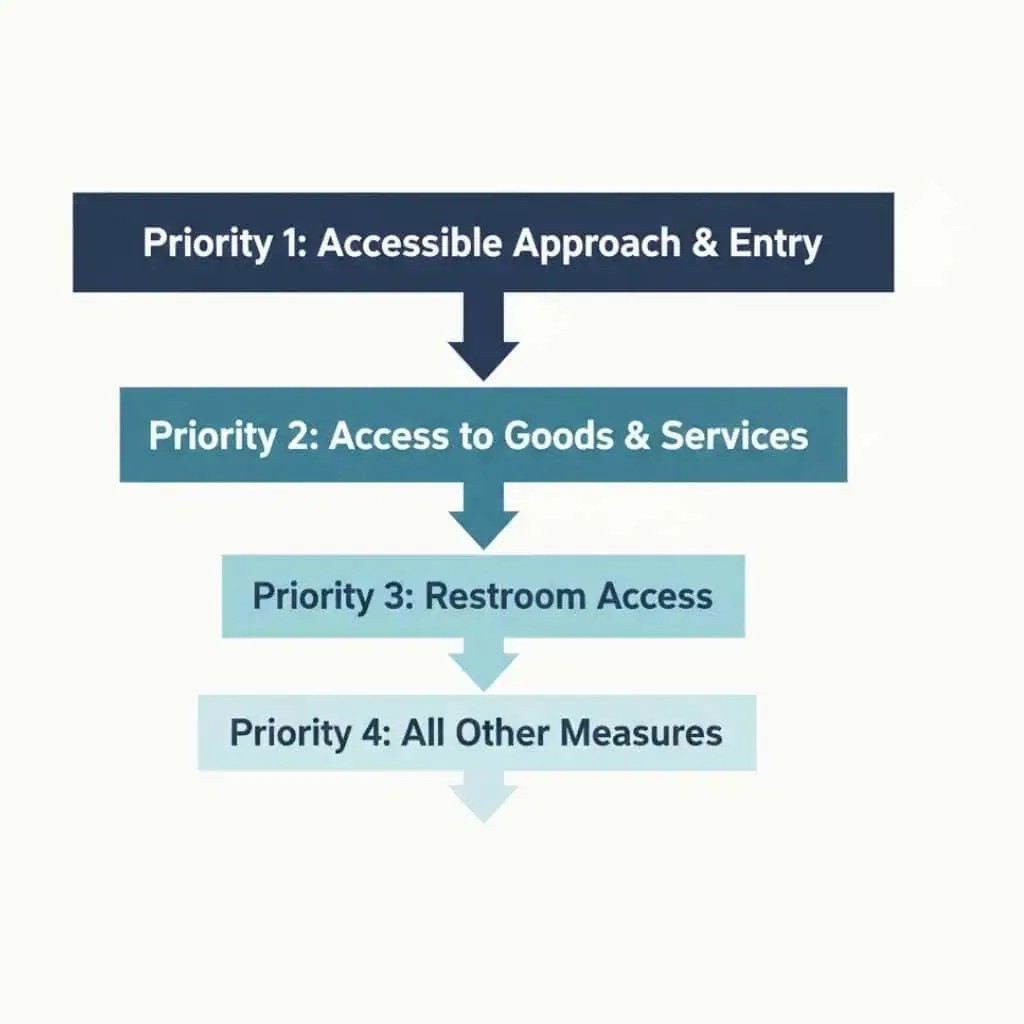
Barrier removal sequencing under ADA Title III is not discretionary. 28 C.F.R. §36.304(c) establishes a specific four-part priority order that public accommodations are instructed to follow when allocating remediation resources across an existing facility. That order applies regardless of when the building was constructed.
The four priorities are:
- Accessible approach and entry. Remove barriers along the route from public sidewalks, parking areas, and transportation stops to the facility entrance. This includes accessible parking stalls, curb ramps, entrance ramps, and widened doorways that allow a person with a disability to reach and enter the building.
- Access to goods and services. Once inside, remove barriers that prevent access to what the facility offers. This covers interior layout adjustments, counter heights, reach ranges, aisle clear widths, and directional signage that guides people through the space.
- Restroom access. Address barriers in restroom facilities — door clearances, turning space, grab bar placement, lavatory clearances, fixture heights, and door hardware.
- All other measures. After the first three priorities are addressed, turn to remaining barriers necessary to make the facility fully accessible.
Each step in this sequence is governed by the “readily achievable” standard defined at 28 C.F.R. §36.104: easily accomplishable and able to be carried out without much difficulty or expense. That determination is not a single calculation. The full definition includes five statutory factors the nature of the action, the overall cost, the financial resources of the site and the covered entity, the type of operation, and the impact on the facility’s operation. A court evaluating a remediation record will assess all five factors.
One additional provision affects how the 2010 ADA Standards for Accessible Design apply to existing elements. The safe harbor under 28 C.F.R. §36.406 provides that elements already in full compliance with the 1991 ADAAG before March 15, 2012 are not required to be brought into compliance with the 2010 Standards solely because of that update. The safe harbor is element-specific and condition-specific. It applies only to those particular elements that were demonstrably compliant under the 1991 standard. A CASp determines applicability for each affected element during the inspection — it is not a blanket exemption a property owner can apply unilaterally.
Under CRASCA, a California facility’s remediation conduct is assessed against whether corrections followed a documented, ordered schedule and the DOJ priority framework is the structure that schedule is expected to reflect.
How California Law Adds a Second Layer to Federal Priority Rules
A CASp inspection report cites both ADA and CBC violations because both frameworks apply simultaneously to California properties and satisfying one does not satisfy the other. Federal priority rules under 28 C.F.R. §36.304(c) govern the sequence of readily achievable barrier removal. CBC Title 24 Part 2 (Chapter 11B) governs technical specifications independently, and CBC Chapter 11B dimensional tolerances are frequently stricter than the 2010 ADA Standards door maneuvering clearances, slope tolerances, and signage specifications are common divergence points. The applicable version of CBC depends on the property’s construction date and alteration history a CASp determines which edition applies to each affected element.
| ADA Title III | CBC Title 24 Part 2 (Chapter 11B) | |
|---|---|---|
| Governing authority | DOJ Civil Rights Division; enforced through private right of action and DOJ enforcement | Division of State Architect (DSA); enforced through plan check, inspection, and private right of action under Cal. Civil Code §55 et seq. |
| Dimensional standard source | 2010 ADA Standards for Accessible Design | CBC Chapter 11B — frequently stricter than federal standards on door maneuvering clearances, slope tolerances, and signage specifications |
| Path-of-travel trigger | Alterations to primary function areas under 28 C.F.R. §36.403; path-of-travel cost capped at 20% of primary alteration cost; standalone barrier removal under §36.304 explicitly carved out | CBC alteration thresholds apply independently and are not subject to the federal 20% disproportionate cost cap in the same form — CBC path-of-travel obligations attach to the alteration scope as defined under California law, which a CASp evaluates separately from the federal trigger |
| Damages framework | Federal claim; no minimum statutory damages under Title III alone | Cal. Civil Code §52(a): $4,000 minimum per violation per visit, triggered by ADA violations through Cal. Civil Code §51(f) or by independent Unruh Act claims under Cal. Civil Code §51 |
The damages row requires specific attention. An ADA violation in California does not simply create a federal claim. Under Cal. Civil Code §51(f), an ADA violation also constitutes a violation of the Unruh Civil Rights Act, which carries statutory damages of $4,000 minimum per violation per visit under Cal. Civil Code §52(a). The $4,000 minimum per violation per visit figure is triggered through the Unruh Act, not through Title III directly.
The Unruh Civil Rights Act operates as an independent claim basis as well. Cal. Civil Code §51 prohibits disability discrimination regardless of whether a predicate ADA violation exists. A plaintiff may prevail on the Unruh Act claim alone, and Cal. Civil Code §52(a) damages attach to that independent claim. CBC violations may also give rise to independent claims under Cal. Civil Code §55 regardless of whether the same condition constitutes an ADA violation.
What this means for a CASp report with both ADA and CBC findings is that the two citation sets are not redundant. Each framework requires its own compliance analysis. A condition that meets federal dimensional standards may still fail CBC Chapter 11B tolerances. A condition that is corrected to ADA specifications may remain a CBC violation if the applicable CBC edition requires a stricter standard. The version of CBC that governs each element is determined by the property’s construction date and alteration history, which the CASp establishes during the inspection.
Reading Your CASp Report's Severity Ratings
CASp reports do not follow a single mandated template. The severity label language varies by inspector and firm. One report may use “immediate concern,” another “safety hazard,” another “priority barrier.” The labels differ. The underlying mapping does not. Before sequencing any finding, position it against three questions.
Does the barrier block the primary accessible route? Barriers on the accessible approach, at the entry point, or along the interior path of travel affect every person with a mobility impairment who attempts to use the facility. These findings move to the front of the sequence regardless of their severity label.
Does it appear in a high-litigation category? Parking, restrooms, and path of travel generate the highest volume of accessibility claims in California courts. A finding in one of these categories carries greater practical urgency than its severity label alone may suggest.
Is removal readily achievable without triggering a permit? Findings that can be corrected without plan check or structural work can be addressed immediately. Findings that require permitting must be sequenced with that timeline accounted for in the remediation schedule.
Those three questions determine sequencing before any schedule is built. The four severity categories that appear most commonly across CASp reports then map to remediation urgency as follows.
Immediate concern / safety hazard. These findings document conditions that create a direct barrier to access or a physical safety risk. Cal. Civil Code §55.56 establishes statutory damages on a per visit basis when a person with a disability encounters a barrier. Immediate concern findings are the conditions where that damages structure is most directly implicated. Address these first. The readily achievable standard under 28 C.F.R. §36.304(a) governs general barrier removal sequencing. It does not function as a cost threshold for correcting safety hazards. Those two categories are governed differently, and a CASp report labels them separately for that reason.
Barrier to access. These findings document conditions that restrict or prevent access but do not rise to the level of an immediate safety concern. Once immediate concern items are cleared, sequence barrier-to-access findings per the DOJ priority framework at 28 C.F.R. §36.304(c): accessible approach and entry first, then access to goods and services, then restroom access, then remaining measures. A barrier-to-access finding in a high-litigation category — parking, restrooms, path of travel — moves toward the front of that sequence in practice, even when its DOJ priority tier would otherwise place it later. The three-question framework above governs that adjustment.
Readily achievable. These findings identify barriers whose removal meets the readily achievable standard under 28 C.F.R. §36.304(a), meaning easily accomplishable without much difficulty or expense given the entity’s resources. Readily achievable findings carry an ongoing removal obligation. They cannot be deferred indefinitely on the basis of cost without reassessing the readily achievable determination. If financial circumstances change, the analysis must be revisited.
Deferred / structural. These findings document barriers that are not readily achievable to correct at the time of inspection, typically because of structural constraints, permitting requirements, or cost relative to the entity’s resources. Deferral is not dismissal. Deferred items must appear on a documented remediation schedule with a target completion date and evidence of active progress: funds set aside, design work commissioned, or a permit application filed. An undocumented deferral does not function as a defense.
The Disability Access Inspection Certificate (DAIC, Form DSA-300) is issued upon completion of the CASp inspection and must be posted at the facility. Its existence does not resolve the findings in the report. The report and the DAIC are separate documents serving separate functions. The certificate records that an inspection occurred. The report documents what was found and what must be addressed.
The Four-Step Remediation Sequence for California Facilities
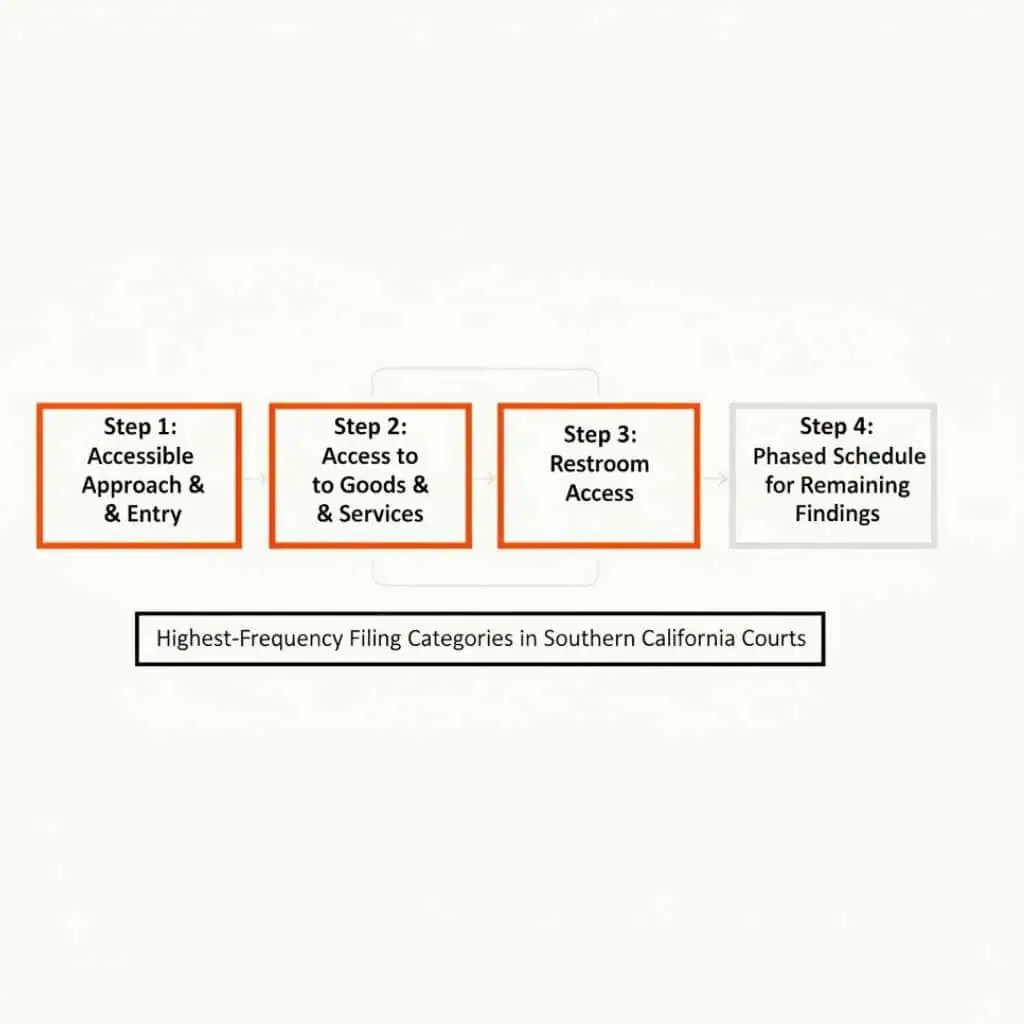
The DOJ priority framework establishes the federal sequence. California litigation patterns establish which barriers within that sequence carry the greatest practical urgency. The four-step remediation sequence below integrates both, applying 28 C.F.R. §36.304(c) against the barrier categories most commonly cited in serial litigant actions in Los Angeles County and Southern California courts. Steps 1 through 3 cover the barrier categories that appear most frequently in California accessibility filings based on barrier type. Step 4 governs everything that cannot be corrected immediately.
Step 1: Clear all barriers on the accessible approach and primary entry.
This step covers every barrier between the public sidewalk, parking area, or transportation stop and the facility entrance. Under 28 C.F.R. §36.304(c)(1), accessible approach and entry is the first priority for barrier removal in existing facilities. The federal framework places it first because access to the facility itself is the precondition for access to everything inside it.
Accessible parking stall dimensions and slope must meet 2010 ADAS §502 and CBC 11B-812. Slope in any direction cannot exceed 1:48 (2.08%). Each accessible parking area requires at least one van-accessible stall per 2010 ADAS §208.2.4 and CBC 11B-812.6. Access aisle width is 60 inches for standard stalls and 96 inches for van-accessible stalls per 2010 ADAS §502.3 and CBC 11B-812.3. The curb ramp connecting the parking area to the accessible route must meet 2010 ADAS §406 and CBC 11B-406, with a maximum running slope of 1:12 and a detectable warning surface on perpendicular ramps. The accessible route from parking to the entry is governed by 2010 ADAS §206 and CBC 11B-206.
At the entrance, door hardware must be lever or push-type, operable with one hand without tight grasping, and mounted at a maximum height of 48 inches AFF per 2010 ADAS §404.2.7 and CBC 11B-404.2.7. Threshold height cannot exceed one-half inch, beveled, per 2010 ADAS §404.2.5 and CBC 11B-404.2.5.
Step 2: Remove barriers blocking access to goods and services.
Once the accessible approach and entry are clear, the facility is reachable but not yet fully usable. Step 2 addresses the barriers that prevent a person with a disability from accessing what the facility offers after they have entered. The sequence reflects the regulatory logic that entry precedes use — a person must be able to reach the service before the service itself can be evaluated for accessibility.
Counter height at service and transaction areas cannot exceed 36 inches AFF per 2010 ADAS §904.4. Reach ranges must fall within forward reach of 15 to 48 inches and side reach of 9 to 54 inches per 2010 ADAS §308. Aisle clear widths must be a minimum of 36 inches for single-direction travel and 44 inches for two-way passage per 2010 ADAS §403.5. Signage at service areas must meet CBC 11B-703 for facilities where tactile and visual signage requirements apply.
Step 3: Address restroom access barriers.
Restroom findings appear in Step 3 under the DOJ priority framework. In California accessibility filings, restroom clearance failures appear alongside parking and path-of-travel barriers as among the most frequently cited conditions in Los Angeles County and Southern California. When the remediation schedule shows Step 1 and Step 2 corrections underway and documented, restroom corrections can be advanced in parallel rather than held until both prior steps are fully complete.
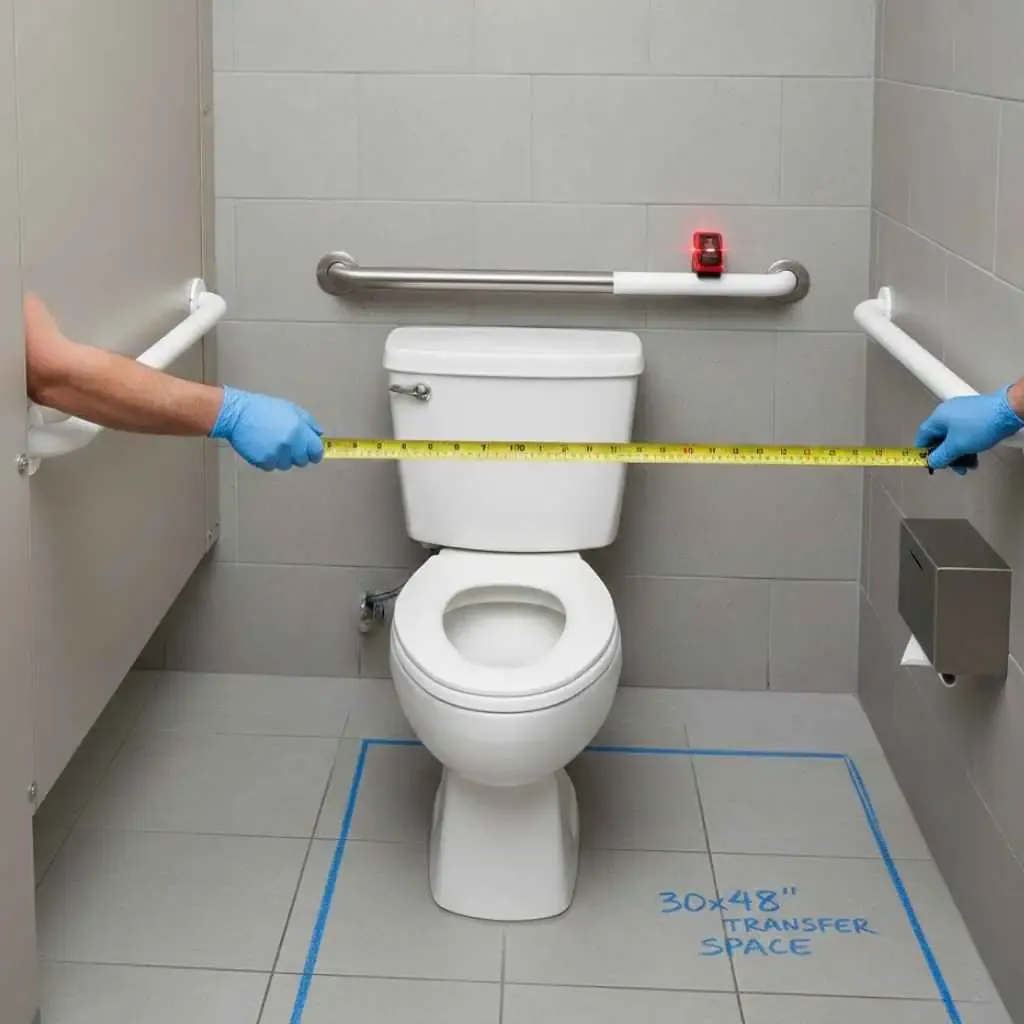
Restroom door clear width must meet a minimum of 32 inches per 2010 ADAS §404.2.3 and CBC 11B-404.2.3. Turning space requires a 60-inch diameter clear floor space or a T-turn configuration per 2010 ADAS §304 and CBC 11B-304. Lavatory clearances require a minimum knee clearance of 29 inches per 2010 ADAS §606.2 and CBC 11B-606.2. Grab bars must be positioned per 2010 ADAS §609 and CBC 11B-609. Toilet centerline must fall between 16 and 18 inches from the side wall per 2010 ADAS §604.2 and CBC 11B-604.2.
Step 4: Phase remaining findings across a documented remediation schedule.
Findings that cannot be corrected in Steps 1 through 3 because of structural constraints, permitting timelines, or cost relative to the entity’s resources must be addressed through a documented phased schedule. The schedule must name each deferred item, cite the applicable code standard, assign a target completion date, and carry evidence of financial progress: funds set aside, design work commissioned, or a permit application filed. Documentation requirements for a compliant remediation schedule are covered below under What a Documented Remediation Schedule Must Include.
Before beginning Step 1 through 3 work in Los Angeles, run a permit trigger check. Restroom alterations and path-of-travel work frequently require plan check under LADBS jurisdiction. The obligation does not disappear when a permit is required. The timeline extends, and that extension must be reflected in the remediation schedule. Full permit trigger detail is covered below under When Permit Requirements Change Your Sequence.
High-Litigation Barrier Categories in Southern California
The DOJ priority framework sequences barrier removal by category. California accessibility filing patterns show which categories within that sequence appear most frequently in Los Angeles County and Southern California courts. The two are not always identical. A facility that follows the federal sequence correctly may still carry unaddressed barriers in the categories that appear most frequently in California accessibility filings in this jurisdiction. The list below identifies those categories, with the specific conditions within each that establish a claim basis under the Unruh Civil Rights Act (Cal. Civil Code §51).
A note on sourcing: the filing pattern data referenced in this section is drawn from California Commission on Disability Access (CCDA) barrier survey data and Judicial Council of California court statistics. Confirm current source before publish per outline instructions.
Accessible parking. Parking failures are the most frequently cited barrier category in Southern California accessibility filings. The specific conditions that establish a claim basis under Cal. Civil Code §51 are stall slope exceeding 1:48 (2.08%) in any direction per 2010 ADAS §502.4, access aisle width below 60 inches for standard stalls or below 96 inches for van-accessible stalls per 2010 ADAS §502.3, and the absence of a van-accessible stall where one is required per 2010 ADAS §208.2.4. Cal. Civil Code §51 does not require a plaintiff to demonstrate harm beyond the encounter with the barrier condition itself.
Path of travel from parking to the primary entry. The accessible route connecting parking to the facility entrance appears consistently among the highest-frequency categories in California accessibility filings. Curb ramp running slope exceeding 1:12 per 2010 ADAS §406.1 and the absence of a detectable warning surface on perpendicular ramps are the most common specific failures. Sidewalk cross-slopes exceeding 1:48 and breaks in accessible route continuity between the parking area and the entrance also appear in this category. Path of travel failures generate an independent claim basis under Cal. Civil Code §51 separate from any parking failure at the same facility — a person who navigates accessible parking successfully but encounters a broken or non-compliant route to the entry has encountered a distinct barrier condition.
Restroom access. Restroom clearance failures appear consistently alongside parking and path-of-travel barriers in California accessibility filings. The conditions most frequently cited are toilet centerline falling outside the 16 to 18 inch range from the side wall per 2010 ADAS §604.2, grab bar placement that does not meet the 42 inch side wall and 36 inch rear wall requirements per 2010 ADAS §609.4, and lavatory clearances below the minimum knee clearance of 29 inches per 2010 ADAS §606.2. Cal. Civil Code §51 establishes a claim basis from a single encounter with a barrier condition during a visit to the facility.
Entry door hardware. Entry door hardware failures appear consistently in Southern California filings. Door hardware that requires tight grasping, pinching, or twisting of the wrist to operate does not meet 2010 ADAS §404.2.7. Door opening force exceeding 5 lbf does not meet 2010 ADAS §404.2.9 and is a separately cited condition at the same location. Threshold height exceeding one-half inch beveled is a third condition frequently cited at the entry point. All three can be encountered in a single entry attempt.
These four categories overlap directly with DOJ Priority 1 and Priority 3 under 28 C.F.R. §36.304(c). A remediation sequence that front-loads these categories satisfies both the federal priority order and the California-specific pattern of conditions that appear most frequently in accessibility filings in this jurisdiction.
When Permit Requirements Change Your Sequence
Certain barrier removal work in California requires a building permit and plan check before work can begin. The permit requirement does not change the obligation to correct the barrier. It changes the timeline, and that timeline must be reflected in the remediation schedule from the point the permit application is filed. Approved plans are required before permitted work begins. Starting permitted work without them places the correction outside the authorized scope of the permit.
The permit trigger is not determined by the barrier category. It is determined by the nature of the correction work itself.
Work that generally does not trigger plan check:
- Restriping accessible parking stalls and access aisles to correct dimensional or slope failures
- Replacing door hardware with compliant lever or push-type hardware at existing door locations
- Installing grab bars at existing blocking or in non-structural wall locations
- Adjusting counter heights where no structural modification is involved — meaning the counter surface or support is reconfigured without altering the wall framing, floor structure, or load-bearing elements behind it
- Correcting signage placement or replacing non-compliant signage
These corrections address barrier findings through direct replacement or reconfiguration of existing elements without altering the structural envelope of the facility. In most Southern California jurisdictions, including LADBS and LA County DPW, these types of corrections fall within the standalone barrier removal carve-out under 28 C.F.R. §36.304 and do not require plan check before work begins.
Work that typically triggers plan check:
- Ramp construction or reconfiguration, including curb ramp modifications that alter grade or drainage
- Restroom reconfiguration involving wall relocation, fixture repositioning, or changes to plumbing rough-in
- Structural threshold modifications that require alteration of the door frame or subfloor
- Path-of-travel improvements that involve grading, paving, or changes to the building’s accessible route infrastructure
In LADBS jurisdiction, accessibility-related permits for commercial properties are processed through the Plan Check LA process. LA County DPW operates as a parallel jurisdiction for unincorporated areas of Los Angeles County and applies the same plan check requirement for commercial accessibility work. Submitting permit applications early affects review queue position and timeline predictability — both of which determine how accurately the remediation schedule can be built around the permitted work. Document the submission date, the permit number once issued, and the current review status as active progress entries in the schedule. A permit application filed and pending is an active entry in the remediation schedule, not a gap in it.
CBC Title 24 Part 2 alteration requirements govern when path-of-travel improvements attach to permitted work beyond the barrier removal itself. That interaction between permitted corrections and path-of-travel obligations is covered in full below under When Alterations Trigger Path-of-Travel Requirements.
The documentation mechanics for permit filings within a qualified defendant remediation schedule are covered below under How Qualified Defendant Status and the 120-Day Window Affect Sequence.
How Qualified Defendant Status and the 120-Day Window Affect Sequence
CRASCA (Cal. Civil Code §§55.51–55.545) establishes a framework that connects the timing and sequence of barrier correction to how statutory damages are calculated if a complaint is served. The framework does not guarantee an outcome. It establishes the conditions under which reduced damages figures apply and under which a stay of litigation is available. Remediation sequencing determines which barriers are corrected before those conditions are tested.
Qualified defendant eligibility
A California business qualifies as a qualified defendant under Cal. Civil Code §55.53 when all of the following conditions are met before a complaint is served. Each condition is independently required — satisfying four of five does not establish qualified defendant status.
- A CASp inspection was completed by a DSA-certified inspector
- The Disability Access Inspection Certificate (DAIC, Form DSA-300) was issued and posted at the facility
- The CASp inspection report was delivered to the business within 30 days of the inspection
- The DSA was notified of the inspection by the CASp
- A documented remediation schedule is in place
All five conditions must be satisfied. A CASp inspection without a posted DAIC does not establish qualified defendant status. A posted DAIC without a documented remediation schedule does not establish it either. The conditions operate together.
The 90-day stay
Qualified defendant status activates a 90-day stay of litigation once a complaint is served. The stay is a procedural mechanism that suspends the litigation timeline, allowing the business and its counsel to assess the complaint against the existing remediation schedule and prepare a substantive response. During the stay period, an Early Evaluation Conference (EEC) is convened — a court-supervised proceeding in which the status of barrier corrections is assessed against the findings cited in the complaint, giving both parties a structured opportunity to evaluate the remediation record before litigation proceeds. The stay does not resolve the complaint. It creates a structured window within which the remediation framework already in place can be evaluated against the findings at issue.
The 120-day grace period for smaller businesses
Businesses with 50 or fewer employees qualify for an additional protection under CRASCA. Cal. Civil Code §55.56 provides a 120-day grace period from minimum statutory damages on violations cited in the CASp report, provided the business commits to correcting those violations within 120 days of the inspection. The grace period runs from the date of inspection. Violations corrected within that window are governed by the damage calculation provisions that apply to documented, committed corrections under Cal. Civil Code §55.56. Violations that remain open when a complaint is served are subject to the standard $4,000 per violation per visit figure.
The damages structure under Cal. Civil Code §55.56
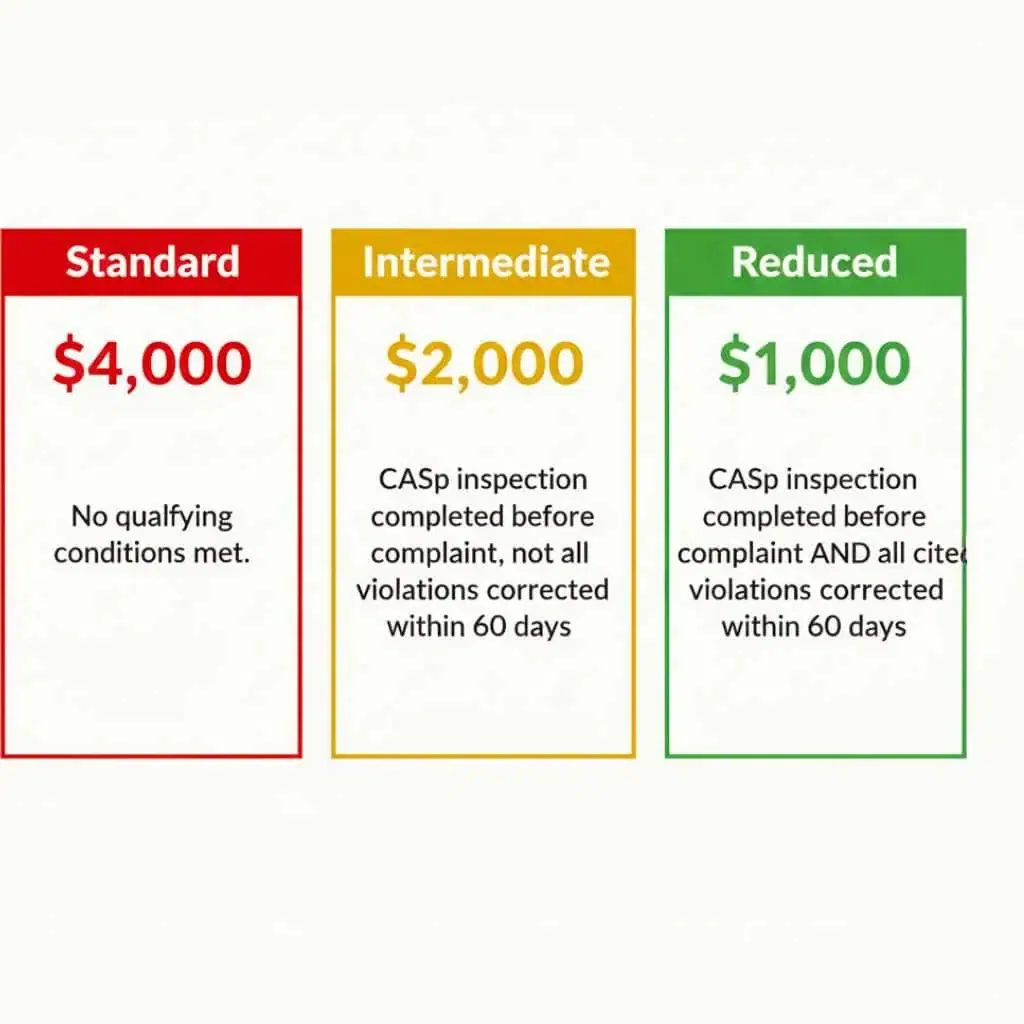
Three damages figures apply under CRASCA depending on the conditions present at the time a complaint is served and the correction timeline that follows.
The standard figure is $4,000 per violation per visit under Cal. Civil Code §55.56. This applies when no qualifying conditions are met.
The intermediate figure is $2,000 per violation per visit. This applies when a CASp inspection was completed before the complaint was served but not all cited violations are corrected within 60 days of complaint service. The inspection establishes the qualified defendant framework; the incomplete correction timeline determines the intermediate rather than reduced figure.
The reduced figure is $1,000 per violation per visit under Cal. Civil Code §55.56(f)(1). This applies when two conditions are both met: the CASp inspection was completed before the complaint was served, and all cited violations are corrected within 60 days of complaint service. Both conditions must be satisfied. Correcting some violations within 60 days does not apply the reduced figure to violations that remain open beyond that window.
Sequencing implication
The barriers most likely to be encountered during a visit to the facility — accessible parking, primary entry, restroom access — are the findings that generate per-visit statutory damages under Cal. Civil Code §55.56. The DOJ priority order under 28 C.F.R. §36.304(c) places accessible approach, entry, and restroom access in the first three priority tiers. The CRASCA damage calculation structure under Cal. Civil Code §55.56 applies its most favorable figures to violations corrected earliest within the documented schedule. Both frameworks identify the same barrier categories as the ones to address first.
CRASCA was established through SB 1608 (2008) and significantly amended through SB 1186 (2012). Confirm current version of Cal. Civil Code §§55.53 and 55.56 against California Legislative Information before publish — both sections are subject to amendment.
Phasing Structural and Permit-Required Repairs
Neither the federal ADA framework nor California law requires a business to complete all barrier removal at once. The readily achievable standard under 28 C.F.R. §36.304(a) accounts for financial resources, operational constraints, and the nature of the correction required. What both frameworks do require is that barriers not corrected immediately appear on a documented schedule with evidence that correction is actively in progress. Cal. Civil Code §55.53 and 28 C.F.R. §36.304(a) both treat documented active progress as the governing standard for deferred items. The absence of documentation does not satisfy either framework.
When barrier removal is not readily achievable
If a barrier cannot be corrected because the cost or complexity places it outside the readily achievable threshold, 28 C.F.R. §36.305 requires that alternative methods be used to provide access to the goods or services affected. Alternative methods include relocating the service to an accessible location, providing home delivery, or restructuring how the service is offered so that a person with a disability can participate without encountering the barrier. The alternative method obligation is not discretionary. It applies when readily achievable removal is not possible and continues until the barrier is corrected.
The 20% disproportionate cost rule
When a facility undertakes planned alterations to a primary function area, path-of-travel improvements are required up to 20% of the primary alteration cost per 28 C.F.R. §36.403(h). This rule applies to alteration-triggered path-of-travel obligations, not to standalone barrier removal under 28 C.F.R. §36.304. A facility correcting CASp report findings through standalone barrier removal without any broader renovation scope does not trigger the 20% path-of-travel obligation. The two scopes operate under different regulatory triggers and must be evaluated separately. The interaction between permitted corrections and alteration-triggered path-of-travel obligations is covered in full below under When Alterations Trigger Path-of-Travel Requirements.
What a phased schedule must document
Each deferred item requires its own entry in the remediation schedule. The entry must be specific enough to demonstrate that the correction is planned, costed, and assigned a timeline — not simply acknowledged as outstanding. Each entry must carry the following:
- Barrier description tied to the CASp report finding number or description
- Applicable code citation — both the ADA standard section and the CBC section where both apply
- Planned correction method
- Estimated cost
- Target completion date
- Current status: not started, in progress, permit filed, or complete
When a building permit is required for a deferred item, file the permit application and record the submission date and permit number in the schedule. The filing date and pending status document that the correction is actively in progress. Update the schedule as each item progresses. Retain all versions with their dates. The remediation schedule is one of the five conditions that must be satisfied before a complaint is served for qualified defendant status to apply under Cal. Civil Code §55.53. The other four conditions are covered in full above under How Qualified Defendant Status and the 120-Day Window Affect Sequence.
Funding and cost reduction resources
The readily achievable determination under 28 C.F.R. §36.304(a) accounts for the financial resources available to the entity. Funding mechanisms that reduce the net cost of barrier removal directly affect that calculation and may bring corrections within the readily achievable threshold that would otherwise fall outside it.
The IRS Section 44 tax credit provides up to $5,000 annually for eligible small businesses, defined as businesses with gross revenues of $1 million or less, or 30 or fewer full-time employees, for ADA barrier removal costs. The credit covers 50% of eligible expenditures between $250 and $10,250 per year. Confirm current credit limits against IRS Form 8826 and IRS Publication 535 before advising clients — the outline flags this as needing source confirmation before publish.
Community Development Block Grant (CDBG) funding is available through Los Angeles County and Southern California municipalities for qualifying properties undertaking accessibility barrier removal. CDBG programs are administered at the municipal and county level. Confirm specific program contacts and current funding availability through LA County and the relevant Southern California municipality before publish — the outline flags specific CDBG program contacts as a needed source.
What a Documented Remediation Schedule Must Include
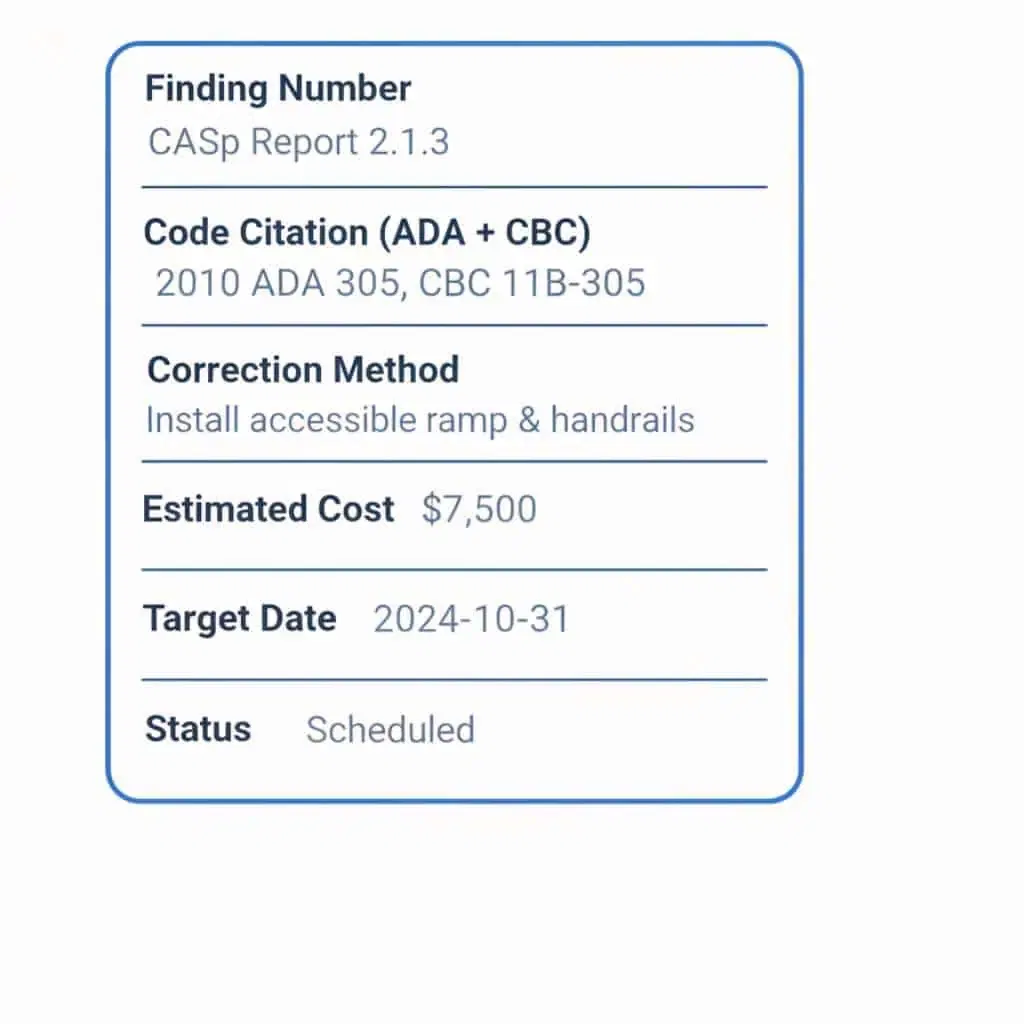
A compliant remediation schedule is an itemized written record tied directly to CASp report findings. It names each barrier, cites the applicable code standard, specifies the planned correction, assigns a target completion date, and documents current progress status. Under Cal. Civil Code §55.53, the schedule must exist before a complaint is served to function as part of the qualified defendant eligibility framework. Cal. Civil Code §55.53 establishes the pre-complaint timing as a condition of eligibility. A schedule that does not exist before a complaint is served does not satisfy that condition as the statute defines it.
The schedule operates at two levels: the individual finding level and the schedule level. Both must be complete.
Required elements at the finding level
Each finding from the CASp report requires its own entry. The entry must include all of the following:
- Barrier identification tied to the CASp report item number or description
- Applicable code citation, covering both the ADA standard section and the CBC section where both apply
- Planned correction method, specific enough to confirm the correction addresses the cited code requirement
- Estimated cost for the correction
- Target completion date
- Current status: not started, in progress, permit filed, or complete
Required elements at the schedule level
The schedule as a whole must also carry the following:
- Date of the CASp inspection
- CASp inspector name and DSA certification number
- Total finding count from the inspection report
- Total estimated remediation cost across all findings
- Phasing rationale for any deferred items, stating why specific findings are scheduled later rather than addressed immediately and connecting each deferral to the readily achievable determination, the permit timeline, or the structural constraint that governs it
The phasing rationale documents the basis for each deferral against the readily achievable determination, the permit timeline, or the structural constraint that governs it. Cal. Civil Code §55.53 and 28 C.F.R. §36.304(a) both treat documented active progress as the standard for deferred items. A deferred item without a documented rationale does not satisfy that standard under either framework.
Supporting documentation
The schedule is the primary record but it does not stand alone. Each entry in the schedule carries greater evidentiary weight when supported by documentation that confirms the correction is planned, costed, and actively in progress. Supporting documentation also provides the dimensional and photographic evidence needed to close out completed findings against the cited code requirement. Maintain the following alongside the schedule:
- Contractor quotes for each finding where cost is the basis for deferral or phasing
- Permit applications with submission dates and permit numbers once issued
- Invoices for completed work
- As-built photos with dimensions confirming that the corrected condition meets the cited code requirement
Supporting documentation should be organized by finding number and retained in the same version-controlled record as the schedule itself. When items are completed, close them out with as-built photos and final measurements. A finding closed without dimensional confirmation is not fully documented.
Re-inspection
A re-inspection by the original CASp after corrections are completed creates the strongest available documentation record. The re-inspection confirms that each corrected finding meets the applicable code standard, produces a formal close-out record tied to the original inspection, and gives the remediation schedule a professional verification layer that contractor invoices and as-built photos alone do not provide.
DAIC posting
The Disability Access Inspection Certificate (Form DSA-300) must be posted at the facility per DSA requirements. Posting the DAIC is a distinct act required for qualified defendant eligibility under Cal. Civil Code §55.53. It is separate from maintaining the remediation schedule. The full eligibility conditions are covered above under How Qualified Defendant Status and the 120-Day Window Affect Sequence.
Version control
Retain all versions of the remediation schedule with their dates. A schedule that shows one version from the date of inspection with no subsequent updates does not demonstrate active progress under the standard Cal. Civil Code §55.53 establishes. Each update to the schedule, whether a status change, a completed item, a revised timeline, or a new permit entry, should be saved as a dated version. The version history is part of the documentation record. A complete, current remediation schedule that satisfies all of the elements above is the document that positions a California business within the qualified defendant framework Cal. Civil Code §55.53 establishes before a complaint is served.
When Alterations Trigger Path-of-Travel Requirements
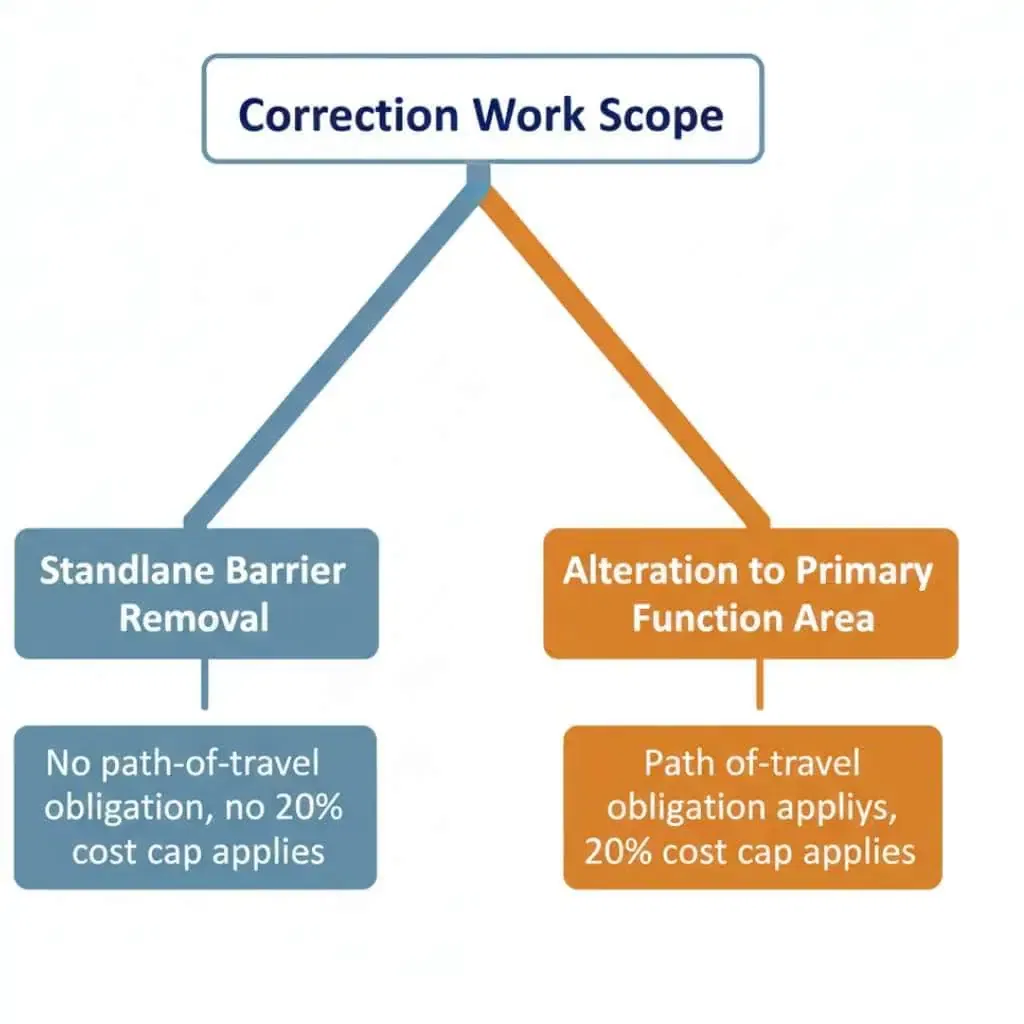
Standalone barrier removal and planned alterations operate under different regulatory triggers. The distinction determines whether path-of-travel improvement obligations attach to the work being done. A facility correcting CASp report findings through standalone barrier removal, without any broader renovation scope, does not trigger path-of-travel obligations under 28 C.F.R. §36.403. Path-of-travel requirements attach when a facility undertakes planned alterations to a primary function area.
The table below maps the key differences between standalone barrier removal and alteration to a primary function area across five dimensions.
| Standalone Barrier Removal | Alteration to Primary Function Area | |
|---|---|---|
| Trigger condition | Correction of existing barriers identified in a CASp report or otherwise found to be non-compliant, with no broader renovation scope | A change to the facility that affects usability per 28 C.F.R. §36.402, excluding maintenance, normal wear-and-tear repair, and aesthetic cosmetic work |
| Path-of-travel obligation | None. Standalone barrier removal is explicitly carved out from alteration-triggered path-of-travel obligations per 28 C.F.R. §36.304 and DOJ guidance | Required. Path-of-travel improvements must be made to the extent they are readily achievable, up to the 20% cost cap |
| 20% cost cap applicability | Not applicable. The 20% disproportionate cost rule under 28 C.F.R. §36.403(h) does not apply to standalone barrier removal | Applicable. The facility must spend up to 20% of the primary alteration cost on path-of-travel improvements, which is a spending cap, not a spending floor |
| Permit implication | Permit generally not required for standalone readily achievable corrections. See When Permit Requirements Change Your Sequence for work-type specific detail | Permit required for alterations to primary function areas in LADBS and Southern California jurisdictions. Permitted restroom work almost always triggers accessible path-of-travel review by plan check |
| Governing regulation | 28 C.F.R. §36.304; DOJ ADA Title III Technical Assistance Manual | 28 C.F.R. §36.402 (alteration definition); 28 C.F.R. §36.403 (path-of-travel); 28 C.F.R. §36.403(h) (20% cap); CBC Title 24 Part 2 |
Two points in the table require additional explanation.
The alteration definition under 28 C.F.R. §36.402 is narrower than it may appear. Maintenance work, normal wear-and-tear repairs, and aesthetic cosmetic changes do not constitute alterations. The trigger is a change that affects usability. Replacing a non-compliant door with a compliant one as a standalone barrier removal correction does not constitute an alteration. Reconfiguring a restroom layout as part of a broader renovation does.
The 20% disproportionate cost rule is a cap, not a floor. When a facility alters a primary function area, it must spend up to 20% of the primary project cost on path-of-travel accessibility improvements. The obligation does not require spending beyond 20%. It also does not permit spending less than what is readily achievable within that 20% threshold.
When renovation and barrier removal work overlap in scope, the two must be evaluated separately before work begins. Under 28 C.F.R. §36.402, the definition of alteration turns on whether the work affects usability. Barrier removal work that is combined with renovation work affecting usability falls within that definition, which attaches path-of-travel obligations to the combined scope. In LADBS and Southern California jurisdictions, permitted restroom work triggers accessible path-of-travel review by plan check regardless of whether the work originated as barrier removal or planned renovation. A CASp evaluation of the combined scope establishes which regulatory trigger applies to each element of the work and whether path-of-travel obligations attach before the project is permitted.
How to Choose a CASp for Remediation Coordination
A CASp inspection that establishes qualified defendant status under Cal. Civil Code §55.53 must be performed by an inspector holding active DSA certification at the time of the inspection. That is the baseline. For remediation coordination, the scope extends to validating the remediation schedule, coordinating with contractors on technical tolerances, and re-inspecting completed work to close out the documentation record. That scope requires a qualification framework that goes beyond certification status alone.
The DSA CASp registry at dsa.dgs.ca.gov/casp is the starting point. Cal. Civil Code §55.53 conditions qualified defendant eligibility on the inspection being performed by a DSA-certified inspector. Pre-engagement verification of registry status confirms that condition is met before the inspection occurs.
Beyond active certification, the following qualifications are directly relevant to remediation coordination work. Each addresses a specific function in the remediation cycle that certification alone does not cover.
Active DSA certification confirmed on the registry
CASp certification is issued under Bus. & Prof. Code §4459.5. Certification status must be verified at dsa.dgs.ca.gov/casp, not through the inspector’s own documentation. The registry reflects current status. An expired certification does not satisfy the Cal. Civil Code §55.53 requirement that the inspection be performed by a DSA-certified inspector, and qualified defendant eligibility does not attach to an inspection performed outside that condition.
DSA construction inspector licensure in addition to CASp certification
A CASp who also holds DSA construction inspector licensure can evaluate completed barrier removal work against code tolerances with the authority of a licensed construction inspector, not just the observational capacity of an access specialist. This dual credential is relevant when the remediation schedule includes structural corrections, permitted work, or conditions requiring dimensional verification against CBC Chapter 11B tolerances.
In-house or directly supervised ADA construction coordination
Remediation work that involves contractors, permit submittals, and phased corrections benefits from a CASp who can coordinate directly with the construction team during the work, not only evaluate the completed result. In-house construction coordination means the CASp is engaged throughout the correction process, not only at the beginning and the end. This engagement produces a documentation record that covers schedule validation, active correction coordination, and dimensional close-out of each completed finding against the cited code standard.
Demonstrated experience with Los Angeles County and Southern California permit jurisdictions
LADBS Plan Check LA and LA County DPW have specific accessibility permit pathways and review processes. A CASp with direct experience in these jurisdictions understands the plan check timeline, the documentation format that reviewers expect, and the conditions that commonly generate re-review requests. That jurisdictional familiarity affects how accurately the remediation schedule can be built around permitted work.
Re-inspection services to close out remediation schedule items
A re-inspection by the original CASp after corrections are completed produces a formal close-out record tied to the original inspection report. It confirms that each corrected finding meets the applicable code standard and provides the dimensional verification that contractor invoices and as-built photos alone do not establish. A re-inspection record that is tied to the original finding numbers and includes dimensional confirmation of each corrected condition is the documentation standard that closes out the remediation schedule completely.
Remediation coordination requires a CASp whose scope of work covers schedule validation, contractor coordination, permit jurisdiction familiarity, and documented close-out. The following three questions establish whether those capabilities are present before engagement. Can the CASp coordinate directly with the contractor during barrier removal? Will the CASp re-inspect completed items and produce a written close-out record tied to the original report findings? Does the CASp have direct experience with LADBS plan check for accessibility work and the review timelines for commercial properties in Los Angeles County?
These three questions address the specific functions that remediation coordination requires beyond the initial inspection — schedule validation against code tolerances, active coordination during correction work, and documented close-out of completed findings.
Sequencing Barrier Removal Is a Regulatory Decision, Not a Preference
The federal priority framework under 28 C.F.R. §36.304(c) establishes the sequence. California law under CBC Title 24 Part 2, CRASCA, and the Unruh Civil Rights Act establishes the context in which that sequence operates. The two frameworks are not alternatives. They apply simultaneously, and the sequencing decisions a California facility operator makes after receiving a CASp report must account for both.
The core principle running through every section of this page is that documentation governs deferral. A barrier that cannot be corrected immediately is not an ignored barrier as long as it appears on a dated, specific, actively updated remediation schedule that names the correction, the applicable code standard, the estimated cost, and the target completion date. That schedule, combined with a posted DAIC and an active CASp certification, is what the qualified defendant framework under Cal. Civil Code §55.53 requires. Each of those three elements is a condition of the framework, not a recommendation.
The barriers that belong at the front of the sequence are the same under both the federal priority order and the California filing patterns covered in this page. Accessible approach and entry, path of travel from parking to the primary entry, and restroom access appear first in the DOJ framework and most frequently in Southern California accessibility filings. Addressing those findings first, with documentation in place from the point the schedule is built, is how the federal compliance framework and the California legal framework align in practice.
For a detailed explanation of how CASp report findings are structured and what each section of a CASp report documents, see How to Read a CASp Report in California.

Written by Emily Johnson
Emily Johnson is a Certified Access Specialist (CASp) Inspector and is passionate about making spaces accessible for all. With over 10 years of experience and degrees in Civil Engineering and Architecture, she inspires others while championing ADA awareness.
RECENT POSTS
CATEGORIES
Get a free quote today!
By clicking “Submit”, you are signing up to receiving emails from us. You can unsubscribe whenever you like. SMS rates may apply.
Want To Know More About ADA Accessibility And How To Get Compliant?
Check out our blog!