Cost of ADA Non-Compliance vs. CASp Inspection in California

Cost of ADA non-compliance in California is the total financial exposure a commercial property owner or business operator carries when accessibility barriers remain unaddressed, measured against the known cost of preventive CASp inspection and structured remediation.
The primary state damages mechanism is the Unruh Civil Rights Act (Cal. Civ. Code §51), which sets minimum statutory damages at $4,000 per violation per occasion with mandatory plaintiff attorney fee recovery and no requirement to prove actual harm.
A CASp inspection, typically $750 to $3,500, activates Qualified Defendant status under Cal. Civ. Code §55.53 and §55.54 when completed before any lawsuit is filed. That status reduces statutory damages by 75% and grants a 90-day litigation stay. Both figures are statute-cited. Both are calculable before any complaint arrives.
What ADA Non-Compliance Costs California Businesses
Is your website ADA Compliant?
A single ADA lawsuit in California costs a business $14,000 on average in settlement alone. That figure comes from the SB 84 legislative analysis published by Sen. Roger Niello. It covers settlement only.
Defense attorney fees for a fully litigated case run $50,000 to $100,000 or more according to Seyfarth Shaw LLP’s annual ADA litigation report. Those fees accumulate through discovery, negotiation, and pre-settlement proceedings regardless of how the case resolves. A property owner who reaches settlement at month three has still paid for every billable hour between service and that date.
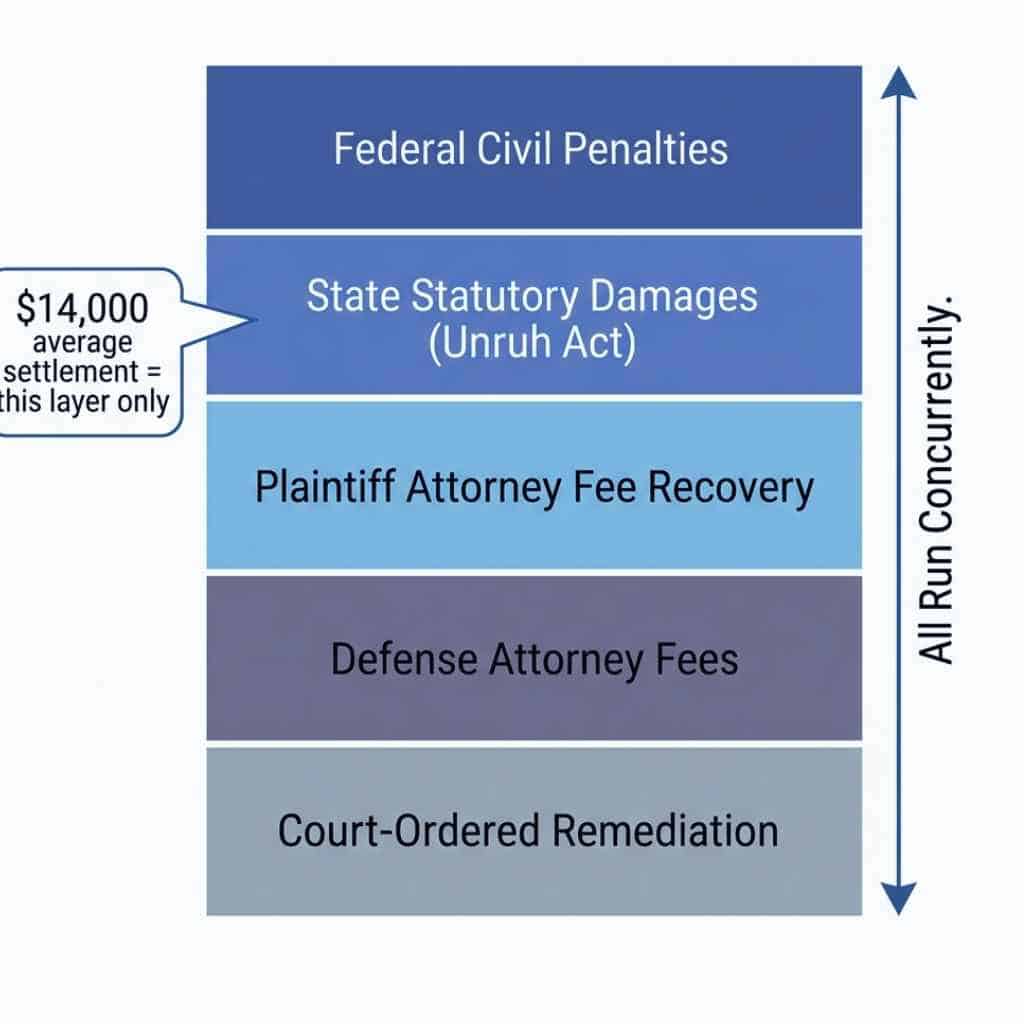
These cost categories stack. Federal civil penalties under 28 C.F.R. §36.504, California Unruh Act statutory damages under Cal. Civ. Code §52, plaintiff attorney fee recovery, and defense costs all run concurrently. Resolving one does not reduce another.
Under 42 U.S.C. §12188(a)(2), injunctive relief is the primary federal remedy in ADA Title III cases, authorizing courts to order physical remediation at the property owner’s expense. This cost sits outside settlement figures and defense fees. Remediation categories that typically require partial closure during construction include restroom retrofits, entrance ramp reconstruction, and accessible parking reconfiguration. Each adds business interruption costs on top of the physical work.
California has no pre-suit notice requirement under current law. A lawsuit can be filed without a prior demand letter and without any opportunity to correct the barrier first. The complaint is frequently the first formal document a property owner receives.
Total exposure across a single litigated case spans five categories: federal civil penalties, state statutory damages, plaintiff attorney fee recovery, defense attorney fees, and court-ordered remediation. The $14,000 average settlement figure does not include any of the four surrounding it.
You Don't Have To Figure This Out Alone
ADA compliance can feel overwhelming, especially when legal language is involved. We break it down, walk you through it, and handle the hard part.
Why California Is the Highest-Risk State for ADA Litigation
California accounts for approximately 37.5% of all federal ADA Title III lawsuits filed nationwide despite representing roughly 12% of the country’s disabled population. The disproportion is structural. California combines statutory damages that make individual cases financially attractive to plaintiffs, no pre-suit notice requirement, and an active serial litigation infrastructure operating at a scale no other state matches.
California filed 3,252 ADA Title III cases in 2024, a 37% increase from 2023 per Seyfarth Shaw LLP’s annual ADA litigation report. Digital claims run parallel to physical barrier filings. California federal courts received 485 website accessibility cases in 2024 alone per the EcomBack 2024 Annual ADA Website Lawsuit Report. Of state court filings, 82.89% originated in Los Angeles County Superior Court.
The Unruh Civil Rights Act sets minimum statutory damages at $4,000 per violation per occasion with mandatory plaintiff attorney fee recovery. That structure makes California filings more financially attractive than federal-only cases in other states. No pre-suit notice is required under current law. High-frequency litigants under Cal. Code Civ. Proc. §425.55, defined as plaintiffs filing ten or more accessibility complaints within a 12-month period, exploit that directly. California’s share of national ADA Title III filings at 37.5% suggests its share of national demand letter volume follows the same pattern. An estimated 35,000 to 50,000 demand letters were sent nationally in 2025 per AudioEye’s 2025 Lawsuit Analysis.
Serial plaintiffs concentrate on specific property categories. Restaurants, retail stores, medical offices, and fuel stations account for the majority of high-frequency filings. Parking violations, entrance barriers, and exterior signage deficiencies can be documented without entering the property. Drive-by documentation is efficient at scale. The UsableNet ADA Lawsuit Tracker confirms these categories as primary serial plaintiff targets year over year.
Plaintiff standing expanded in 2023. In Langer v. Kiser, 57 F.4th 1085 (9th Cir. 2023), the Ninth Circuit removed the intent-to-return defense. Before that ruling, defendants could challenge standing by arguing the plaintiff had no genuine intention of visiting the property again. That challenge is no longer available in the Ninth Circuit. Without it, a defendant must engage the case on its merits from the point of service. There is no low-cost procedural exit before discovery begins.
SB 84 (2025) is pending legislation that would introduce a pre-suit notice and cure period. If enacted, it modifies the no-notice dynamic described above. The current no-notice rule is treated as stable for purposes of this article. Verify SB 84 status before publishing. If it has passed, every section referencing no pre-suit notice requires revision.
Federal vs. California State Penalties for ADA Violations
Federal ADA penalties cap at $75,000 for a first offense and $150,000 for subsequent offenses under 28 C.F.R. §36.504, with no private monetary damages available to plaintiffs. California’s Unruh Civil Rights Act adds $4,000 minimum in statutory damages per violation per occasion under Cal. Civ. Code §52, mandatory plaintiff attorney fee recovery, and no requirement to prove actual harm. The two systems operate in parallel. Plaintiffs routinely file under both.
| Penalty Category | Federal ADA (Title III) | California Unruh Act |
|---|---|---|
| Primary Remedy | Injunctive relief (42 U.S.C. §12188) | Statutory damages + injunctive relief |
| Private Monetary Damages | None available to plaintiffs | $4,000 minimum per violation per occasion (Cal. Civ. Code §52) |
| Government Penalties | Up to $75,000 first offense; $150,000 subsequent (28 C.F.R. §36.504) | No separate government penalty structure |
| Attorney Fee Recovery | Available to prevailing plaintiffs | Mandatory for prevailing plaintiffs (Cal. Civ. Code §52) |
| Actual Harm Required | Yes, for standing in federal court | No — statutory damages apply without proof of actual harm |
| ADA Violation = State Violation | N/A | Every ADA violation is automatically an Unruh violation (Cal. Civ. Code §51(f)) |
| Per-Visit Multiplication | Not applicable | Each encounter with a barrier recognized as a separate violation |
| Treble Damages | Not available | Available under Cal. Civ. Code §52(a) where violation is willful, oppressive, or malicious |
| Standing Threshold | Higher — federal Article III standing requirements apply | Lower — California state court standing is broader |
Filing under both federal and state law simultaneously is standard plaintiff practice in California. It is not a complex legal maneuver. It is routine because the two systems complement each other directly. Federal law provides injunctive relief. California law provides statutory damages. A single property visit can generate claims under both in the same action. Neither system cancels out the other.
Federal Article III standing requires a plaintiff to demonstrate injury in fact and a deterrent effect — meaning the barrier must have actually prevented or deterred access, and the plaintiff must show a plausible intent to return. California state court does not impose that threshold. That is why 82.89% of California ADA state court cases originate in Los Angeles County Superior Court rather than federal court. State court gives plaintiffs a lower bar to clear before the case proceeds on the merits.
Per-visit multiplication is how Unruh Act exposure scales. Courts have recognized each encounter with an accessibility barrier as a separate violation. A plaintiff who visited the same property on three occasions and encountered the same parking barrier each time can claim $4,000 per visit. Three visits. One unresolved barrier. $12,000 in statutory damages before attorney fees are calculated. The barrier does not need to change between visits for each encounter to count separately.
Treble damages are available under Cal. Civ. Code §52(a) where a violation is found to be willful, oppressive, or malicious. When that standard is met, the court may award up to three times the actual damages in addition to statutory damages. That adds a third multiplier beyond per-visit stacking and mandatory attorney fee recovery.
The California Disabled Persons Act (Cal. Civ. Code §54 through §54.3) runs parallel to the Unruh Act and provides a separate cause of action for disability-based access violations. Plaintiffs may pursue claims under both statutes in the same filing. A single property visit can generate Unruh Act damages, California Disabled Persons Act damages, and a federal injunctive relief claim simultaneously.
Common ADA Violations That Trigger Lawsuits in California
Parking lot violations, restroom non-compliance, entrance and ramp barriers, signage deficiencies, and website inaccessibility are the five highest-frequency categories driving ADA lawsuits in California. Parking and entrance violations account for a majority of serial plaintiff filings because they are visible from the street and require no interior access to document. Exterior barriers are documented quickly and without staff interaction.
The following categories represent the barriers CASp inspectors identify most frequently across California commercial properties, cross-referenced against California Building Code Chapter 11B and the ADA Standards for Accessible Design.
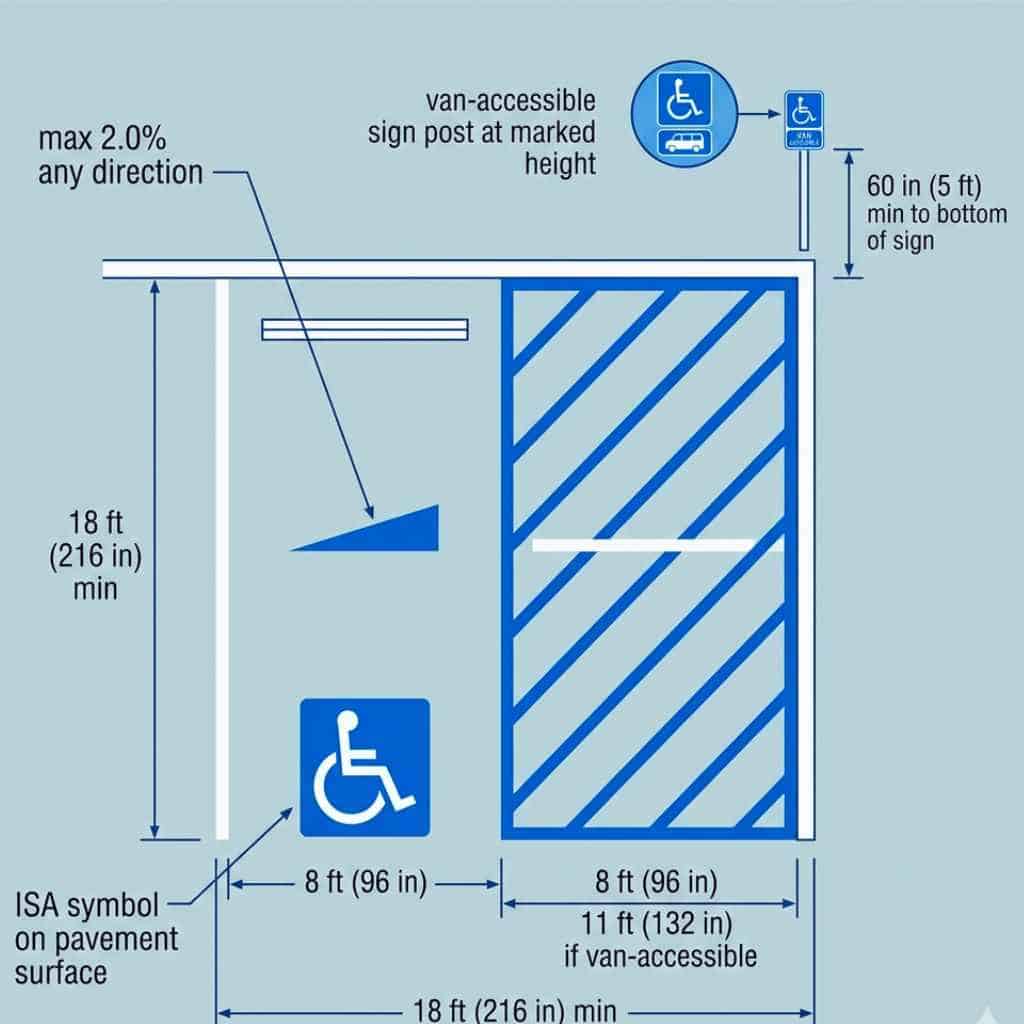
Parking Accessible space dimensions, van-accessible designation, access aisle width, and signage are the four components serial plaintiffs document first. CBC Chapter 11B requires a maximum slope of 2.0% in any direction across accessible spaces and access aisles. The federal ADA Standards allow 2.083%, but California’s stricter standard governs. Signage must meet specific height, content, and ISA symbol requirements. A space with correct dimensions but non-compliant signage is a documentable violation.
Entrances and Ramps Ramp slope cannot exceed 1:12 under both CBC Chapter 11B and the ADA Standards for Accessible Design. Minimum clear width is 36 inches. Landing dimensions at the top and bottom of each ramp run are specific and frequently deficient in older construction. Door opening force on non-fire-rated doors cannot exceed 5 pounds of pressure under CBC Chapter 11B.
Restrooms Grab bar placement, stall dimensions, turning radius, sink height, and flush control accessibility are the primary restroom violation categories. CBC Chapter 11B sets a minimum 60-inch turning radius inside accessible stalls. Grab bars must meet specific diameter, mounting height, and structural backing requirements. Sink height, knee clearance, and faucet hardware are separately evaluated. Restroom violations are dense because each fixture is an independent compliance point.
Signage Braille and raised character requirements apply to permanent room identification signage throughout a facility. Mounting height is specific: centerline of the sign at 60 inches above the floor, positioned on the latch side of the door. Contrast ratios between characters and background must meet the 70% non-glare standard under CBC Chapter 11B. A sign with correct Braille but incorrect mounting height or placement is a documentable deficiency.
Website Accessibility WCAG 2.1 Level AA is the accepted benchmark for digital accessibility under current DOJ guidance. Screen reader compatibility, alt text for images, keyboard navigation, and video captioning are the four elements generating the highest volume of California digital accessibility claims. Screen reader compatibility failures are the most frequently cited technical basis in California filings per EcomBack 2024, typically involving missing ARIA landmarks, unlabeled form fields, and focus order failures that automated scanners flag but manual audits confirm.
Serial plaintiffs prioritize exterior categories because parking and entrance documentation requires no property access and produces evidence that is straightforward to establish. Interior categories including restrooms and signage are typically documented on follow-up visits or through tenant-reported conditions. The sequence follows access, not severity.
Getting Served With a Claim Doesn't Mean It's Over
Getting Served With a Claim Doesn't Mean It's Over
California actually built in protections for property owners who act quickly. We’ll help you understand your options and move through the process with as little disruption as possible.
A CASp inspection typically costs between $750 and $3,500, depending on property size, complexity, number of public-facing areas, and location. The inspection evaluates the property against both the ADA Standards for Accessible Design and California Building Code Chapter 11B simultaneously. Deliverables include an Access Compliance Report with severity-rated findings and code citations, and optionally a Disability Access Inspection Certificate.
Cost varies for predictable reasons. A single-tenant retail space with one entrance, one restroom, and a small parking area sits at the lower end. A multi-tenant medical office complex with multiple entrances, accessible routes across several floors, and a large parking structure sits at the higher end. Property location affects cost when travel is required. The inspection fee covers time on site and report preparation.
Cal. Civ. Code §55.53(b) mandates dual-code analysis. The inspector evaluates every element against both the ADA Standards and CBC Chapter 11B, applying the stricter standard where the two conflict. California’s standards exceed federal requirements in several categories including parking slope, door hardware, and restroom fixture specifications. An inspection conducted against the federal standard only does not satisfy California’s CASp requirement.
The Access Compliance Report documents every barrier identified, assigns a severity rating to each finding, cites the specific code section, and provides remediation recommendations. It is a documented condition assessment with a code reference attached to every finding. The report is structured for use by contractors, architects, and attorneys. It is not a summary. Every finding is traceable to a specific standard.
The Disability Access Inspection Certificate is sequentially numbered, bears the California state seal, and documents that a certified inspection occurred. It is the primary evidence used to establish Qualified Defendant status under Cal. Civ. Code §55.53 and to satisfy lease disclosure requirements under Cal. Civ. Code §1938. The DAIC is issued after inspection completion. It is optional but carries direct legal function.
Approximately 900 certified CASp inspectors serve more than 4.1 million California businesses. The CASp exam carries an approximately 39% pass rate. Supply is limited relative to demand. Most inspections complete in one day on site. Reports are delivered within three to five business days after the site visit.
Re-inspection is recommended every three to five years under normal operating conditions. Three triggers reset the cadence regardless of where it stands: a major remodel, a permitting change, or a tenant change. Each matters for a distinct reason. A major remodel alters physical conditions the prior report documented. A permitting change can modify the scope of accessibility requirements that apply to the property. A tenant change introduces new public-facing areas the prior inspection may not have evaluated.
How Qualified Defendant Status Reduces Your Exposure
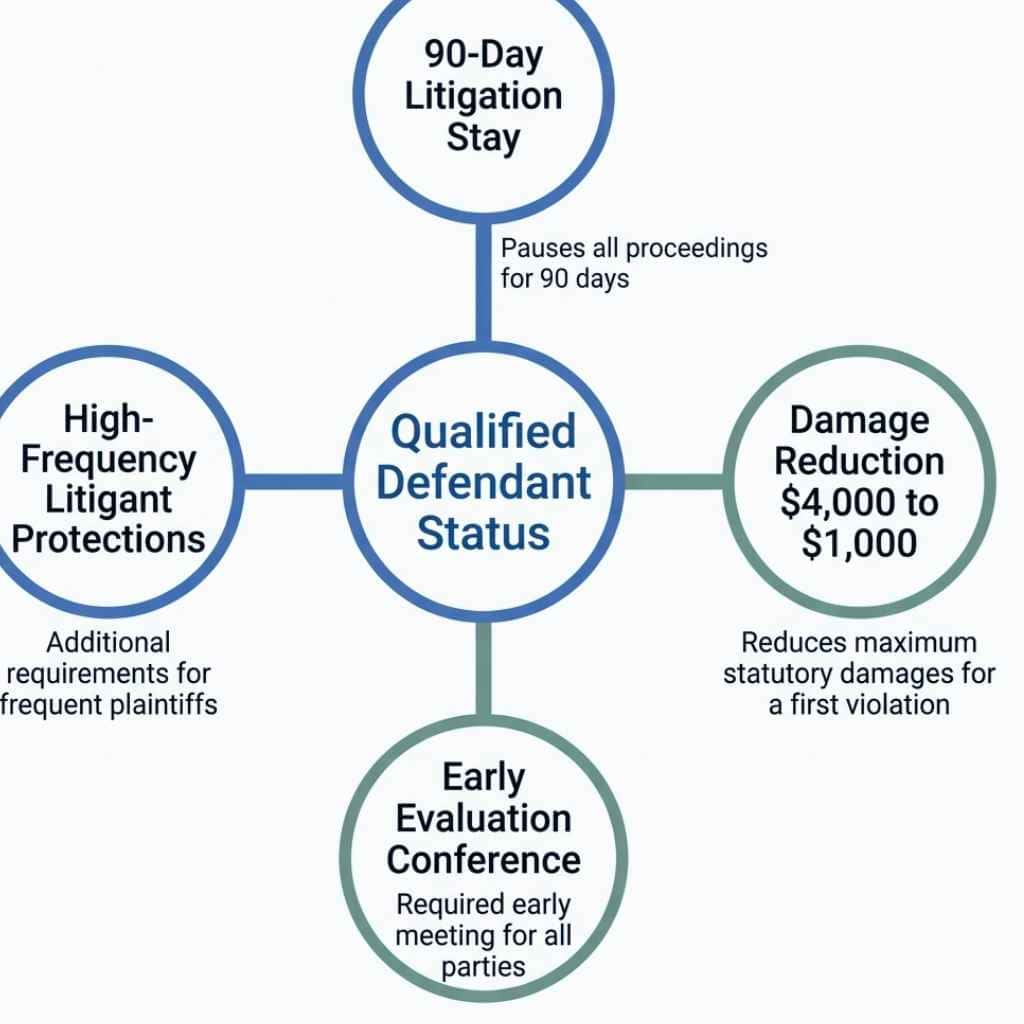
Qualified Defendant status under Cal. Civ. Code §55.53 and §55.54 reduces Unruh Act statutory damages from $4,000 to $1,000 per violation, grants a 90-day stay of litigation, and provides access to an Early Evaluation Conference for faster, lower-cost resolution. These protections activate only if the CASp inspection was completed before any lawsuit is filed. A post-litigation inspection does not qualify for that case.
The mechanism is statutory. §55.53 defines the designation. §55.54 governs the stay and Early Evaluation Conference procedure. §55.56 governs the damage reduction. SB 1608 and SB 1186 established and refined the framework. Completing a CASp inspection before being sued establishes eligibility. Activating the protections requires a procedural filing step upon being served, covered in the activation section below.
According to the CCDA 2024 Annual Report, 99% of California ADA defendants did not have an active CASp inspection in place when sued. That figure means 99% entered litigation without the damage reduction, the stay, or the Early Evaluation Conference.
The activation sequence is procedural and order-dependent. The steps and the protections they unlock are covered separately in the two sections below.
How to Activate Qualified Defendant Status
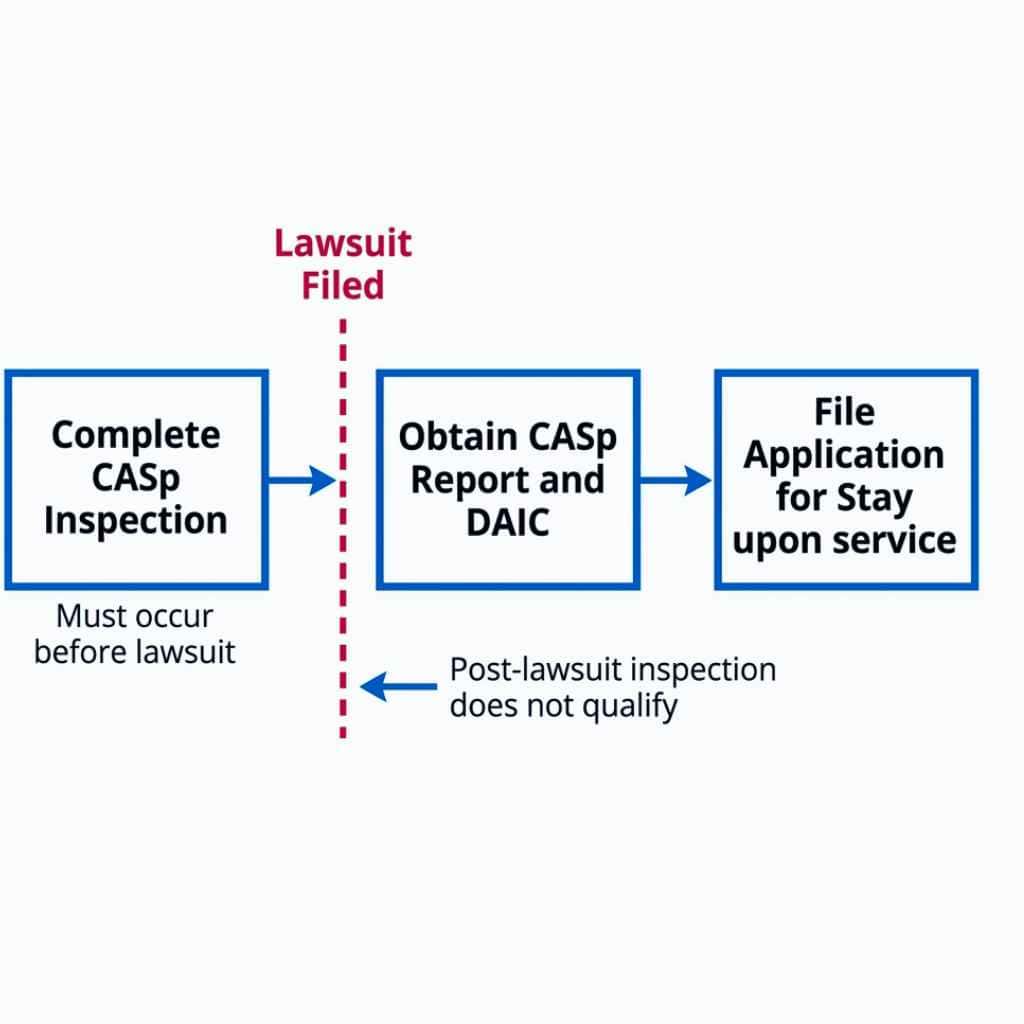
Activating Qualified Defendant status requires three sequential actions: complete a CASp inspection before any lawsuit is filed, obtain a CASp report and if applicable a DAIC, and file an Application for Stay and Early Evaluation Conference under §55.54(c) upon being served. Each step must be completed in order. The first step must be completed pre-litigation for the status to apply to that case.
Step 1: Complete a CASp inspection before any lawsuit is filed. This is the hard dependency. No other step in the sequence matters if this one is not completed before a complaint is filed. A CASp inspection scheduled after receiving a complaint does not activate Qualified Defendant status for that case. The inspection must predate the lawsuit, not the served complaint.
Step 2: Obtain a CASp report and, if applicable, a DAIC. The Access Compliance Report documents the inspection, identifies barriers, and provides severity ratings and code citations for every finding. Those two elements, severity ratings and specific code citations, are what the §55.54(c) application relies on to establish that a certified inspection occurred and what it found. The DAIC provides sequentially numbered, state-sealed documentation of the inspection. Both the report and the DAIC satisfy §1938 commercial lease disclosure requirements independently of the litigation context.
Step 3: Upon being served, file an Application for Stay and Early Evaluation Conference under §55.54(c). Being served triggers the filing window. The application must be filed promptly upon service. It initiates the 90-day stay, which pauses litigation and opens the window to consult counsel and correct violations within the 60-day correction period under §55.56. This is the procedural act that converts inspection eligibility into active Qualified Defendant status. Having the inspection and the
Protections Granted Once Activated
Once Qualified Defendant status is activated, four parallel protections apply immediately. Each protection has a calculable dollar value. The damage reduction and correction window are quantified in the list below. The four protections operate concurrently, not sequentially.
- 90-day litigation stay (Cal. Civ. Code §55.54). The lawsuit is paused for 90 days from the date the Application for Stay is filed. The stay creates the window to consult legal counsel, assess the CASp report findings, and begin correcting violations before the case proceeds.
- Statutory damage reduction from $4,000 to $1,000 per offense (Cal. Civ. Code §55.56). The reduction applies provided all construction-related violations are corrected within 60 days of being served. That is a 75% reduction per violation. On a case involving five separate violation findings, unreduced Unruh exposure is $20,000. With the reduction and timely correction, it is $5,000.
- Early Evaluation Conference (Cal. Civ. Code §55.54). The court evaluates compliance status and correction progress before full litigation proceeds. At the EEC, the court reviews the CASp report findings, the corrections completed since service, and whether both parties have made good-faith efforts toward resolution. The EEC creates a structured resolution pathway that does not require the case to run through discovery and trial to reach an outcome.
- Additional protections against high-frequency litigants (Cal. Code Civ. Proc. §425.55). Plaintiffs filing ten or more accessibility complaints within a 12-month period are classified as high-frequency litigants. When a high-frequency litigant files against a Qualified Defendant, the court can require the plaintiff to provide additional documentation of the accessibility barriers claimed, impose sanctions for filings found to be vexatious, and apply heightened scrutiny to the complaint at the pleading stage.
All four protections are forfeited if the CASp inspection was not completed before the lawsuit was filed. No step in the activation sequence substitutes for that pre-litigation requirement.
CASp Inspection Cost vs. ADA Lawsuit Cost: Side-by-Side Comparison
A CASp inspection at $750 to $3,500, combined with typical remediation costs of $3,000 to $20,000, represents a total proactive investment of $3,750 to $23,500 before tax incentives. A single ADA lawsuit without Qualified Defendant status costs $14,000 in average settlement per the SB 84 legislative analysis, plus $50,000 to $100,000 in defense fees per Seyfarth Shaw LLP’s annual ADA litigation report. The proactive path costs 5 to 20 times less than a single lawsuit.
| Cost Category | Proactive Path | Reactive Path (No QD) | Reactive Path (With QD) |
|---|---|---|---|
| CASp Inspection | $750–$3,500 | Not completed | Completed pre-litigation |
| Remediation | $3,000–$20,000 (planned) | Court-ordered (unplanned) | Within 60-day correction window |
| Tax Incentive Offset | Section 44 credit + Section 190 deduction (detail in H2-8) | Not available | Not available |
| Settlement Cost | N/A | $8,000–$35,000 | Reduced |
| Defense Attorney Fees | N/A | $50,000–$100,000+ | Reduced (90-day stay limits early accumulation) |
| Unruh Statutory Damages | N/A | $4,000 per violation | $1,000 per violation (75% reduction) |
| Federal Civil Penalties | N/A | $75,000–$150,000 (DOJ action) | $75,000–$150,000 (unchanged) |
| Total Estimated Exposure | $3,750–$23,500 before incentives | $64,000–$250,000+ per lawsuit | Significantly reduced |
Tax incentives reduce the proactive path further. Section 44 provides a federal tax credit of up to $5,000 per year for qualifying small businesses. Section 190 provides a deduction of up to $15,000 per year for any business, regardless of size. Combined, the maximum offset is $20,000. For qualifying businesses whose remediation costs fall within the deduction ceiling, the net proactive cost goes negative. Eligibility conditions and combination rules are detailed in the following section.
The 90-day stay reduces defense fee accumulation. Defense fees in ADA cases accumulate fastest during discovery and pre-trial motions. The stay interrupts that phase before it begins. A defendant who activates Qualified Defendant status immediately upon being served limits billable hours to the period between service and the stay taking effect. That is a fraction of what a fully litigated case costs.
Serial plaintiffs under Cal. Code Civ. Proc. §425.55 file against the same property repeatedly when barriers remain uncorrected. According to the CCDA 2024 Annual Report, 99% of California ADA defendants never activated Qualified Defendant protections. Each filing by a serial plaintiff against a property without Qualified Defendant status generates the same unreduced cost exposure as the first. Once a CASp inspection is completed and barriers are corrected, Qualified Defendant status becomes available on subsequent filings and the unreduced exposure no longer applies.
Federal civil penalties apply to DOJ enforcement actions. A private plaintiff cannot impose them directly. The $75,000 to $150,000 figure in the table reflects DOJ-initiated enforcement. Both exposure categories can apply to the same property for the same violations. They arise through separate legal channels.
Tax Credits and Deductions That Offset Compliance Costs
Two federal tax incentives directly offset ADA compliance costs. The Disabled Access Credit under IRC Section 44 provides a credit of up to $5,000 per year for qualifying small businesses. The Barrier Removal Tax Deduction under IRC Section 190 allows any business to deduct up to $15,000 per year in qualified barrier removal expenses. Both can be applied in the same tax year on the same project, provided the same dollar is not claimed under both.
IRC Section 44 — Disabled Access Credit Eligibility is limited to small businesses with gross receipts not exceeding $1,000,000 or 30 or fewer full-time employees in the preceding tax year. The calculation is straightforward: eligible access expenditures minus $250, multiplied by 50%, with a maximum credit of $5,000 per year.
A business spending $10,250 on eligible access improvements reaches the credit ceiling. Eligible expenditures include barrier removal, accessible formats for printed materials, sign language interpreters, and adaptive equipment. New construction is excluded. Routine maintenance and repairs that restore original condition without improving accessibility do not qualify as eligible access expenditures. The credit is claimed on IRS Form 8826 and carried through Form 3800 as part of the General Business Credit.
IRC Section 190 — Barrier Removal Tax Deduction Available to any business regardless of size or revenue. The maximum deduction is $15,000 per year for qualified architectural and transportation barrier removal expenses.
Unlike Section 44, Section 190 has no employee count or revenue threshold. A large commercial property owner who does not qualify for Section 44 can still deduct up to $15,000 in barrier removal costs under Section 190.
The combination rule is specific. Both incentives can apply to the same project in the same tax year, but the same dollar cannot be claimed under both. Section 44 applies to the first $10,250 of eligible expenditures, generating the maximum $5,000 credit. Section 190 applies to the remaining expenditures up to $15,000.
The worked example makes the combination concrete. A business with $20,000 in barrier removal costs applies Section 44 to the first $10,250, generating a $5,000 credit. Section 190 covers the remaining $9,750 as a deduction. Total tax benefit on $20,000 in remediation: $5,000 credit plus $9,750 deduction. The credit reduces tax liability dollar for dollar. The deduction reduces taxable income.
For a qualifying small business applying both incentives to $20,000 in remediation, the combined tax benefit of $5,000 credit plus $9,750 deduction reduces the after-tax cost of compliance significantly below the pre-incentive total. The exact net depends on the business’s marginal tax rate applied to the deduction.
Industries Most Targeted by ADA Lawsuits in California
Restaurants, retail stores, medical offices, hotels, fuel stations, and multi-family residential properties face the highest ADA lawsuit volume in California. Restaurants are the single most targeted category because of high public traffic, multiple accessibility touchpoints, and the visibility of violations to serial plaintiffs conducting exterior assessments. Filing volume rankings are sourced to Seyfarth Shaw LLP’s annual ADA litigation report. Serial plaintiff targeting patterns are sourced to EcomBack 2024. Industry-specific breakdown data is sourced to the UsableNet ADA Lawsuit Tracker.
The following categories represent the industries generating the highest ADA litigation volume in California.
- Restaurants. The most frequently targeted property category in California. Parking, entrance, seating, restroom, and menu accessibility are all independent claim categories under CBC Chapter 11B and the ADA Standards for Accessible Design. High turnover and frequent renovation cycles mean compliance conditions change regularly, keeping restaurants in active rotation for repeat filings.
- Retail and shopping centers. High public traffic and multiple storefronts create numerous exterior access points for barrier documentation. A shopping center with ten tenants presents ten separate compliance profiles. Parking lot violations, entrance barriers, and signage deficiencies across multiple storefronts can be documented in a single drive-by assessment.
- Medical offices. Patient access barriers carry both legal and regulatory consequences. A medical office that fails ADA accessibility standards faces private Unruh Act claims alongside potential Section 504 of the Rehabilitation Act exposure for any practice receiving federal financial assistance. The dual exposure makes medical offices a higher-consequence target than retail or restaurant properties of equivalent size.
- Hotels. Room accessibility, common areas, pool and spa access, and reservation system accessibility all generate independent claims. Federal ADA Title III regulations impose specific accessible room count requirements tied to total room inventory. Online reservation systems that do not allow guests to reserve accessible rooms face digital accessibility claims separate from physical barrier filings.
- Fuel stations. Pump accessibility and convenience store compliance are the two primary serial plaintiff targets. Older pump models with non-compliant card reader heights, intercom systems requiring voice interaction without visual alternatives, and access aisle widths at pump islands are the three conditions generating the highest claim volume at fuel stations. The exterior nature of these violations makes them documentable without entering the property.
- Multi-family residential. Shared amenities in apartment complexes and HOA common areas are subject to ADA and Fair Housing Act requirements. Leasing offices, fitness centers, pools, and parking areas serving residents are all publicly accessible spaces under California law. Private dwelling unit exemptions do not extend to common areas, which are evaluated under the same accessibility standards as commercial properties.
- eCommerce and websites. Digital accessibility lawsuits in California grew 37% year-over-year in 2025 per AudioEye’s 2025 Lawsuit Analysis. California federal courts received 485 website accessibility filings in 2024 alone per EcomBack 2024. Screen reader compatibility failures generate the highest claim volume because they affect the broadest range of disability categories, are detectable by automated scanning tools, and produce documented technical evidence without requiring manual site verification by the plaintiff. Missing alt text and keyboard navigation deficiencies follow as the second and third most cited technical bases. A business with physical ADA barriers and a non-compliant website faces simultaneous physical and digital claim exposure.
How to Calculate the ROI of a CASp Inspection for Your Property
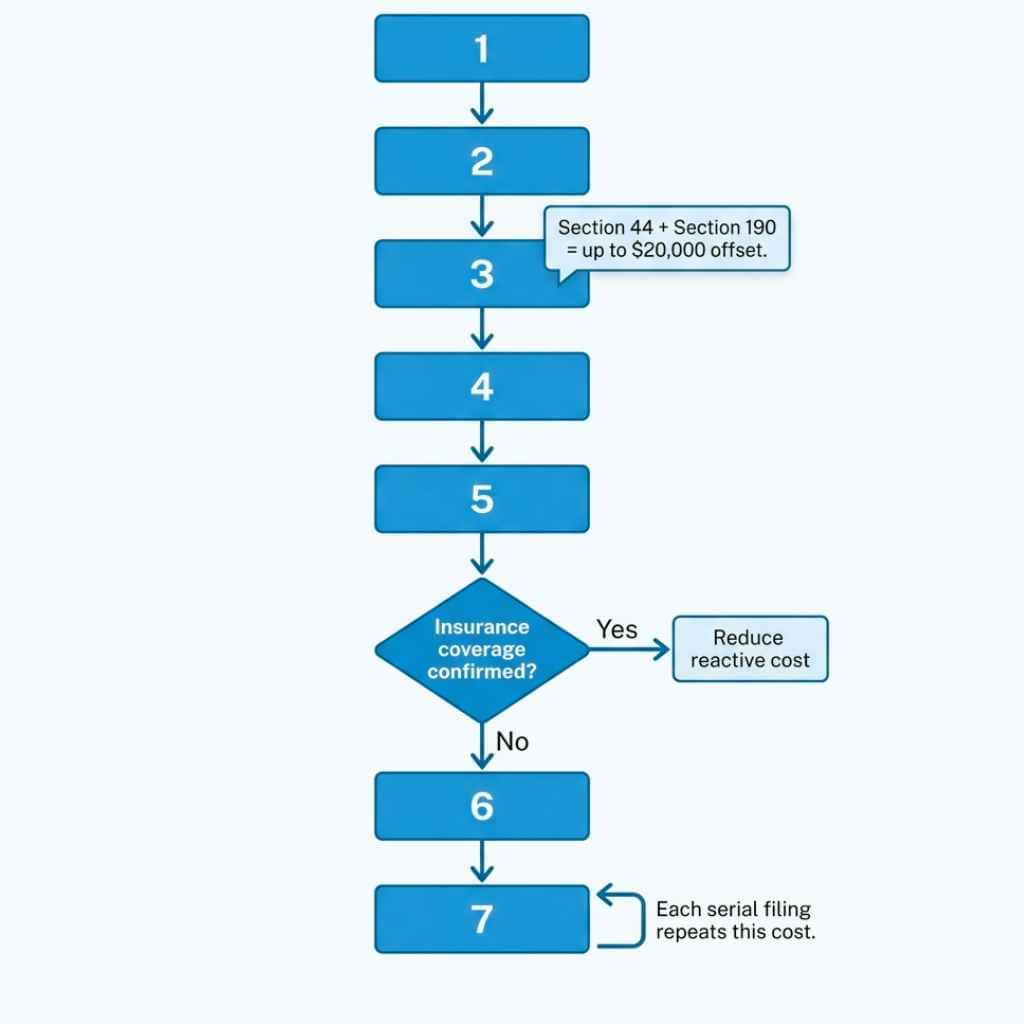
Calculate CASp inspection ROI by subtracting total proactive cost from projected reactive cost. For most California commercial properties, the proactive path costs between $0 and $8,500 net after tax incentives. A single reactive lawsuit without Qualified Defendant status costs $64,000 to $250,000 or more. The ROI on the proactive investment runs 7:1 to 30:1 depending on property size, violation count, and tax incentive eligibility.
The seven steps below apply to any California commercial property. Insurance coverage posture is a separate modifier on the reactive cost figure and is covered in the section that follows. Confirm coverage before finalizing Step 5.
Step 1: Determine your CASp inspection cost. Inspection fees run $750 to $3,500 depending on property size, complexity, number of public-facing areas, and location. A single-tenant retail space sits at the lower end. A multi-tenant medical office complex with multiple floors and a large parking structure sits at the higher end.
Step 2: Estimate remediation costs for your property type. Typical remediation ranges from $3,000 to $20,000 for most commercial properties. Parking lot slope corrections, entrance ramp reconstruction, and restroom retrofits are the three categories that drive the higher end of that range. A property with only signage and door hardware deficiencies sits closer to the floor.
Step 3: Calculate your tax incentive offset. Section 44 provides a credit of up to $5,000 per year for qualifying small businesses. Section 190 provides a deduction of up to $15,000 per year for any business. Maximum combined offset is $20,000. Apply Section 44 to the first $10,250 of eligible expenditures. Apply Section 190 to the remainder up to $15,000. A qualifying small business with $20,000 in combined inspection and remediation costs can reduce net proactive cost to near zero in the year the work is completed.
Step 4: Calculate net proactive cost. Net proactive cost equals inspection fee plus remediation estimate minus tax incentive offset. For a qualifying small business: ($750 to $3,500 inspection) + ($3,000 to $20,000 remediation) minus (up to $20,000 in incentives) = $0 to $3,500 net in most scenarios. For a non-qualifying business, net proactive cost runs $3,750 to $23,500.
Step 5: Calculate projected reactive cost without Qualified Defendant status. Add the following: average settlement of $14,000 per the SB 84 legislative analysis, plus defense fees of $50,000 to $100,000 per Seyfarth Shaw LLP, plus Unruh damages of $4,000 per violation, plus court-ordered remediation at unplanned scope and cost. Total reactive exposure on a single lawsuit runs $64,000 to $250,000 or more depending on settlement timing, plaintiff type, Qualified Defendant status, and violation count.
Step 6: Divide reactive cost by net proactive cost to determine ROI ratio. Using the qualifying small business net proactive cost floor of approximately $0 to $3,500 against a conservative reactive cost of $64,000, the ROI ratio runs from 18:1 to effectively uncapped at the net-zero proactive end. Using the non-qualifying business proactive cost ceiling of $23,500 against $64,000 reactive, the ratio is approximately 2.7:1 at minimum. The 7:1 to 30:1 range reflects the spread between the non-qualifying business proactive cost ceiling of $23,500 and the qualifying small business net-zero floor, measured against the $64,000 conservative reactive cost floor.
Step 7: Factor in multiple lawsuit exposure. Serial plaintiffs under Cal. Code Civ. Proc. §425.55 file against the same property repeatedly when barriers remain uncorrected. Each subsequent filing generates the same reactive cost cycle. A property sued twice without Qualified Defendant status doubles the reactive cost figure in Step 5. The proactive cost in Step 4 is a one-time investment. The reactive cost in Step 5 is per filing.
How Insurance Coverage Responds to ADA Claims
Most commercial general liability policies exclude ADA Title III statutory damages and defense costs for intentional acts. D&O policies typically do not respond to accessibility-based statutory civil rights claims. A property owner modeling reactive cost should assume 100% out-of-pocket exposure for settlement, defense fees, and Unruh statutory damages unless their broker confirms specific endorsement coverage in writing.
CGL policies typically follow the ISO CG 00 01 commercial general liability form as a base. That form generally excludes coverage for statutory damages and defense costs where the underlying act is characterized as intentional. ADA violations are frequently characterized as intentional for coverage purposes because the property owner is presumed to have known about the accessibility requirement and failed to act. The exclusion applies regardless of whether the owner was aware of the specific violation.
D&O coverage does not respond to ADA Title III or Unruh Act claims under most standard policy forms. A property owner who includes D&O as a coverage offset in the reactive cost calculation is working from an incorrect baseline.
The broker verification step belongs before Step 5 of the ROI calculation. Request a written coverage opinion that specifically addresses ADA Title III claims, Unruh Act statutory damages, and defense cost coverage under the current policy form and any endorsements. The opinion should identify whether coverage exists, which exclusions apply, and whether any ADA-specific endorsement is attached to the current policy. A verbal confirmation is not sufficient. If the broker cannot provide a written opinion addressing these specific points, treat the policy as excluding coverage for modeling purposes.
If coverage is confirmed through a specific endorsement, reduce the out-of-pocket reactive cost in Step 5 by the covered amounts. If coverage is excluded, the full $64,000 to $250,000 reactive cost range applies without offset. Property owners without a specific ADA endorsement on their current policy are typically in the excluded category. A property owner who completes the broker verification step before modeling reactive cost has a defensible basis for the figures in Step 5. One who skips it does not.
Lease Disclosure Requirements for Commercial Property Owners
California Civil Code §1938, as amended by AB 2093 and effective January 1, 2017, requires every commercial property lease to disclose whether the premises have been inspected by a CASp. The disclosure obligation applies to every commercial property lease. Inspection status determines which disclosure path applies, not whether disclosure is required. Failure to comply creates a separate legal exposure unrelated to ADA barrier claims.
The disclosure requirement branches based on inspection status.
If the property has been CASp-inspected and no modifications have occurred since the inspection, the owner must provide a copy of the CASp report to the prospective tenant before lease execution. The tenant has the right to review the report for at least 48 hours before signing. If the report is not provided within that window, the tenant holds a 72-hour right to rescind the lease after execution.
If the property has been inspected and meets all applicable standards, the owner provides the DAIC and the inspection report within seven days after lease execution. The DAIC documents that the inspection occurred and that the property met the standards evaluated at the time of inspection.
If the property has not been CASp-inspected, the lease must include specific statutory language advising the tenant of their right to obtain a CASp inspection and negotiate who bears the cost. The statutory language is prescribed by §1938. Substituting a paraphrased version does not satisfy the requirement.
Report confidentiality is a condition of disclosure. The tenant must agree in writing to keep the CASp report confidential, with one exception: information necessary to complete repairs agreed upon between the parties may be shared with contractors and other parties directly involved in the remediation work.
Non-compliance with §1938 creates exposure on two tracks. The first is the rescission right. A tenant who did not receive the required report within the 48-hour window can rescind the lease within 72 hours of execution, voiding the agreement and returning both parties to their pre-lease positions. Lost rental income for the period between rescission and re-letting, carrying costs during the vacancy, and the requirement to re-execute a fully compliant lease are the three operational consequences rescission creates for a committed property owner. The second track is contractual. A lease that does not include the required statutory disclosure language for uninspected properties is deficient on its face. That deficiency can be raised by the tenant as a defense or leverage point at any stage of the lease relationship, not only at execution.
The §1938 disclosure obligation pairs directly with the CASp inspection timing decision. A property owner who completes a CASp inspection before entering a new lease satisfies the disclosure requirement and provides the prospective tenant with a documented compliance baseline.
When to Schedule a CASp Inspection to Maximize Protection
Schedule a CASp inspection before any complaint or demand letter arrives. Qualified Defendant protections under Cal. Civ. Code §55.53 activate only if the inspection is completed before any lawsuit is filed. A post-litigation inspection does not qualify for that case.
The following triggers represent the highest-priority scheduling windows for California commercial property owners.
- Before any demand letter or lawsuit complaint. Qualified Defendant status requires a pre-litigation inspection. A demand letter is the first written signal before formal filing. An inspection completed after a lawsuit is filed does not activate Qualified Defendant protections for that case, regardless of how quickly it is completed.
- Before signing a commercial lease. Cal. Civ. Code §1938 requires disclosure of CASp inspection status in every commercial property lease. A current inspection report satisfies the disclosure requirement, eliminates the rescission risk that attaches when no report is available, and provides the prospective tenant with a documented compliance baseline before execution.
- During or before a remodel or permitting process. Inspection findings completed before construction begins can be incorporated directly into the construction scope. Barrier corrections addressed during a permitted remodel cost less than standalone remediation work because they are absorbed into the existing construction contract and permitting process.
- After acquiring a commercial property. New owners inherit existing accessibility exposure from the prior ownership period. A CASp inspection completed immediately after acquisition establishes a compliance baseline, documents pre-existing conditions, and starts the Qualified Defendant eligibility clock from the new owner’s first day of operation.
- After receiving any informal accessibility complaint. Verbal complaints and written demand letters are both early warning indicators that a barrier has been identified. A verbal complaint signals a documented barrier with no formal legal weight. A written complaint creates a record the plaintiff can reference in subsequent proceedings. A demand letter opens the pre-litigation window directly and is the most urgent scheduling trigger of the three. An inspection completed before formal litigation preserves Qualified Defendant eligibility.
- On a recurring cadence. Follow the three to five year re-inspection frequency established in the CASp inspection scope section above. A tenant change can introduce new use patterns, fixture modifications, and common area alterations that create barriers the prior inspection did not evaluate. Each of those changes can alter the compliance state the prior report documented as current. Reset the cadence after any major remodel, permitting change, or tenant change.

Written by Emily Johnson
Emily Johnson is a Certified Access Specialist (CASp) Inspector and is passionate about making spaces accessible for all. With over 10 years of experience and degrees in Civil Engineering and Architecture, she inspires others while championing ADA awareness.
RECENT POSTS
CATEGORIES
Get a free quote today!
By clicking “Submit”, you are signing up to receiving emails from us. You can unsubscribe whenever you like. SMS rates may apply.
Want To Know More About ADA Accessibility And How To Get Compliant?
Check out our blog!